AACR-PCWG Across the Map: Researcher Spotlight
RESEARCH
What are you most excited about with respect to your research?
My graduate training was steeped in chemistry — physical, bio-, and medicinal chemistry — while my postdoctoral work shifted toward molecular biology in pediatric cancer. What excites me most right now is finally integrating these worlds. Different genomic approaches to mapping EWSR1::FLI1 localization often yield subtly different results, especially for mutants we care about. Now that we can purify recombinant full-length EWSR1::FLI1, we can directly interrogate the biochemistry driving these patterns. My trainees bring me exciting new data almost weekly, revealing how this fusion oncoprotein functions as an integrated unit — work that could enable new strategies to target its specific properties.
What emerging opportunities might your laboratory or research program explore next?
We’re just starting to scratch the surface of what we can learn about EWSR1::FLI1 structure and function using mutants with interesting cell-based findings. This is a real opportunity for new discoveries and novel biochemical and biophysical approaches to studying fusion oncoproteins. With great collaborators for single-molecule work, we’re building an integrated platform to study fusion oncoprotein behavior and, eventually, molecules that might target them. We’re also exploring metabolic vulnerabilities based on our finding that SP-2509 disrupts iron-sulfur clusters (ISCs), a critical class of metabolic cofactors, and focusing on selectively targeting one ISC protein rather than all of them.
Vision
What are the main challenges that remain to be addressed in your field, and how is your work helping to address them?
A major challenge in Ewing sarcoma research came from advice one of Steve Lessnick’s senior students gave me as I started with the lab: “Whatever you think you know about how something works in another cancer, it’s different, and often backwards, in Ewing sarcoma.” My lab takes this to heart and tries to let the data lead us rather than our assumptions. This is how we discovered off-target effects of SP-2509 and seclidemstat driving cytotoxicity in Ewing sarcoma cells, and I hope this finding opens new ways to target unique vulnerabilities with FDA-approved therapies. It’s also how we ended up purifying recombinant EWSR1::FLI1: faced with conflicting genomic data, we needed a tie-breaker, so we just went for it.
What is something unique about the way that you approach making an impact in pediatric cancer research?
One unique aspect of my research program is that we’ve pushed further into biophysics and biochemistry to increase our impact. We still don’t understand how many oncogenic fusion transcription factors work mechanistically, and uncovering fundamental principles could move the field forward. There also aren’t many biochemists or biophysicists in pediatric cancer research, so we sometimes puzzle over the right conference for a trainee, since their findings don’t always map onto the usual oncology circuit. We’ve stayed unafraid to explore new directions and let data speak for itself, which has paid off scientifically and given trainees a sense of venturing into uncharted territory.
Life
What is one unexpected way that your location opened up an opportunity for you?
When I was a postdoc, I attended a Gordon Conference in Les Diablerets, Switzerland. On the train ride down the mountain, I overheard someone talking about his nucleosome research — and then he mentioned living in Columbus, OH, where Nationwide Children’s Hospital is. I remember thinking it would be great to find a project intersecting with his lab’s expertise, but I was too shy to introduce myself. Turns out that was Michael Poirier, and ~10 years later, he’s my main collaborator and co-investigator on two grants! His expertise in chromatin biochemistry and biophysics, and his interest in how transcription factors engage chromatin, is perfectly suited to the questions we’re now asking.
Biography
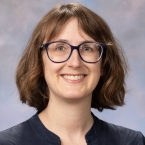
Dr. Emily Theisen is a Principal Investigator at Nationwide Children’s Hospital and Assistant Professor at The Ohio State University. She received her PhD in Pharmaceutics and Pharmaceutical Chemistry from the University of Utah, where her dissertation contributed to the discovery of noncompetitive LSD1 inhibitors. As a postdoctoral fellow in Dr. Stephen Lessnick’s lab, she studied chromatin regulation and fusion oncoprotein biology in Ewing sarcoma, developing sequencing approaches to map structure-function relationships of EWSR1::FLI1 and its effects on LSD1 genomic localization.
Building on this foundation, her current work investigates the mechanistic basis for noncompetitive LSD1 inhibitor efficacy and the biochemical and biophysical basis for EWSR1::FLI1 activity, aiming to uncover new strategies to target the fusion oncoprotein and related vulnerabilities directly.