September is Childhood Cancer Awareness Month
join with the aacr to find better ways to prevent and treat childhood cancers
These are words a parent never wants to hear: “Your child has cancer.”
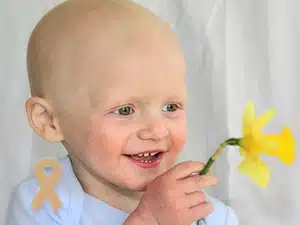
While relatively rare, pediatric cancers are the leading cause of death from disease among children in the United States.
Over the past several decades, the five-year survival rate for pediatric cancer has improved, increasing from around 58-68% in the 1970s to 83-88% in recent years.
Despite those advances, approximately 1,600 children and adolescents in the United States die of cancer each year.
The most common types of cancers in children are acute lymphocytic leukemia (ALL), brain and other central nervous system (CNS) tumors, lymphoma, germ cell tumors and neoplasms, soft tissue sarcoma, and neuroblastoma.
HOW RESEARCH is helping CHILDREN WITH CANCER
- Michael Methner of East Brunswick, New Jersey, was diagnosed with a brain tumor at the age of 2. After years of grueling chemotherapy and other treatments, he and his parents are seeing progress with a new molecularly targeted treatment. Read his story in the AACR Cancer Progress Report 2024.
- Investigational treatments were effective for Parker Shaw of Lakeside, California, as he and his parents dealt with a neuroblastoma that had spread to 87% of his bone marrow when he was 6 years old. He’s now a teenager and thriving. Read his profile in the AACR Cancer Progress Report 2024.
More on childhood cancers
- As a survivor of pediatric brain cancer, Ethan Schilling understands the mental toll that cancer can take on children. That is why he became a hospital psychologist—to help children and young adults with cancer and blood disorders adjust to their new reality. Read more about his story in Cancer Today magazine: A Pediatric Cancer Survivor Helps Kids Cope.
- At the 2024 AACR Special Conference on Pediatric Cancer, researchers shared what they are learning about the genetic underpinnings of childhood cancer and how this could help lead to new treatments. Learn more on Cancer Research Catalyst, the official blog of the AACR.
- CAR T-cell therapy has helped many children with leukemia live significantly longer, and now researchers are examining the application of CAR T cells in children with brain and CNS tumors and ways to overcome the unique challenges that come with treating the brain. Learn more in this post on Cancer Research Catalyst.
- There are more than 100 subtypes of childhood sarcomas and pinning down the exact subtype can help physicians pair their patients with the right therapies. Researchers are working on AI models to improve pediatric sarcoma diagnoses. Learn more about their progress on Cancer Research Catalyst.
- Most people diagnosed with childhood or adolescent cancer will develop a significant health condition related to their diagnosis or treatment by the time they reach age 45. Read more about the outlook for childhood cancer survivors in Cancer Today magazine: The Late Effects of Childhood Cancer and Melanoma Risk in Childhood Cancer Survivors.
- The AACR highlights progress in treating cancer in children, adolescents, and young adults in the AACR Cancer Progress Report 2024, examining topics such as the biology of childhood cancers, genetic testing in children with cancer predispositions, research-driven progress against these cancers, and cancer survivorship in children, adolescents, and young adults.
What the AACR is Doing in childhood cancer Research
Pediatric Cancer Working Group
- The AACR sponsors a Pediatric Cancer Working Group. Its mission is to establish childhood cancer research as a global priority that is supported by improved funding, the latest technologies, and the best educational strategies.
AACR Conferences
- In September 2025, the AACR and its Pediatric Cancer Working Group will hold a Special Conference on Pediatric Cancer in Boston, Massachusetts. The meeting will include discussions on the development of childhood cancer, potential advances in treatment, and approaches to child-first medicine.
Supporting Research
The AACR has recently awarded research grants to investigators pursuing promising research related to pediatric cancers.
- In 2025, Janeala Morsby, PhD, of St. Jude Children’s Research Hospital, received the AACR-QuadW Foundation Sarcoma Research Fellowship in Memory of Willie Tichenor. Her work explores the therapeutic potential of the dual inhibition of ATM and PARP in pediatric osteosarcoma.
- In 2024, Shawn H.R. Lee, MBBS, MMed, MRCPCH, MCI, PhD, of the National University of Singapore, received the AACR-St. Baldrick’s Foundation Pediatric Cancer Research Grant. His research focuses on advancing precision medicine in pediatric acute lymphoblastic leukemia through pharmacogenomics and immunogenomics.
- In 2023, Zulekha A. Qadeer, PhD, of University of California, San Francisco, received the AACR-Sontag Foundation Brain Cancer Research Fellowship. Her work involves investigating potential therapeutic vulnerabilities for medulloblastoma, one of the most common malignant brain tumors in children.
- In 2023, Jennifer C. Coleman, PhD, of the University of Cambridge, received the AACR-Pediatric Brain Tumor Foundation Medulloblastoma Research Fellowship. She is examining medulloblastoma with DDX3X mutations and working to identify potential compounds for treating this cancer in children.
For more information
Hematologic malignancies and tumors of the brain and central nervous system are the most common childhood cancers. But many others exist. Please see the pages on these and other childhood cancers for more specific information on these diseases and their treatment.

Your gift helps the American Association for Cancer Research fund pioneering science that is saving lives every day.
Donate Now
There are many ways in which you can lend your talents to support lifesaving research. Learn how you can become an advocate for cancer research, participate in events to raise awareness, volunteer your time, and share your story of how cancer has affected your life.
Get Involved