AACR Grantee Spotlight: Adwoa Mensah’s Mission to Improve Breast Cancer Screening in Ghana
By Janet Mosugu
Timely cancer screening and diagnosis at an early stage of disease can save lives, but in resource-constrained settings, care often begins too late. This is especially true in parts of sub-Saharan Africa, including Ghana, where limited access to early detection services contributes to disproportionately high cancer mortality rates. In response to the disparities in cancer care, coupled with the notably high prevalence of triple-negative breast cancer (TNBC), Adwoa Bemah Boamah Mensah, PhD, an oncology nurse, lecturer, researcher, and recipient of a Beginning Investigator Grant for Catalytic Research (BIG Cat), is leading efforts to improve early cancer detection and reduce the burden of late-stage diagnoses through innovative, locally grounded approaches. The BIG Cat grant is administered by the American Association for Cancer Research (AACR) in collaboration with the African Organisation for Research and Training in Cancer (AORTIC) and the National Cancer Institute’s Center for Global Health.

Born and raised in Ghana, Mensah works in the Ashanti Region, which recently reported a 33% rise in cancer cases between 2023 and 2024, including a 92% increase in breast cancer cases. During her training as a registered nurse, Mensah witnessed first-hand the physical and emotional suffering of cancer patients. This experience, along with high mortality rates—particularly in cases of TNBC—sparked her interest in oncology nursing, education, and research.
“I witnessed the multifaceted challenges faced by patients, families, and health care providers, including late-stage presentation, inadequate palliative care, and high cancer-related mortality,” Mensah said. “These observations informed much of my research, which primarily aims to understand the sociocultural, structural, and systemic factors contributing to delayed cancer diagnosis and poor survival outcomes in Ghana.”
She began her research career through the National Institutes of Health (NIH)-funded Ghana Breast Health Study, which focused on breast health among Ghanaian women. Early in her career, she also worked to improve the cancer care infrastructure in Ghana through the Kumasi Cancer Registry, where she played a key role in its expansion into a sub-national registry in 2012. She later engaged in community-centered participatory research, exploring how local beliefs, traditional healers, and caregivers influence cancer care-seeking behaviors. In all these efforts, Mensah has worked to drive change in cancer care within resource-limited settings.
A Mobile Breast Screening Application
In a 2022 publication, Mensah and her colleagues reported that breast self-examination rates were very low among Ghanaian women with social and economic barriers, particularly among those with limited education and those living in rural areas. This finding motivated her to identify a resource that could support cancer screening and education, one that would be readily accessible to community members across socioeconomic backgrounds.
With support from a 2022 BIG Cat grant funded by Takeda, Mensah acted on these insights by leading the development of Mbreastcheck, a culturally tailored mobile health (mHealth) application designed to promote early detection and improve cancer care uptake among Ghanaian women. To inform the development of the app, Mensah and her colleagues surveyed 914 rural women. While most were aware of breast cancer and breast self-examination, their knowledge was limited: 73.5% held misconceptions like breast cancer is transmissible or spiritually caused, and only 41.9% could recognize key warning signs, and even fewer understood the risk factors. Common barriers to screening included low levels of education, high cost, poor knowledge about cancer, feelings of shame, and distance to facilities. Meanwhile, health care workers highlighted systemic issues, like staff shortages and low literacy. Just under half of the women (48.6%) were already practicing breast self-examination, which was closely associated with being taught the technique (46.6%). Most women owned mobile phones (98.2%), and even though 41.1% preferred alternative care (e.g., traditional healers), 93% expressed a willingness to use a mHealth application.
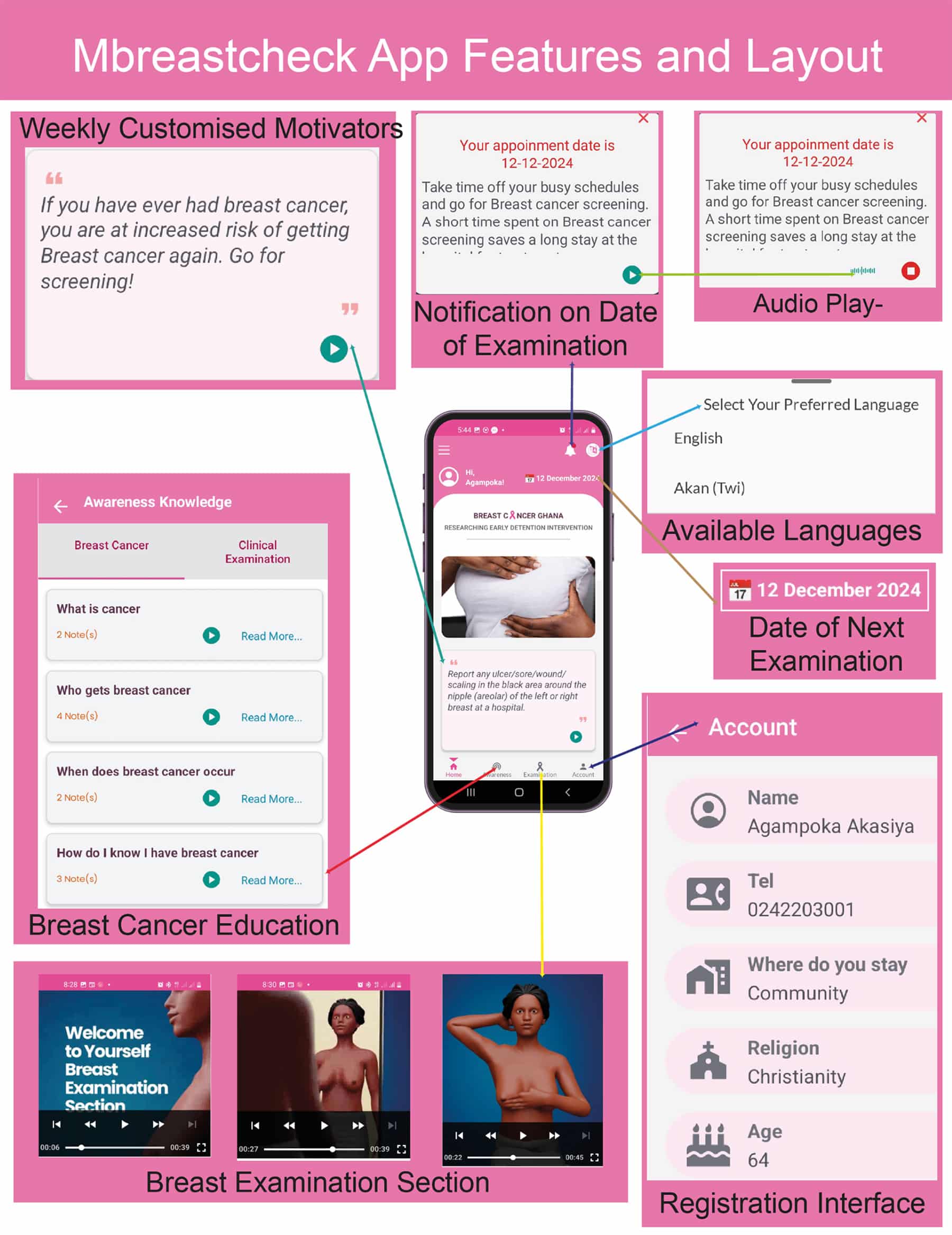
The application was designed to integrate mobile technology, oncology expertise, and behavioral theory to deliver personalized cancer education and self-breast examination tutorials. In addition, the mHealth tool was developed in local languages to maximize accessibility and ensure cultural relevance. Even though Mbreastcheck is still in a developmental phase, Mensah said that early results are showing a promising impact. Preliminary findings showed women with perceived self-efficacy were more likely to report practicing breast self-examinations. She noted that the application has helped to address key uptake barriers—such as stigma, low awareness, and low self-efficacy by engaging community leaders and cancer survivors to rebuild trust in science and health care systems. It has also inspired positive behavioral changes, countered misinformation, and will hopefully boost early-stage cancer presentations in screening programs.
“The next plans will be to conduct usability testing and pilot feasibility studies, and the baseline data from this study will be leveraged to test the mobile app in real-world settings,” Mensah said.
Beyond its direct impact on cancer awareness, the project enabled Mensah to mentor early-career researchers and oncologists, thereby contributing to strengthening Ghana’s oncology research capacity. This trajectory exemplifies the mission of the BIG Cat program: to empower early-career African cancer researchers to build impactful careers within their home institutions, while strengthening local research infrastructure and generating evidence that informs both practice and policy.
The Long-term Impact of BIG Cat
As Mensah emphasized, the BIG Cat grant marked a pivotal milestone in her career, accelerating her advancement in oncology and palliative care research. Prior to receiving the grant, her research primarily focused on exploring barriers to cancer care. While she had recognized the potential of technology-driven solutions, limited resources had constrained her ability to pursue them. The 2022 BIG Cat grant not only provided access to critical resources but also offered a platform for interdisciplinary collaboration and the development of leadership and mentorship skills.
To sustain impactful oncology research, Mensah offered clear advice to decision makers: “Support structures and key resources are required such as long-term and flexible investment in young researchers, policies that dedicate time to research, facilitate local and international collaborations, and promote research mentorship. Early-career researchers should be encouraged to focus and view cancer care barriers as an avenue to conduct impactful, context-specific studies.”
Mensah recognizes the significant opportunity the BIG Cat grant provided in expanding her expertise in quantitative research and the design of technological interventions. She believes that, in alignment with the AACR legacy of advancing innovative evidence-based cancer interventions, the confidentiality, personalization, cultural competence, and interactivity offered by Mbreastcheck can effectively reduce stigma, combat misinformation, and promote health-seeking behaviors in underserved communities. She envisions a future where every woman in underserved communities has access to the information needed to make proactive, informed breast health decisions.
“Digital care, informed by research and aligned with local context,” Mensah said, “can improve cancer care outcomes.”

Janet Mosugu received her Master of Science degree in Communication for Development and Social Change at the Temple University’s Klein College of Media and Communication, specializing in Health Communication. She was the first recipient of the Margaret Foti Scholarship Fund, and is currently interning at the AACR, where she is working on the planning and implementation of an anticancer education and awareness campaign initiative for diverse populations through community-centered, inclusive, and culturally tailored approaches.