Fighting Through Advanced Lung Cancer
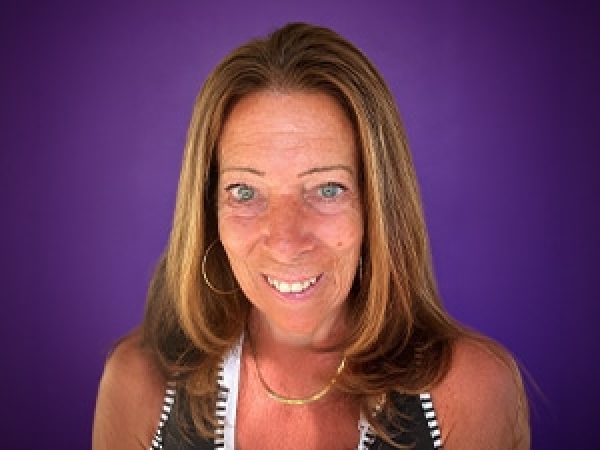
How Eugenia Horan trusted her gut about her diagnosis.

On February 15, 2019, a five-centimeter tumor was found in the apex of my right lung, along with another atop my right bronchus. Already an anxious person, I was beyond terrified—especially since getting the diagnosis had been challenging. While I had classic lung cancer symptoms and a smoking history, the doctors were thrown off by my younger than average age. I pushed for bloodwork to be done, and found myself having a CT scan within hours of receiving the test results. Three days later, I was told I would need two lobes of my lung removed. I didn’t feel there was much hope.
I had the option of surgery, but I opted out because the tumor atop my main bronchus—the one cutting off my air—couldn’t be reached.
I tried the desperate things so many other patients are doing right now. When it became hard to eat and impossible to walk within four months, my husband carried me into a different hospital.
After a few tests, one of which was incorrectly administered, I received palliative dual chemotherapy. I lasted five weeks before I passed out in a hypercapnic breathing emergency. The ER head told my husband there was nothing else they could do. Undeterred, he had me taken by ambulance to a different hospital. There, they’d find the tumor on my bronchus had grown to cover 95% of my trachea. Friable, it was also bleeding. I was put into a coma. That tumor was removed over 10 days, but more were found in my small intestine. I was stage 4 and in the ICU.
My treatment board was erased. I was told essentially to wait for death. My weight now in the 60s, I knew it wasn’t going to be long. I was mechanically ventilated and had staph pneumonia in my only working lung. I felt I only had days left. I was mute; I held up my dry-erase white board, my only way to communicate, and wrote: “HOSPICE, PLEASE.”
After 25 days in the ICU, I was home. I began to eat, because I’d heard the doctor say starvation—not cancer—was killing me. In the hospital, I also heard about a medication called Keytruda that might help, but I was unable to get it. After six days of bites of food and PEG tube feeds in hospice, I was anxious to fight. I had my husband carry me and my now copious medical supplies back to my original oncologist to advocate for myself and trying Keytruda, now that I was officially outpatient. I was weak, very ill, ECOG 4, had one working lung, and was unable to walk or stay in a wheelchair. I didn’t give up and made my case for 45 minutes. It was prescribed.
That was all I needed. I learned to eat, speak, and walk again by myself. Keytruda melted the 17-centimeter tumor and my lung reinflated 15 days after my first infusion. By my fourth infusion, I gained 60 pounds and was normal except for the trach scar, the PEG scar, and the zipper scar from taking out six inches of small bowel.
I have been free of cancer since the initial post-Keytruda scan in December 2019. I’m still told by doctors that I’m terminal. I remind them I wasn’t expected to survive beyond August 2019, but I did. Because I always believed. Never once did I ever give up.
I’ve now been a patient advocate for five years and have published a book about my year in end-stage cancer care, and my three-month recovery from three days to live. Now, I get to help others. I get to save lives. It seems like a decent trade-off.
Whether you are a patient, survivor, caregiver, or loved one touched by cancer, your story can have an enormous impact. You can provide hope and inspiration to someone recently diagnosed with cancer or a patient undergoing therapy.
SHARE YOUR STORY
Learn about physician-scientists and cancer researchers like Fellow of the AACR Academy Lewis C. Cantley, PhD, who are driving progress against cancer.
Learn More
There are many ways in which you can lend your talents to support lifesaving research. Learn how you can become an advocate for cancer research, participate in events to raise awareness, volunteer your time, and share your story of how cancer has affected your life.
Get Involved