The AACR Rare Cancers Initiative: Uniting Researchers, Undoing Barriers, and Unleashing Progress
Of all the challenges that cancer poses to human health, the confounding nature of rare cancers may be one of the most logistically difficult. The rarity of each rare cancer, considered individually, can make rigorous study difficult; however, considered as a collective, rare cancers threaten a substantial number of individuals by accounting for about 25% of all cancer cases. Responding to this challenge, therefore, requires a judicious and global approach to convene resources among cancer researchers to maximize the benefits of rare cancers’ limited data.

Such was the aim of the American Association for Cancer Research (AACR) Special Conference in Cancer Research: Breaking Barriers in the Fight Against Rare Cancers, held July 18-20 in Vancouver, Canada, where scientists gathered to share successes and consider new approaches. But the meeting also marked a new direction for AACR with the unveiling of the AACR Rare Cancers Initiative. Announced by AACR Immediate Past President, Lillian L. Siu, MD, FAACR, the Initiative will carry the momentum of rare cancer research forward by centralizing and organizing rare cancer research efforts.
Having announced this momentous undertaking, Siu sat down with Cancer Research Catalyst to give her perspective on what the new Initiative aims to accomplish.
What is the AACR Rare Cancers Initiative?
The AACR Rare Cancers Initiative is a global effort to accelerate progress in rare cancer research through a more coordinated, strategic, and collaborative approach. By bringing together researchers, clinicians, patient advocates, industry partners, and other stakeholders, the Initiative aims to create the scientific environments and clinical conditions necessary to translate discoveries into new treatments more efficiently for patients with rare cancers.
AACR is uniquely positioned because it already connects many of the critical components required to advance rare cancer research. Through its scientific meetings, grants programs, journals and publications, policy activities, patient engagement efforts, and data-sharing resources such as Project GENIE®, AACR can convene experts across disciplines and institutions.
What are some of the hurdles to rare cancer research that the new AACR Rare Cancer Initiative seeks to overcome?
Rare cancer research faces several structural challenges. Patient populations are small and geographically dispersed, expertise and data are often fragmented across institutions, and biological understanding may be limited. Traditional research and drug development models are generally optimized for common cancers, where larger patient populations allow multiple opportunities to test and refine hypotheses. Rare cancers, which have smaller patient populations by definition, require much more intentional, targeted, and innovative clinical trial designs.
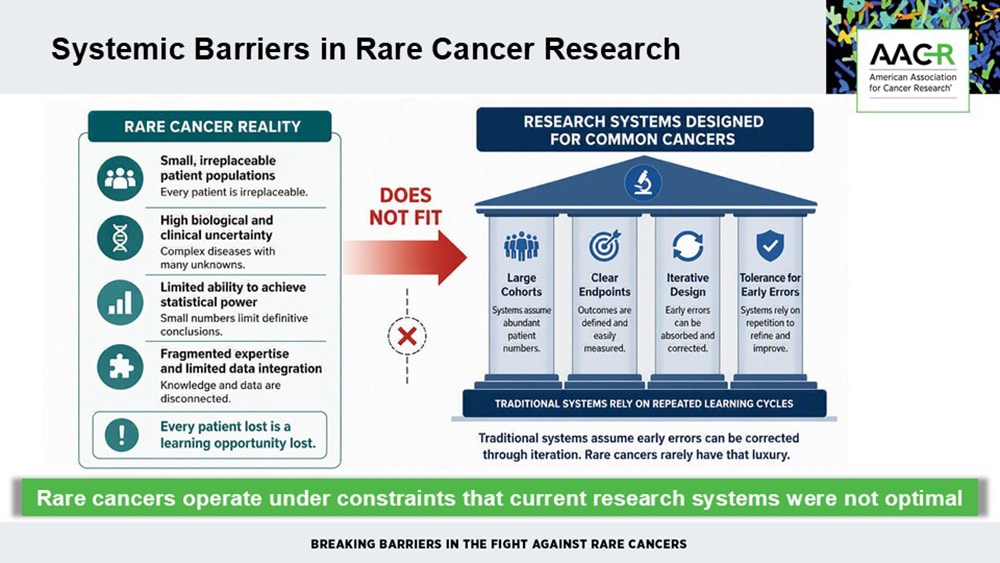
To address these barriers, the AACR Rare Cancers Initiative will focus on creating the conditions needed for success: clearer biological understanding, well-characterized patient populations, better data sharing, coordinated research priorities, and feasible clinical study designs. By bringing together researchers, clinicians, patients, advocates, and partners, AACR aims to improve decision-making, reduce duplication of effort, and accelerate the translation of validated discoveries into clinical studies and development programs. The goal is to make rare cancer research more efficient and more likely to generate meaningful advances for patients.
What are some material outcomes of the Initiative that you hope to see in the coming years?
Over the next several years, I hope to see the Initiative help create a more connected and coordinated rare cancer research ecosystem. Discussions at the AACR Special Conference: Rare Cancers highlighted both the challenges and opportunities in the field, from the need for better data sharing and novel clinical trial designs to the importance of bringing together researchers, clinicians, patients, advocates, industry, and regulators around shared priorities. Success would mean transforming those conversations into action: reducing uncertainty earlier in the research process, fostering meaningful collaborations, identifying high-impact areas for investment, and creating clearer pathways for therapeutic development.
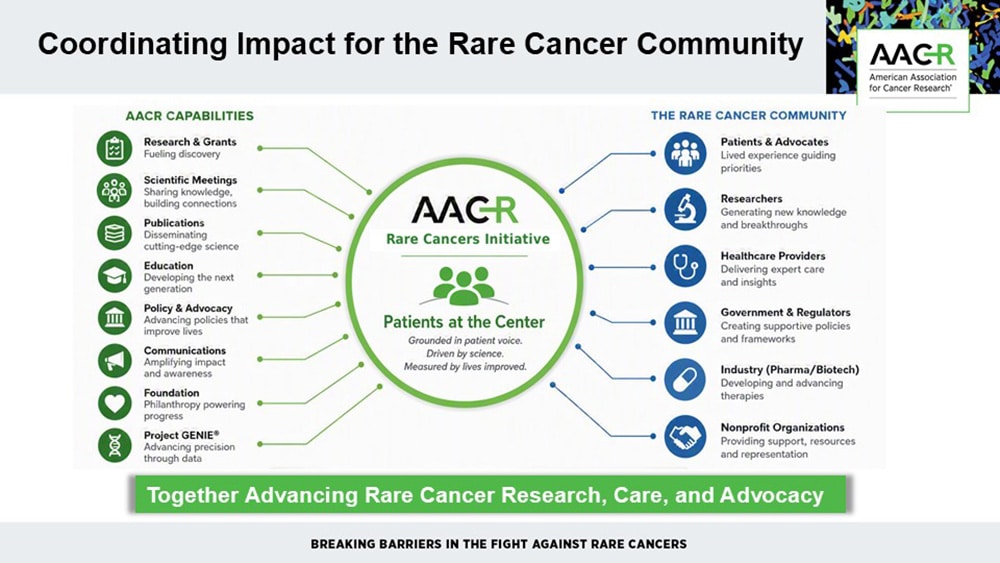
One aspect of the Initiative that I’m excited to see AACR pursue is the formation of partnerships with the biopharma sector, who can be powerful collaborators for delivering the necessary funding and infrastructure for a robust rare cancer research pipeline. As the Initiative begins its work, I look forward to seeing how we can work with partners in industry to secure funding opportunities and access to therapeutics to support the scientists working to advance this field.
Ultimately, our goal is to accelerate the translation of biological discovery into new treatment options for patients with rare cancers, just as we are beginning to see across rare solid tumors, pediatric cancers, and hematologic malignancies.
What kind of hope do you think patients with rare cancers might derive from the kind of progress that the Initiative aims to accelerate?
As a clinician, I have a longstanding interest in rare cancers, having witnessed firsthand the unique challenges involved in diagnosing and treating these diseases. Several years ago, I cared for a patient with a rare salivary gland cancer who has since become a passionate advocate for rare cancer research. Highly proactive in raising awareness, he dedicates much of his time to writing about his experiences as a patient and championing the need for greater research and support for those affected by rare cancers.
This particular patient’s cancer was androgen receptor-positive, suggesting that androgen-targeted therapy might offer clinical benefit. However, because this cancer is so rare, there was limited evidence to support the use of androgen blockade in this disease setting, and the approach was relatively understudied at that time. Since then, there has been growing interest in the field and increasing evidence being collected.
During our discussions about treatment options, I explained that chemotherapy was the established standard of care for his disease. Nevertheless, he was interested in pursuing androgen deprivation therapy, despite its unconventional nature and the lack of robust data supporting its use for this indication. It ultimately proved to be the right choice for him. He derived significant benefit from androgen blockade therapy and remained clinically well for an extended period. His experience highlighted the potential value of a personalized treatment approach, even in the setting of a rare cancer where robust clinical evidence is limited.
I am reminded that patients with rare cancers shouldn’t need to feel as though they are outliers, like unicorns, and have to navigate entirely uncharted scientific territory.
That conversation left an impact on me, and I remember saying, “If you feel comfortable with pursuing this approach, I think we should try it.” And he said, “Yes, because I truly believe this can help me.”
Reflecting on his bravery and willingness to pursue a nonstandard treatment, I am reminded that patients with rare cancers shouldn’t need to feel as though they are outliers, like unicorns, and have to navigate entirely uncharted scientific territory. While each rare cancer may affect only a small number of individuals, collectively these patients represent a significant global population whose needs deserve greater scientific attention and research investment.
The AACR Rare Cancer Initiative will take advantage of AACR’s convening power to bring together the global rare cancer research community. By fostering collaboration across institutions, disciplines, and borders, we aim to ensure that researchers and patients no longer view rare cancers as isolated “unicorn” cases, but as shared challenges that can be tackled collectively through science, partnership, and innovation.