What Is CAR T-cell Therapy?
The mythical chimera comprised elements of a lion, goat, and serpent, forming a hybrid creature with features of each of these animals. Likewise, chimeric antigen receptor (CAR) T cells, a type of immunotherapy, are made of seemingly incongruous components that work together to endow a cell with unique capabilities to work against cancer cells.
With seven CAR T-cell therapies approved by the U.S. Food and Drug Administration (FDA), this innovative immunotherapy has revolutionized the treatment of blood cancers in recent years. Here, we’ll provide an overview of how this therapy works and which cancers it’s approved to treat.
A Living Drug That Helps T Cells See Cancer Better
T cells are among the many immune cells that roam our bodies looking for threats, like invading viruses or cancers arising from our own cells. If they find one of these threats, they launch an attack, in coordination with other elements of the immune response, to get rid of it before the infection or cancer causes widespread damage to the body.
Finding these threats, however, is not guaranteed.
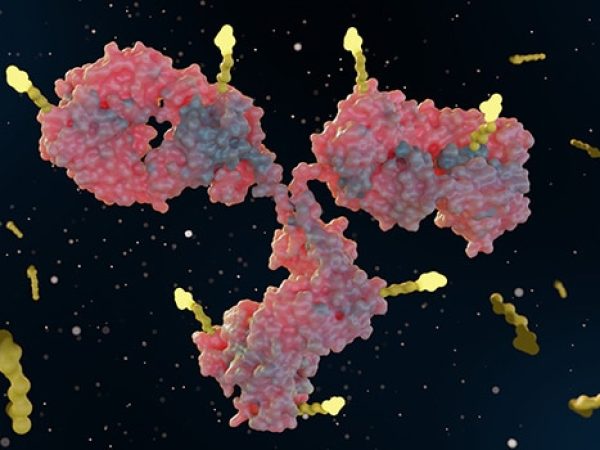
Some proteins expressed by cancer cells can serve as red flags that these cells are harmful. Unfortunately, these proteins are sometimes “invisible” to T cells. Antibodies, which are proteins made by certain other immune cells, can “see” these “invisible” red-flag proteins, but unlike T cells, they can’t directly attack the cancer. As a result, many cancers remain under the radar and keep growing.
CAR T-cell therapy is a way to give T cells the power to “see” cancer better.
During this treatment, a patient’s T cells are isolated from their blood and modified in a lab to produce what’s known as a CAR, which is a synthetic, chimeric protein that is part antibody and part T cell.
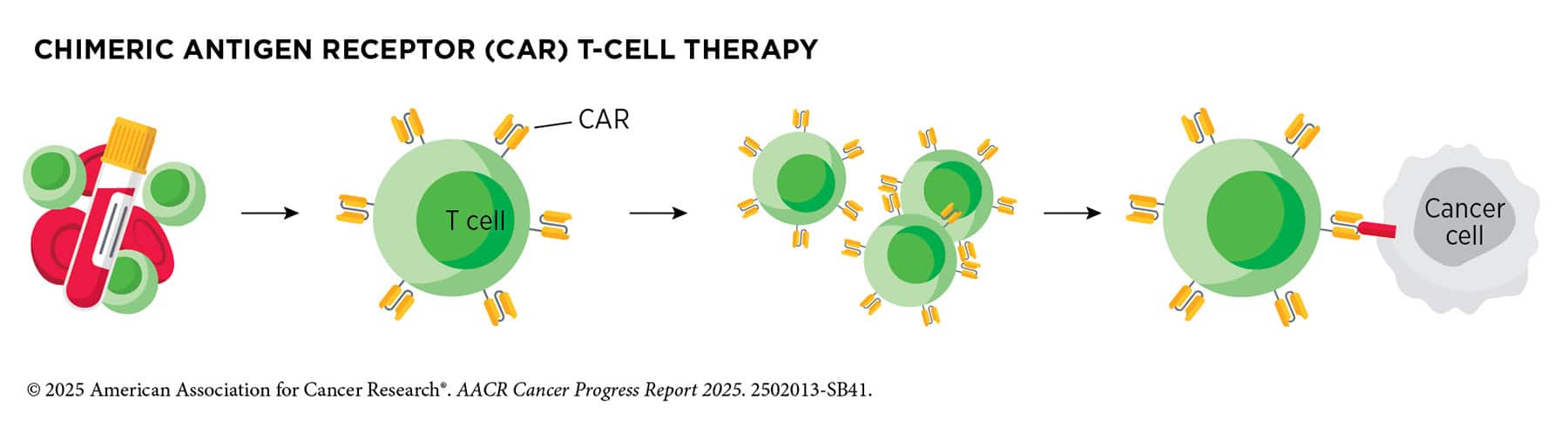
The antibody-like portion faces outward, ready to latch onto cancer cells that express the target protein, and a T cell-activating fragment resides inside the cell, triggering the T cell to attack once a cancer cell is found. Through this design, the CAR endows T cells with the antibody-like ability to recognize an otherwise “invisible” cancer protein, while keeping the cell-killing ability of T cells intact.
The modified T cells are then multiplied before being infused back into the patient, where they seek out and kill cancer cells. Because CAR T-cell therapy results in T cells that live within the patient’s body and fight cancer even after treatment has ended, it is often referred to as a “living drug.”
The Road to Now: CAR T-cell Development and FDA Approvals
The first chimeric T cells were reported in the late 1980s and early 1990s, providing confirmation that such an approach was feasible—in the lab, that is. It would be decades before further insights and technological advances would allow clinicians to successfully treat a patient with CAR T cells.
One of the challenges with the first-generation CAR T cells was that they were far too short-lived to exert anticancer effects in patients. So, researchers tried a different CAR design. The second-generation CARs kept the basic structure of the original design but incorporated additional elements that improved longevity of the cells.
By 2010, a second-generation CAR T-cell therapy called tisagenlecleucel had entered clinical testing for adults with relapsed/refractory chronic lymphocytic leukemia in a trial led by Carl H. June, MD, FAACR, of the University of Pennsylvania.
“Our first three patients had responses that were dramatic. … In fact, in our first trial, we had a 90% complete response rate,” said June in an interview with Cancer Research Catalyst. Additional trials over the next few years showed the treatment’s efficacy for adults and children with other leukemias as well.
In 2017, the approval of tisagenlecleucel (Kymriah) for children and young adults with relapsed/refractory B-cell acute lymphoblastic leukemia (ALL) marked the first FDA approval for a CAR T-cell therapy, and many more soon followed.

As of July 2026, seven CAR T-cell therapies have been approved for various types of leukemia, lymphoma, and multiple myeloma.
Tisagenlecleucel is approved to treat certain patients 25 years or younger with relapsed/refractory B-cell precursor ALL and certain adults with relapsed/refractory cases of large B-cell lymphoma (LBCL) or follicular lymphoma (FL). Tisagenlecleucel targets the protein CD19 that is expressed by almost all leukemia and lymphoma cells.
Axicabtagene ciloleucel (Yescarta) is approved to treat certain adults with relapsed/refractory LBCL or FL. This CAR T-cell therapy, the first to be approved to treat these types of lymphoma, also targets CD19.
Brexucabtagene autoleucel (Tecartus) is a CD19-targeted CAR T-cell therapy approved to treat certain adults with relapsed/refractory mantle cell lymphoma or B-cell precursor ALL. It was the first CAR T-cell therapy approved for mantle cell lymphoma and the first for adults over the age of 25 with B-cell precursor ALL.
Idecabtagene vicleucel (Abecma) is approved to treat certain adults with relapsed/refractory multiple myeloma. With its approval in 2021, it became the first CAR T-cell therapy to be approved for multiple myeloma and the first to target BCMA instead of CD19.
Lisocabtagene maraleucel (Breyanzi) is approved to treat certain adults with relapsed/refractory cases of LBCL, chronic lymphocytic leukemia/small lymphocytic lymphoma (CLL/SLL), FL, mantle cell lymphoma, or marginal zone lymphomas. It was the first CAR T-cell therapy to be approved for CLL/SLL and for marginal zone lymphoma.
Ciltacabtagene autoleucel (Carvykti) is another BCMA-targeted therapy approved to treat certain adults with relapsed/refractory multiple myeloma. Unlike idecabtagene vicleucel, it targets two parts of BCMA instead of one.
Obecabtagene autoleucel (Aucatzyl) is approved to treat certain relapsed/refractory B-cell precursor ALLs. Unlike previously approved CD19-directed CAR T cells, obecabtagene autoleucel has a slightly different CAR design that may reduce toxicity and improve longevity.
The Road Ahead: What’s Next for CAR T-cell Therapy?
CAR T-cell therapy has transformed the treatment of many blood cancers. But just as the chimera of myth was fallible, so, too, are CAR T cells. Treatment resistance is common, and despite its successes against certain hematologic cancers, CAR T-cell therapy has been far less effective in solid tumors. Plus, patients undergoing this therapy face a prolonged and costly manufacturing process.
In an upcoming blog post about the latest advances in CAR T-cell therapy, we will discuss how researchers are exploring new strategies to overcome these hurdles, including finding ways to infiltrate hard-to-penetrate solid tumors, shorten the manufacturing process, and use CAR T-cell therapy in earlier lines of therapy. These efforts and others are driving progress toward more effective, more durable, and more accessible iterations of this revolutionary cancer treatment.
Learn More About CAR T-cell Therapy
How Long Does It Take to Make CAR T Cells?
The multistep manufacturing process can take several weeks and requires various types of clinical and research specialists. Some patients may undergo other forms of treatment to manage their cancer while they wait for their custom-made CAR T cells.

How Are the Patient’s T Cells Isolated?
The patient’s T cells are isolated via a procedure known as leukapheresis. This procedure uses a machine that collects the patient’s blood and separates the T cells from the many other components found in blood before returning the rest of the blood back to the patient’s body.
How Is the CAR Inserted Into T Cells?
The patient’s isolated T cells are sent to a lab to be genetically modified. During this step, researchers use a special virus to deliver a gene to T cells that instructs them to produce a CAR. The virus used in this step can’t make people sick, and it doesn’t spread to other people like the viruses that cause the flu or COVID-19. The modified T cells are propagated in the lab until there are millions of these CAR T cells available for treatment.
How Are CAR T Cells Administered to the Patient?
Before the CAR T cells can be administered, the patient undergoes chemotherapy to deplete their existing immune cells. The CAR T cells are then delivered to the patient through an intravenous (IV) infusion, and the patient typically remains at the hospital for some time to be monitored for side effects.
What Are the Side Effects of CAR T-cell Therapy?
Most commonly, patients treated with CAR T-cell therapy experience a higher risk of infections and a loss of antibody-producing cells.
Some patients may experience severe toxicities, including cytotoxic release syndrome (CRS). CRS is caused by the rapid release of immune-modulating proteins called cytokines into the blood and can lead to fever, nausea, headache, rash, rapid heartbeat, and—in rare cases—death. Patients experiencing CRS may be treated with tocilizumab (Actemra), which blocks the activity of a cytokine called IL-6. Patients may also receive steroid treatment.
CAR T-cell therapy may also lead to neurological symptoms, such as confusion, seizures, and trouble speaking. Steroids can be used to treat these symptoms.