What Are Antibody-drug Conjugates?
Killing cells is easy. So easy, in fact, that our bodies do it billions of times per day, every day. And cancer cells, though notoriously hardy and crafty in their ability to survive, are still cells. So what’s the issue?
One of the central challenges of cancer treatment is not killing cells per se but killing the right cells. Chemotherapies attempt to circumvent this fundamental issue by killing rapidly dividing cells faster than normal cells, but chemotherapy has its reputation for a reason: The drugs are highly toxic at a systemic level and often lead to a lifetime of effects for survivors.
But what if there were a way to guide chemotherapy toward cancer cells and away from healthy ones? Over a century ago, chemotherapy pioneer and Nobel Laureate Paul Ehrlich, MD, hoped for a “magic bullet” that would somehow know to deliver chemotherapy’s fatal effects to cancer without harming the rest of the body. Ehrlich’s magic bullet would inspire countless researchers who followed in his footsteps, leading to a new era of precision therapies.
Smart Chemotherapy: The ABC of ADC
A type of cancer therapy called an antibody-drug conjugate (ADC) is designed to more selectively deliver chemotherapy drugs to cancer cells. At the most basic level, an ADC is a type of targeted drug built from three components:
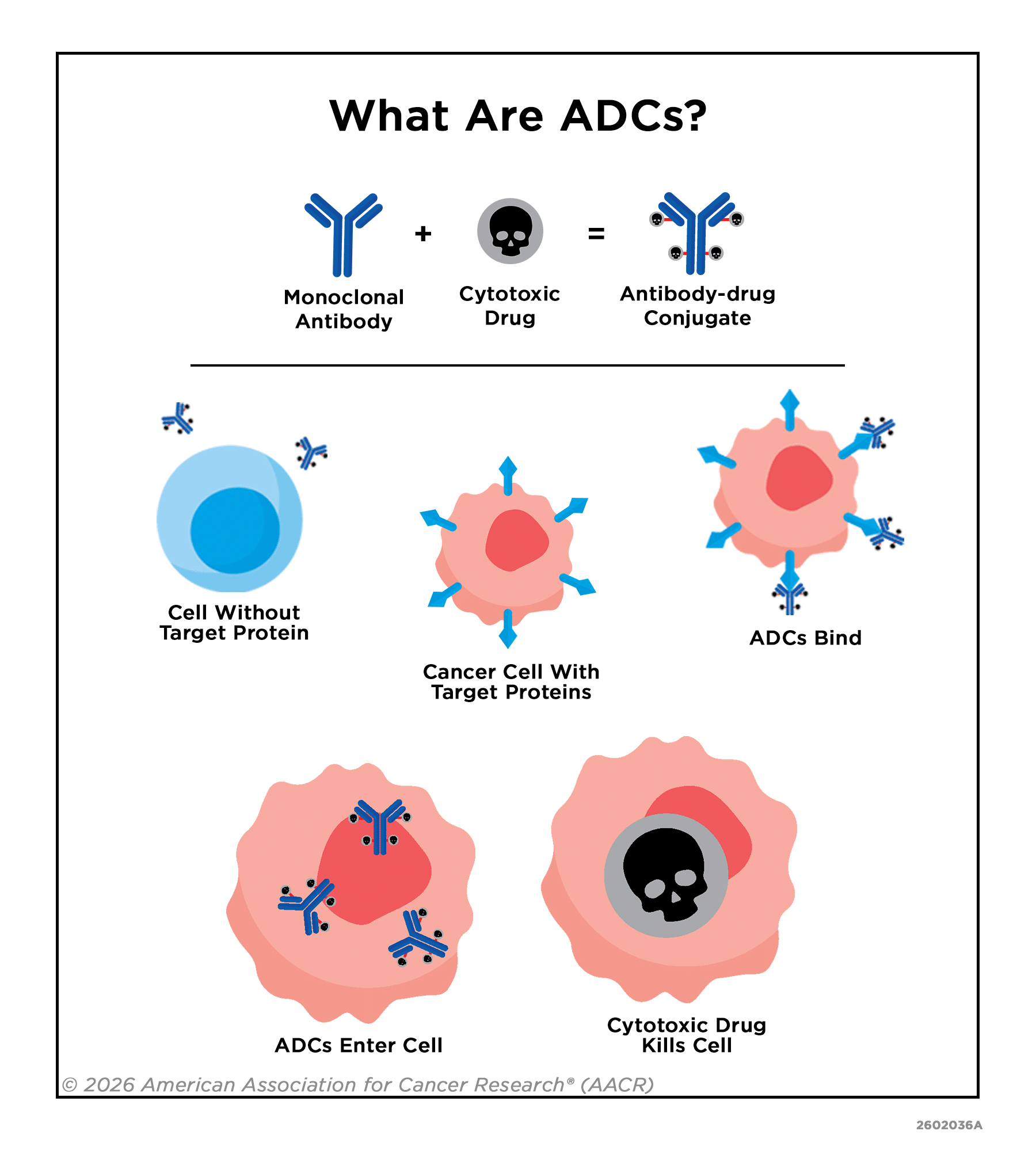
- a monoclonal antibody (a kind of protein that can bind to a target protein, or antigen, expressed on cell surfaces);
- potent, cell-killing drug molecules (often known as the “payload” in ADC parlance); and
- chemical linkers to join (or “conjugate”) them together.
Upon binding to a cell expressing the targeted protein, ADCs enter the cell and release the payload. Once enough payload is absorbed, the cell dies (unless the cell becomes resistant to the payload—but more on that later). By making drug release contingent on how and where the antibodies bind, ADCs are engineered to deliver cancer therapy with precision (and, ideally, mitigate systemic toxicity).
The ADC revolution has transformed the oncology treatment landscape. Even as newer designs use complex bioengineering techniques to deliver even better ADCs, the technology traces its origins to basic biological research.
From Hamsters to Humans: A Brief History of Antibody-drug Conjugates
A review published in Cancer Research, a journal of the American Association for Cancer Research (AACR), dates the first laboratory proof-of-concept of ADCs to 1958, when French researcher and oncologist Georges Mathé, MD, conjugated the chemotherapeutic methotrexate to antibodies derived from leukemia-injected hamsters.
But the real ADC revolution came toward the end of the 20th century, following the development of a method to reliably produce monoclonal antibodies in the 1970s—a method that would win its inventors the Nobel Prize in Physiology or Medicine. The ability to design specific monoclonal antibodies gave scientists an indispensable tool, and the use case for monoclonal antibodies as targeting systems for chemotherapy delivery was readily apparent.
Researchers began the work of attaching drug payloads to manufactured antibodies, and the modern ADC was born. By the 1980s and ’90s, several ADC designs had entered clinical trials. One clinical trial, as published in Cancer Research, harked back to Mathé’s work by testing an ADC design that conjugated methotrexate with a monoclonal antibody designed to bind to antigens expressed in some forms of non-small cell lung cancer.
FDA-approved Antibody-drug Conjugates: Which Drugs Treat Which Cancers
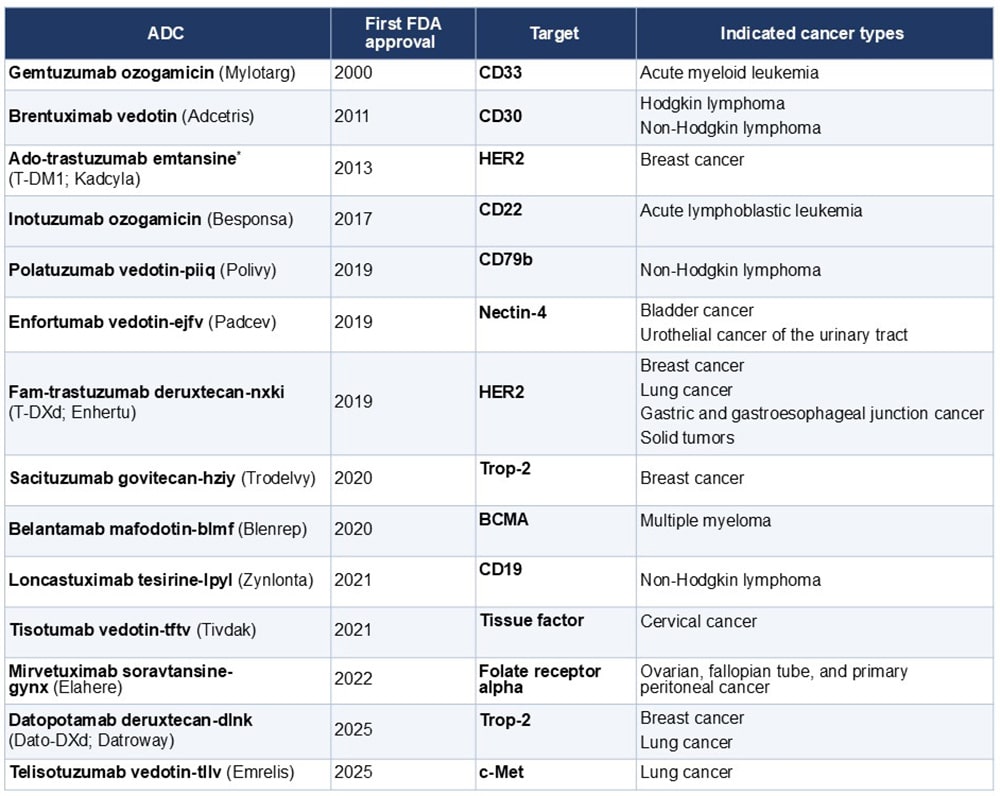
The U.S. Food and Drug Administration (FDA) granted its first approval to an ADC as cancer treatment in 2000, when it approved gemtuzumab ozogamicin (Mylotarg) to treat relapsed CD33-positive acute myeloid leukemia in adults aged 60 or older who are not candidates for cytotoxic chemotherapy.
For over a decade, gemtuzumab ozogamicin remained the only ADC on the U.S. market—but that changed in the 2010s as the FDA approved one ADC after another. At the time of this writing, the FDA has approved 14 different ADCs in oncology throughout a variety of indications.
Collateral Damage: ADC Toxicity
The fully idealized goal of ADCs, however, has yet to be reached: they still cause treatment toxicities. One problem is that the target antigens may be found on some healthy cells—which can mark them for destruction too. This phenomenon is known as on-target toxicity (as compared with off-target toxicity, which occurs when ADCs bind to domains beyond their target).
ADCs’ toxicities can vary depending on the specific payload, but they include many serious conditions like cardiac toxicity, interstitial lung disease, and even blindness. To manage the risk of these side effects, clinicians closely monitor patients receiving ADC treatment.
Researchers are working toward reducing the toxicity of ADCs through a number of strategies. New developments aim to better constrain the toxic payloads outside of targeted contexts.
Making Antibody-drug Conjugates Irresistible: Overcoming Resistance
Like any other cancer therapy, ADCs can also run into the problem of drug resistance. The chemotherapeutic payloads can lose their effectiveness when the cancer mutates and acquires resistance to those compounds.
To overcome this challenge, researchers are deploying new strategies for ADCs. One team of researchers demonstrated the efficacy of a method they called “payload diversification,” which they detailed in a paper published in Clinical Cancer Research. The researchers treated two groups of breast cancer cell lines until they became resistant to T-DXd or sacituzumab govitecan (Trodelvy), both of which use a topoisomerase-inhibiting payload (a DNA-damaging compound).
However, both the T-DXd- and sacituzumab-govitecan-resistant cell lines responded to treatment with ADCs that used a microtubule-inhibiting payload instead (which kills cells by destroying their structure), when injected into xenograft models. The researchers also confirmed that the resistance dynamics at work were a function of the payload, irrespective of the antigen the ADC targeted. Though a preclinical finding, the researchers suggested that their data might provide a basis for testing payload diversification in the clinic.
Although ADCs with different payloads could be given sequentially, it’s also possible to create ADCs with more than one payload as a means of overcoming resistance. For example, in 2021, a research team successfully created a HER2-targeting, dual-payload ADC that successfully killed cancer cells with acquired resistance to the single-payload ADC T-DM1.
Work on dual-payload ADCs continues. In a recent study published in Molecular Cancer Therapeutics, researchers designed a Trop2-targeted ADC that contained both a topoisomerase-inhibiting payload and triptolide—a compound derived from traditional Chinese medicine that can kill cancer cells by disrupting their DNA transcription.
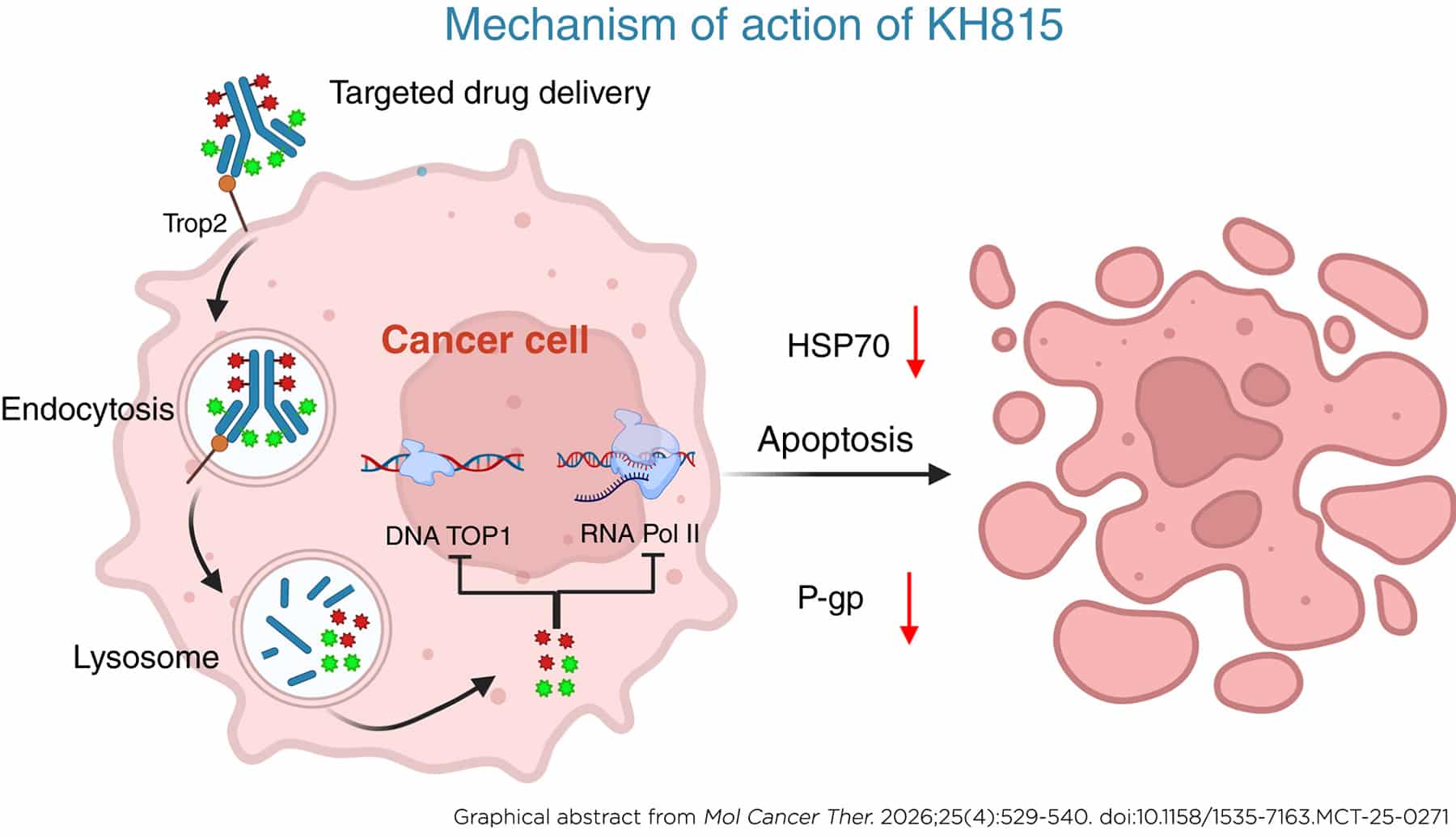
According to the researchers, by releasing the triptolide payload first, their ADC design makes cells vulnerable to topoisomerase inhibition before the topoisomerase inhibitor is released as the second payload. In a series of cell line and preclinical model experiments, the researchers found that their dual-payload design significantly outperformed Dato-DXd at inhibiting tumor growth.
Paul Ehlrich’s idealized cancer therapy may not exist yet, but decades of progress has brought ADCs from the realm of the theoretical to the real world of clinical use, with more indications and designs continuing to emerge.