How New Science is Reshaping Ovarian Cancer Treatment and Care
Ovarian cancer doesn’t announce itself. There’s no routine screening test, no reliable early warning—just symptoms vague enough to blame on something else. It is often called the “silent killer” because many cases are found only after the disease has advanced. Only about 20% of patients are diagnosed at an early stage when treatment works best. Even when treatment does work, the disease often comes back. Roughly 70% of patients relapse after first-line therapy.
Fortunately, discoveries at the bench and recent U.S. Food and Drug Administration (FDA) approvals are leading to new treatment options and improving outcomes for ovarian cancer patients.
Rewriting the Origin Story of Ovarian Cancer
One of the biggest advances in ovarian cancer research in recent years challenged a fundamental assumption about the disease.

For decades, ovarian cancer was believed to originate primarily in the ovaries themselves. Evidence now suggests that many high-grade serous ovarian cancers—the most common and deadliest subtype—actually begin in the fallopian tubes.
Understanding where ovarian cancer begins has created an opportunity to stop it before it starts. This discovery has led to increasing adoption of opportunistic salpingectomy, the removal of the fallopian tubes during another pelvic or abdominal surgery while preserving the ovaries, as a strategy that may reduce ovarian cancer risk in women for whom fertility is no longer a concern.
Researchers are now pushing further back to the earliest cellular changes before cancer is even detectable. Studies published in Cancer Discovery revealed that changes in the immune environment can begin long before a tumor forms, and identified a population of cells in the fallopian tube that may set the stage for it. Together, these findings provide a clearer picture of how some ovarian cancers develop and may eventually point to new opportunities for prevention and early detection.
When Ovarian Cancer Stops Responding
Current treatment for ovarian cancer includes platinum-based chemotherapy, surgery, and maintenance poly ADP ribose polymerase (PARP) inhibitors for eligible patients. These therapies can produce positive initial responses, but they are often temporary. Many tumors eventually evolve to evade treatment, setting the stage for disease progression and recurrence.
When ovarian cancer returns and no longer responds to platinum chemotherapy, it is known as platinum-resistant ovarian cancer. Platinum-resistant ovarian cancer has historically faced limited treatment options. Available therapies have largely consisted of chemotherapy drugs such as pegylated liposomal doxorubicin, topotecan, paclitaxel, and gemcitabine, combined with bevacizumab, an anti-angiogenic medication. These drugs provided benefit, but durable responses have been difficult to achieve.
A major milestone came in 2022 when mirvetuximab soravtansine (Elahere) became the first antibody-drug conjugate (ADC) to receive accelerated approval for platinum-resistant ovarian cancer. It targets tumors that express high levels of folate receptor alpha (FRα), delivering a potent cancer-killing agent directly to those cells. Approximately 35% of patients with platinum-resistant ovarian cancer may be eligible for the therapy following FRα biomarker testing. The approval marked the first significant treatment advance for platinum-resistant disease in eight years.
A New Wave of Treatments for Ovarian Cancer
First Immunotherapy-based Regimen
Among the many strategies being explored for platinum-resistant ovarian cancer, few generated as much anticipation—and frustration—as immunotherapy. While immune checkpoint inhibitors revolutionized the treatment of many cancers, they repeatedly fell short in ovarian cancer. Researchers have often described ovarian cancer as an “immune-cold” tumor because it typically does not attract enough immune cells to mount a strong antitumor response. Moreover, early studies produced overall response rates of only 10-15%.
That changed in February with the approval of pembrolizumab (Keytruda) given with weekly paclitaxel, with or without bevacizumab, for patients whose tumors express PD-L1. This marks the first immunotherapy-based regimen approved for ovarian cancer.
Pembrolizumab is an immunotherapy that helps the body’s immune system recognize and attack cancer cells. It works by blocking the PD-1 pathway—a molecular “brake” that cancer cells can use to evade immune detection—allowing T cells to recognize and attack tumor cells more effectively. Paclitaxel can strengthen this effect by killing cancer cells and releasing tumor proteins that make the cancer visible to the immune system.
The approval underscores the importance of selecting patients based on immune biomarkers and suggests that combination with chemotherapy may enhance responses by making tumors more susceptible to immune attack.
Targeting Cancer’s Stress Response
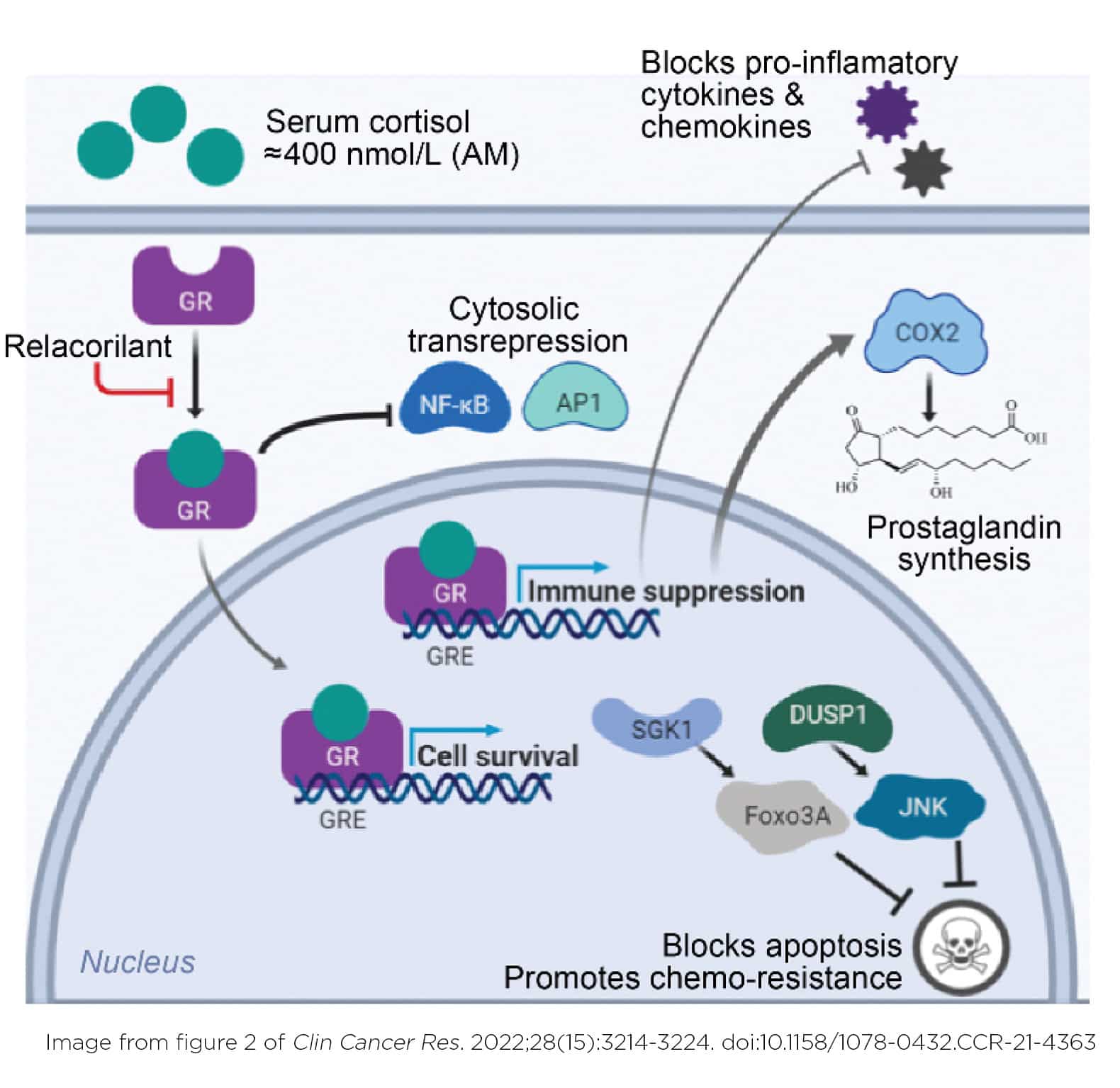
One month later, a second approval attacked the problem from a completely different direction. Relacorilant (Lifyorli), the first-of-its-kind selective glucocorticoid receptor antagonist, approved for use in combination with nab-paclitaxel in patients with platinum-resistant ovarian cancer, was designed to increase the impact of chemotherapy by overcoming stress-induced resistance.
The drug targets the glucocorticoid receptor, a key regulator of cells’ response to stress. The receptor can act like a cellular shield: When activated by the stress hormone cortisol, it can trigger survival pathways that help cancer cells endure the damage caused by chemotherapy. Relacorilant lowers that shield by blocking cortisol from turning on the receptor, potentially making tumor cells more vulnerable to treatment and enhancing the effectiveness of chemotherapy.
A study published in Clinical Cancer Research helped establish the scientific rationale for this strategy. In the preclinical study, researchers showed that relacorilant enhanced the activity of taxane chemotherapy and showed potential to overcome taxane resistance, providing early evidence that targeting the glucocorticoid receptor could help make resistant tumors more responsive to treatment.
Notably, unlike other recently approved therapies for platinum-resistant ovarian cancer, relacorilant does not require biomarker testing, potentially making it an option for a broad range of patients.
More Options, More Opportunities
Two approvals in two months marked a significant period of progress for ovarian cancer. While these approvals are already changing treatment for some patients, other promising approaches remain much earlier in development. The AACR Drug Discovery and Development (AACR D3) conference, held July 21-24, 2026, showcased innovations that may shape the field’s next chapter.
The Magic of Molecular Glue
One promising approach involves targeting cyclin E1 (CCNE1), a protein that helps regulate cell division. CCNE1 amplification is relatively common in several tumor types, including ovarian, and is associated with aggressive disease and poor outcomes. Despite its importance, it has been long considered “undruggable” because it lacks the features that conventional drugs typically target.
An emerging class of small molecule drugs known as molecular glue degraders may offer a solution. Rather than blocking a protein’s activity, these drugs act like molecular cleanup crews, bringing disease-causing proteins into contact with the cell’s natural disposal machinery so they can be broken down and removed.
Nina Ilic-Widlund, PhD, of Monte Rosa Therapeutics, described MRT-55811, a novel molecular glue degrader that selectively targets CCNE1. In preclinical studies, the molecule reduced cancer cell growth in vitro and slowed tumor growth in mouse models. This effect was limited to cell lines and models that overexpress CCNE1, highlighting its selectivity. Ilic-Widlund noted that because MRT-55811 targets a unique site on CCNE1, it is expected to cause fewer off-target toxicities than conventional cell cycle inhibitors. Supporting this hypothesis, the molecule did not induce toxicity in human bone marrow progenitor cells.
The Next Generation of Antibody-drug Conjugates
ADCs, like mirvetuximab soravtansine, are playing an increasingly important role in ovarian cancer treatment. As the field continues to evolve, researchers are working to build on the success of early ADCs and extend their benefits to more patients.

Among them is Jing Li, MD, PhD, of VelaVigo Limited, who presented data on VBC106, a next-generation ADC that targets both FRα and mesothelin, another protein commonly overexpressed on ovarian cancer cells. Li noted that ovarian tumors are highly heterogeneous and that not all express FRα at levels sufficient for mirvetuximab soravtansine to be effective. By targeting two distinct markers, this approach could broaden the patient population that is eligible for ADC-based therapy.
VBC106 showed stronger target binding and greater tumor-cell killing in ovarian cancer cell lines and mouse models compared with ADCs directed against either target alone. Li added that the agent has shown activity even in models with low FRα expression, raising the possibility that extensive biomarker screening may not be necessary to identify patients most likely to benefit.
While significant challenges remain, particularly in early detection and recurrent disease, the ovarian cancer landscape looks markedly different than it did just a few years ago with new treatment options available for patients and more potential advances on the way.