New First-line Treatment Option for Advanced Triple-negative Breast Cancer
Sacituzumab govitecan-hziy was approved as a monotherapy or in combination with pembrolizumab.
The U.S. Food and Drug Administration (FDA) has approved sacituzumab govitecan-hziy (Trodelvy) for two indications in adult patients with unresectable locally advanced or metastatic triple-negative breast cancer (TNBC) who have not received previous systemic therapy:
- as a single agent for patients who are not eligible for PD-1 or PD-L1-based checkpoint inhibitor therapy; or
- in combination with pembrolizumab (Keytruda) or pembrolizumab and berahyaluronidase alfa-pmph (Keytruda Qlex) for patients whose tumors express PD-L1.
Sacituzumab govitecan-hziy is a type of targeted therapy called an antibody-drug conjugate (ADC). It comprises an antibody targeting the TROP2 protein, which is highly expressed on TNBC cells, linked to the SN-38 agent that causes DNA damage and cell death. When it binds to TROP2 on a cell, the ADC is internalized by the cell and the cytotoxic payload is released, killing the cell.
Pembrolizumab is a PD-1-targeted immune checkpoint inhibitor, a type of immunotherapy, that helps prevent suppression of antitumor immune responses by blocking the interaction between PD-1 on immune cells and PD-L1 on cancer and other cells. Pembrolizumab can be administered via an intravenous infusion or—when combined with berahyaluronidase—as a subcutaneous injection.
Sacituzumab govitecan-hziy initially received accelerated approval in 2020 for previously treated metastatic TNBC. Under the latest approval, it can now also be used in patients who have not received prior treatment.
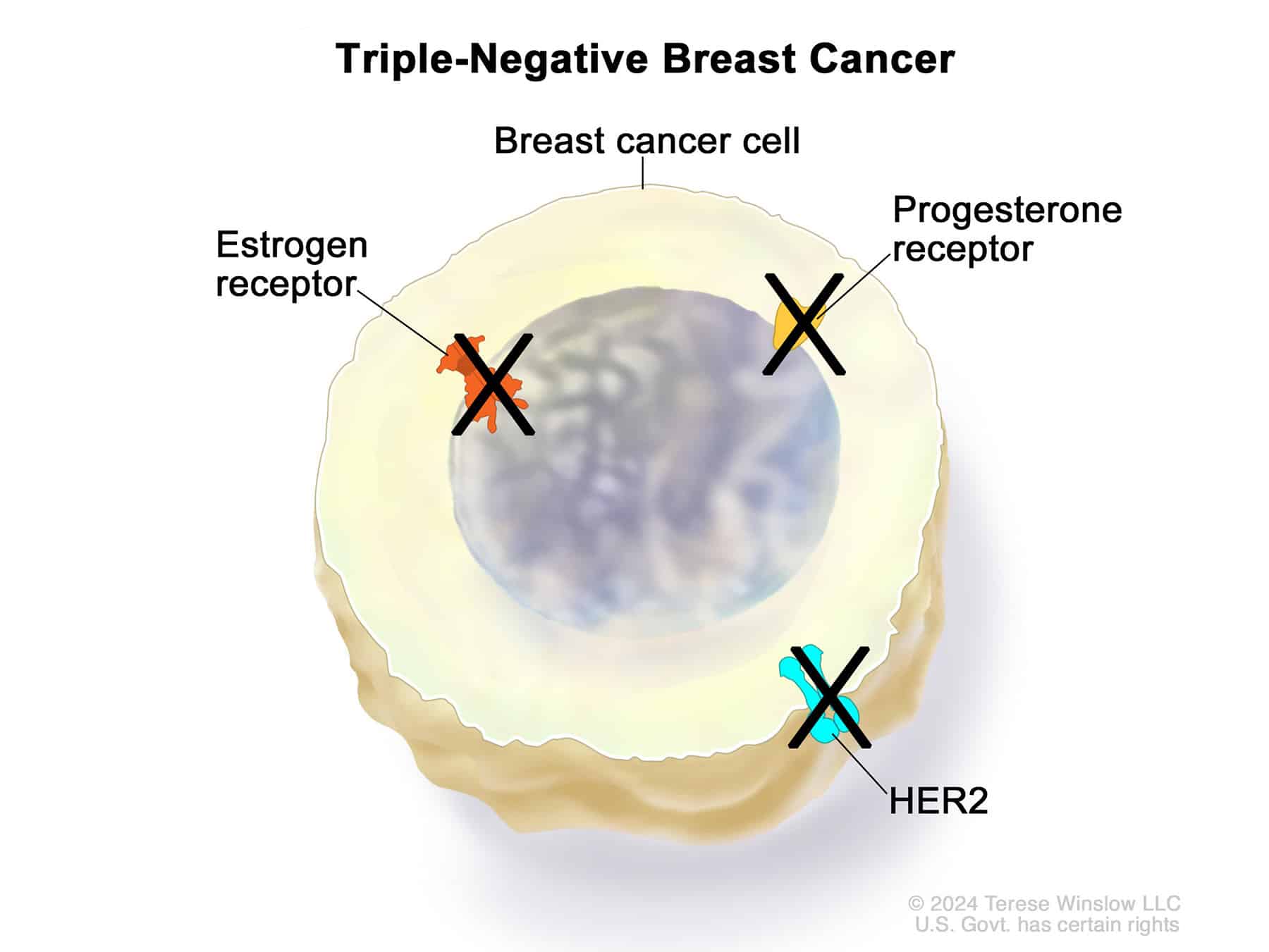
Because TNBC does not respond to breast cancer therapies that target hormone receptors and/or human epidermal growth factor 2 (HER2), newly diagnosed patients have typically received treatment with chemotherapy. The 2020 approval of pembrolizumab for metastatic TNBC provided a new first-line option for some patients, but most patients are ineligible due to the lack of PD-L1 expression on their TNBC tumors. The approval of sacituzumab govitecan-hziy—as well as the May 2026 approval of another TROP2-directed ADC, datopotamab deruxtecan-dlnk (Datroway)—means that some patients who are ineligible for first-line immune checkpoint inhibition now have a targeted therapy available to them.
Efficacy of sacituzumab govitecan-hziy as a single agent was evaluated in ASCENT-03, a multicenter, open-label, randomized phase III clinical trial that enrolled 558 patients with unresectable locally advanced or metastatic TNBC. Patients had not received previous systemic therapy for advanced disease and were not eligible for PD-1/PD-L1-targeted immune checkpoint inhibitor treatment due to their tumors being PD-L1-negative or due to a comorbidity. Patients were randomly assigned (1:1) to receive either sacituzumab govitecan-hziy or a treatment of physician’s choice (TPC) among nab-paclitaxel, paclitaxel, or gemcitabine and low-dose carboplatin.
Median progression-free survival (PFS) was 9.7 months in the sacituzumab govitecan-hziy arm and 6.9 months in the TPC arm, corresponding to a 38% reduction in the risk of disease progression or death among patients treated with sacituzumab govitecan-hziy compared with patients who received TPC. Confirmed objective response rate (ORR) was 50% and 47% in the sacituzumab govitecan-hziy arm and the TPC arm, respectively. At the time of the analysis, not enough data were available to establish whether the treatment improved overall survival (OS) compared with TPC.
Efficacy of sacituzumab govitecan-hziy in combination with pembrolizumab was evaluated in ASCENT-04/KEYNOTE-D19, a multicenter, open-label, randomized phase III trial that enrolled 443 patients with locally advanced or metastatic TNBC. Eligible patients had not received previous systemic therapy for advanced disease and had tumors that were positive for PD-L1 expression. Study participants were randomly assigned (1:1) to receive pembrolizumab combined with either sacituzumab govitecan-hziy or TPC (consisting of nab-paclitaxel, paclitaxel, or gemcitabine and low-dose carboplatin).
Median PFS was 11.2 months in the sacituzumab govitecan-hziy plus pembrolizumab arm and 7.8 months in the TPC plus pembrolizumab arm. Risk of disease progression or death was 35% lower in patients in the sacituzumab govitecan-hziy plus pembrolizumab arm than in those in the TPC plus pembrolizumab arm. Confirmed ORR was 61% and 55% in the sacituzumab govitecan-hziy plus pembrolizumab arm and the TPC plus pembrolizumab arm, respectively. At the time of the analysis, not enough data were available to establish whether sacituzumab govitecan-hziy plus pembrolizumab improved OS compared with TPC plus pembrolizumab.
The prescribing information of sacituzumab govitecan-hziy contains a boxed warning for diarrhea and neutropenia. The recommended dose as a single agent or in combination with pembrolizumab is 10 mg/kg given as an intravenous infusion on days 1 and 8 of each 21-day cycle. Treatment with sacituzumab govitecan-hziy should be continued until disease progression or unacceptable toxicity.
Breast cancer is the most common cancer type diagnosed in women, aside from skin cancer. According to federal statistics, it was estimated that 321,910 women would be diagnosed with breast cancer and 42,140 of them would die of the disease in the United States in 2026. TNBC is an aggressive type of breast cancer that lacks expression of estrogen and progesterone hormone receptors and does not overexpress the protein HER2. TNBC represents about 11% of all breast cancer cases.
The FDA rendered its decision on June 24, 2026. Check this resource for updated information on all therapeutics regulated by the FDA.