
From the Bench: Finding New Ways to Detect Cancer Early
Researchers are exploring innovative early cancer detection strategies involving tiny cancer hunters, the voice, electronic noses, and more.

Researchers are exploring innovative early cancer detection strategies involving tiny cancer hunters, the voice, electronic noses, and more.

Adding chemotherapy to targeted therapy improves outcomes for people with advanced EGFR-positive non-small cell lung cancer.
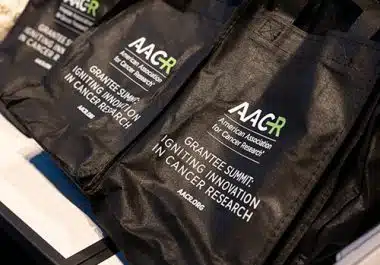
Since 1993, the American Association for Cancer Research (AACR) has invested more than $542 million in grants to sustain the pipeline of cancer researchers and accelerate breakthroughs for patients. The second annual AACR Grantee...

A look at recent research on determining breast cancer risk, the impact of lifestyle changes on cancer risk, and why screening is important.

COVID vaccines may improve immunotherapy effects, and a drug combination reduces the risk for death in bladder cancer.

In October 2025, AACR's journals editors highlighted studies on the anticancer function of an Alzheimer’s-related protein, small-molecule-drug conjugates, and more.

Frank McCormick, PhD, FAACR, reflected on a career chasing the notorious RAS oncogene that earned him the inaugural Stephenson Global Prize.

For September 2025, the editors of AACR's journals highlighted studies on cervical cancer screening, supercharging immunotherapy, and more.

Researchers are helping advance ovarian cancer care with breakthroughs that are reshaping treatment and early detection approaches.

New research is redefining the role of surgery, revealing approaches to help cancer patients preserve their organs, function, and identity without compromising outcomes.

AACR Fellow Lewis C. Cantley, PhD, leads a national effort targeting triple-negative breast cancer and ovarian cancer with a novel drug combination.
Learn More