Survival From Lung Cancer, Including the Type That Pope Leo XIV Has, Continues to Improve Thanks to Sustained Cancer Research Progress
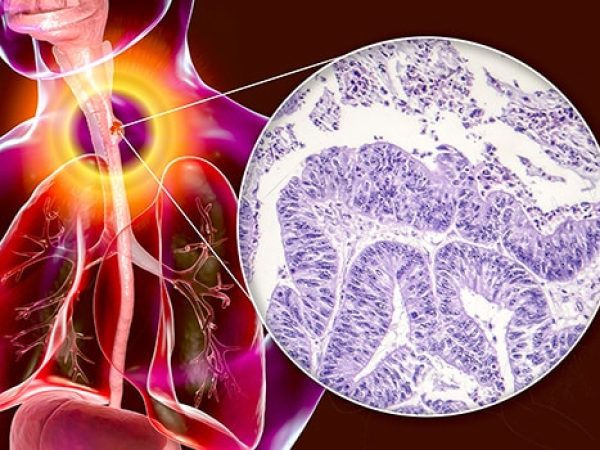
When Pope Leo XIV was diagnosed with lung adenocarcinoma, oncologists quoted in the media reports indicated that he may face a rather promising prognosis, largely because the cancer was detected early. The fact that such a statement can be made about lung cancer—a disease historically responsible for the most cancer deaths of any cancer type in the United States—indicates just how far we’ve come in our understanding of preventing and treating lung cancer, thanks to cancer research.
Cancer Research Catalyst, the official blog of the American Association for Cancer Research (AACR), takes this opportunity to review the remarkable progress made against lung cancer that we’ve documented, even as further research is required to prevent future cases and deaths.
Lung Cancer Screening Expansion Catches Cancer Early
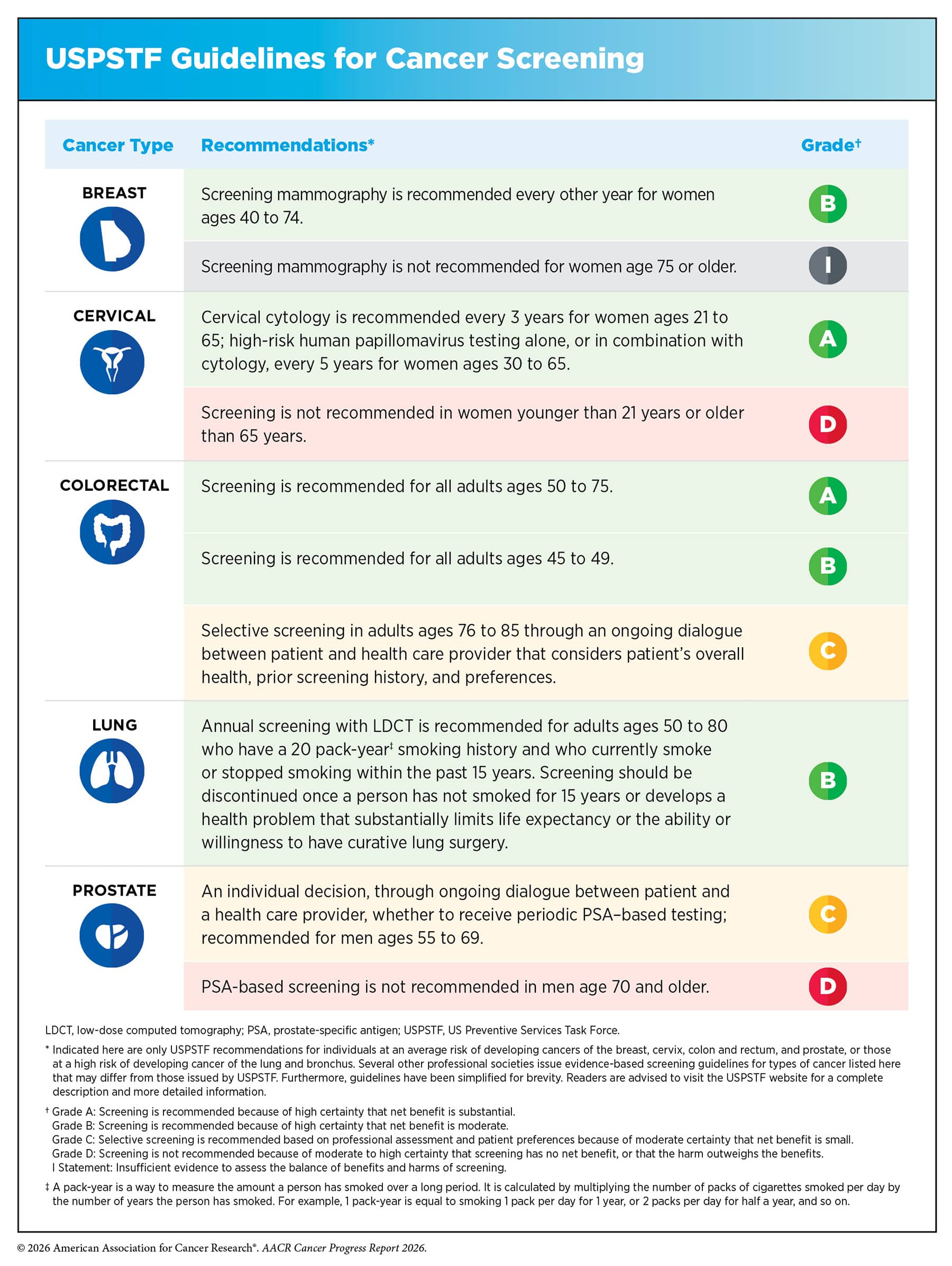
Catching lung cancer early, as may be the case for Pope Leo XIV, can make a critical difference in the likelihood of a positive patient outcome. And critical to early detection is screening.
In 2021, the U.S. Preventive Services Task Force significantly broadened the population who should, according to their recommendations, undergo lung cancer screening.
New and Expanded Drug Approvals for Lung Cancer Treatment
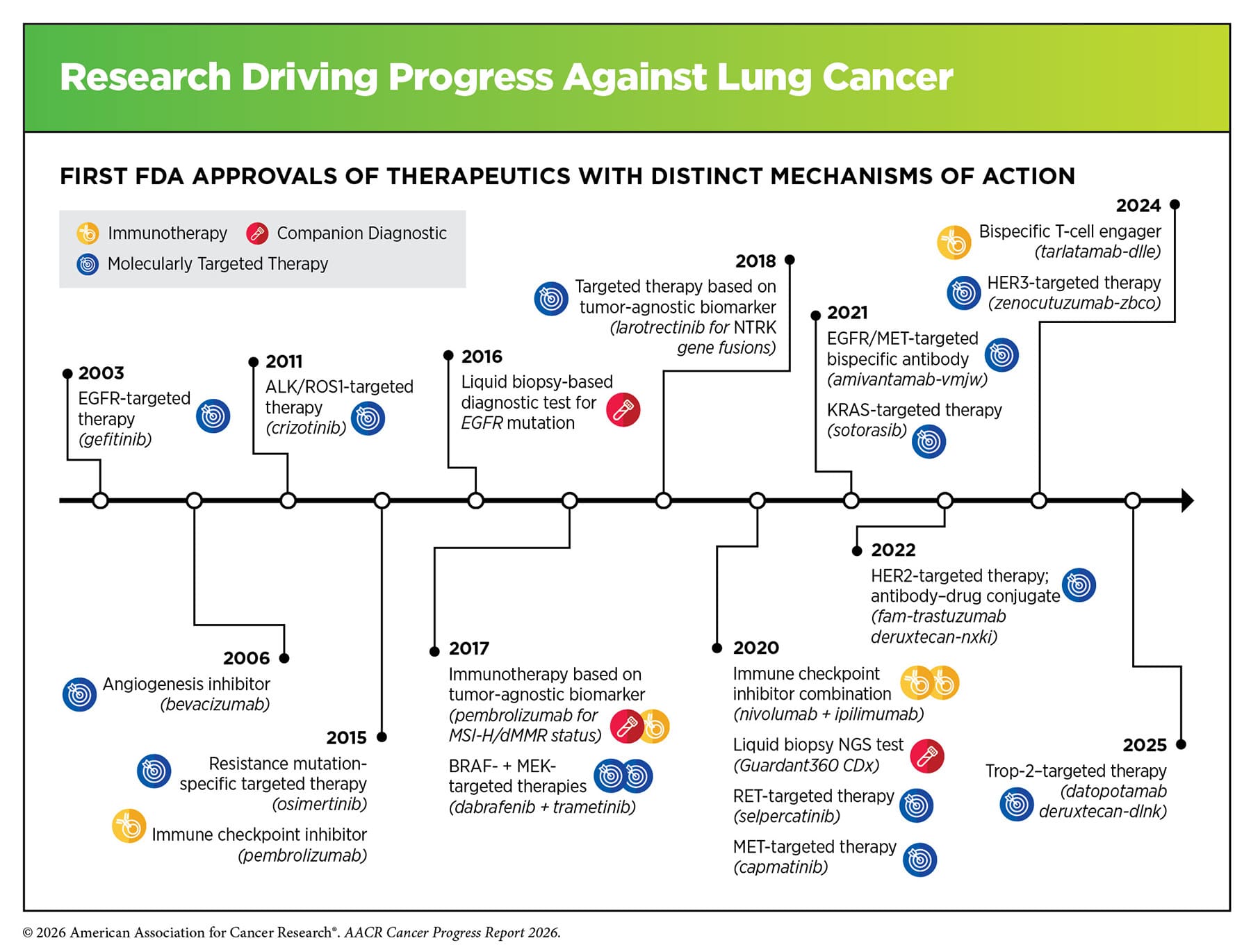
The progress against lung cancer through the years has been substantial—which reflects a long line of targeted therapies, made possible by exhaustive research, that the U.S. Food and Drug Administration (FDA) has approved to treat lung cancer.
Just this year, the FDA has approved three targeted drugs for certain lung cancer indications:
- zongertinib (Hernexeos), a tyrosine kinase inhibitor, was approved for the first-line treatment of adult patients with unresectable or metastatic non-squamous non-small cell lung cancer (NSCLC) whose tumors harbor activating mutations in the human epidermal growth factor receptor 2 (HER2) tyrosine kinase domain;
- zidesamtinib (Jideytro), a next-generation ROS1 inhibitor, was approved for adults with locally advanced or metastatic non-small cell lung cancer (NSCLC) harboring a ROS1 gene fusion whose disease has been previously treated with at least one other ROS1-targeted therapeutic; and
- sevabertinib (Hyrnuo), a tyrosine kinase inhibitor, received accelerated approval for adults with locally advanced or metastatic NSCLC with tumors that have activating mutations in the tyrosine kinase domain of HER2.
Targeted treatments have given patients with lung cancer—like survivor Sydney Barned, MD, who received a treatment targeting the ALK genetic alteration that her tumor harbored—more options and reason for hope.
Falling Smoking Rates, Falling Lung Cancer Rates
As detailed in the AACR Cancer Progress Report 2026, the decline of U.S. smoking rates has been both sustained and steep. That decline, in turn, has helped lower lung cancer incidence, which has fallen from 64.6 cases per 100,000 individuals in the United States in 1992 to today’s 38.9 cases per 100,000.
Outcomes are improving too. In the 1990s, a patient newly diagnosed with metastatic disease had only about a 2% chance of surviving for five years, but that figure has recently risen to about 10%. For all stages, the improvement in the five-year survival rate is also substantial.
Youth smoking, too, has reached new lows; any supposed Generation Z smoking comeback is not substantiated by official data, as cigarettes remain historically unpopular with the young. These declines demonstrate the proven value of the research-informed drive to reduce and prevent smoking as one of the single most effective interventions against lung cancer.
Improving Disparities in Lung Cancer
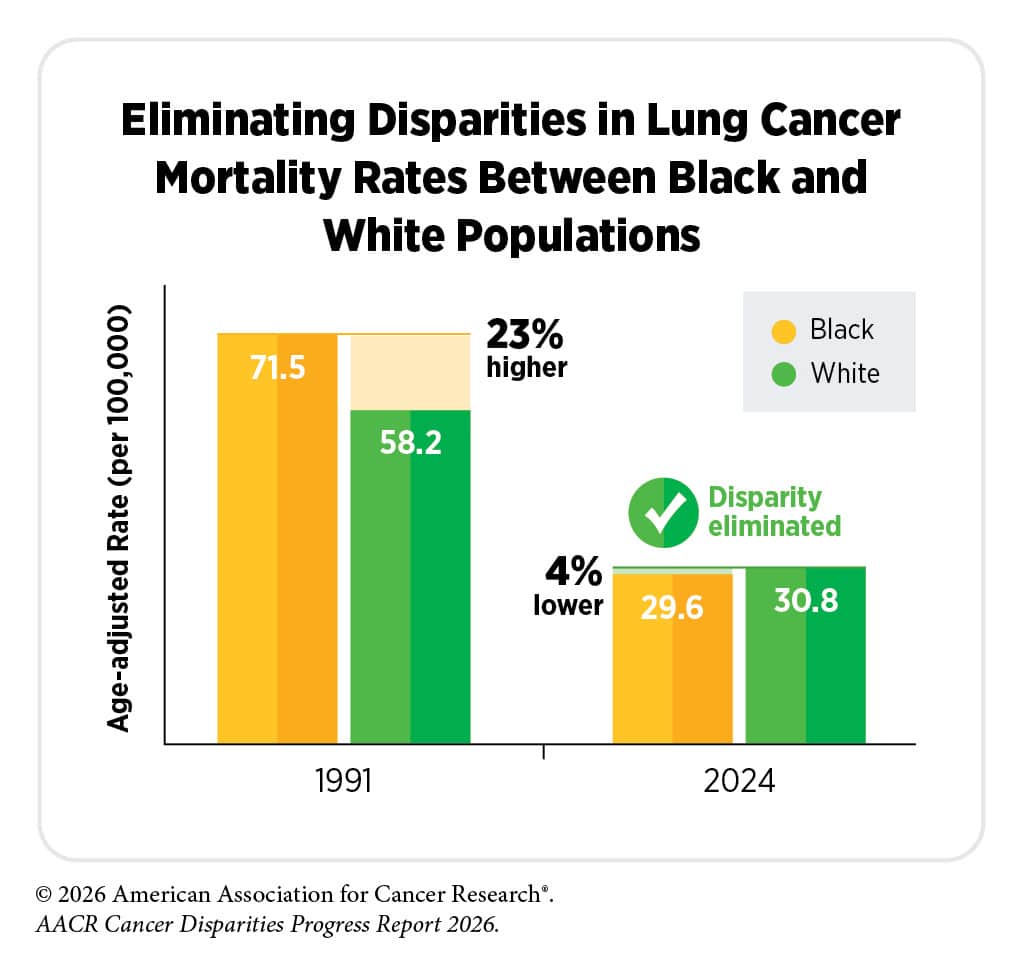
The AACR Cancer Disparities Progress Report 2026 shows a promising trend for Black individuals as well. Previously, in 1991, Black people were significantly more likely (23% more) than white people to die of lung cancer.
That disparity has been completely eliminated, with Black people now having a 4% lower rate of lung cancer mortality than white people. And this welcome news comes alongside substantially decreased lung cancer mortality rates for all populations as well.
Emerging Clarity on Lung Cancer in Never Smokers
As covered by Cancer Research Catalyst in our Unboxing Cancer News series, new research developments point to a possible explanation for a question that has long vexed scientists: why do about 15% to 25% of people who have never smoked develop lung cancer?
The answer may lie, at least in part, in a hereditary mutation to the EGFR gene, according to a study published in Science. In that analysis of more than 3.3 million people, researchers found that carriers of the heritable T790M mutation in EGFR who never smoked were more than 60 times more likely to develop lung cancer than people without the mutation.
Findings like these may help identify candidates for lung cancer screening and may also eventually inform certain treatment strategies.
The Future of Lung Cancer Research
Despite these hard-won advances, lung cancer remains a significant challenge—one that will require continued research efforts to sustain momentum. This summer, in Cancer Discovery, the AACR Lung Cancer Task Force published their roadmap for transforming lung cancer outcomes, in which they wrote: “international collaboration, centralized clinical trial databases, novel clinical trial designs, and artificial intelligence-driven analytics should accelerate precision medicine and aid in elucidating drug resistance mechanisms.”
From January 14-17, 2027, in San Diego, AACR will host a conference on lung cancer. Learn more about the meeting: Redefining Lung Cancer: From Mechanistic Biology to Emerging and AI‑Driven Therapies.