
Why Do Some Communities Experience Disparities in Early-onset Colorectal Cancer Screening and Survival?
Some communities have higher death rates from early-onset colorectal cancer than others. Why is this the case?
This was a question that Justin Xavier Moore, PhD, MPH, of the University of Kentucky, was left asking after he and his colleagues identified certain counties in the southern United States as high mortality “hot spots” for early-onset colorectal cancer. Across the country, the number of individuals under 50 who are being diagnosed with and dying from colorectal cancer continues to rise (an annual 6.6% increase in incidence and 1.1% in mortality), but outcomes are worse in some communities, Moore explained during a poster presentation at the 19th AACR Conference on The Science of Cancer Health Disparities, held October 18-21.
Moore wanted to understand whether the lower survival rates are tied to social vulnerability factors within those communities, such as lower income, no access to transportation, housing issues, etc. “Understanding this relationship will help elucidate which communities are possibly disproportionately affected and allow for resource allocation and risk prevention in vulnerable communities,” he explained.
Moore and colleagues decided to focus on Kentucky and Georgia, given both states have large underserved populations affected by early-onset colorectal cancer, and were among the states with “hot spots” identified in their previous analysis. For this new study, they analyzed data from 68,789 patients with colorectal cancer in the Kentucky (31.2%) and Georgia (68.8%) cancer registries in association with information from the Centers for Disease Control and Prevention’s Social Vulnerability Index (SVI).
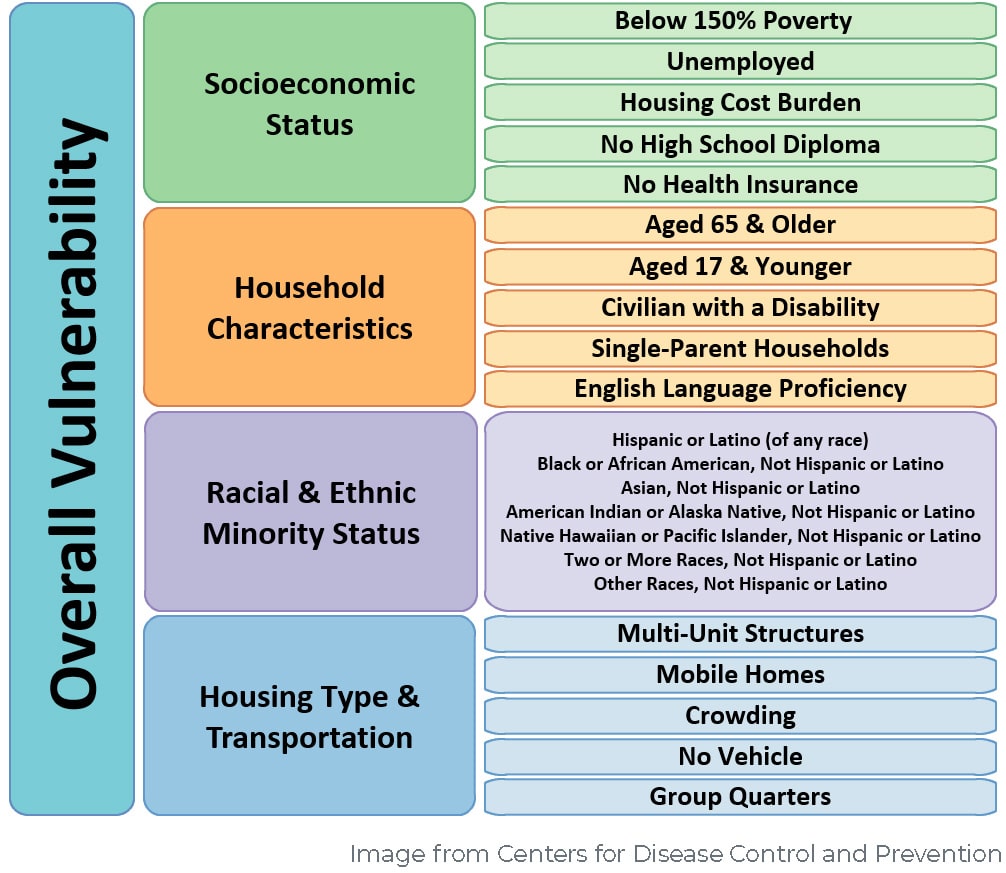
The SVI takes into consideration 16 factors to form a composite measure of community-level disadvantage using U.S. census data. These 16 factors are grouped into one of four categories: socioeconomic status, household composition, minority status, and housing and transportation. Moore’s team examined how early-onset colorectal cancer time-to-treatment and survival were impacted by neighborhood disadvantage based on SVI overall and then by each of those four categories.
Among the patients in the analysis, 13.6% were diagnosed with colorectal cancer before they had turned 50. The researchers found that overall, these individuals had a colorectal cancer-specific five-year mortality rate that was 27% lower than those who were diagnosed with colorectal cancer after turning 50 (which is considered average-onset cancer). When factoring in SVI, however, early-onset patients who lived in a disadvantaged area had a 30% increased risk of five-year death from colorectal cancer compared to early-onset patients in advantaged areas. Notably, this was nearly double the 16% increased risk of death among patients with average-onset colorectal cancer in disadvantaged vs. advantaged areas.
But when Moore and his team examined each of the four SVI categories, they found that only socioeconomic status and housing/transportation played significant roles. Disadvantaged socioeconomic status was associated with a 21% higher risk of death from colorectal cancer in early-onset patients and a 13% higher risk in average-onset patients. Meanwhile, disadvantaged housing/transportation was associated with a 17% increased risk of death for early-onset patients and 7% for average-onset patients.
The Cumulative Effects of Neighborhood Disadvantages
Even though early-onset patients from disadvantaged neighborhoods had worse survival rates than average-onset patients in those areas, the study showed that time-to-treatment was actually shorter for early-onset patients. Early-onset colorectal patients in disadvantaged neighborhoods received their first treatment within five days compared with six days for average-onset patients.
Moore speculated that given the rising trend of younger people dying from this disease, doctors may be recommending early-onset patients start treatment as soon as possible. He added that even though the results of this study suggest neighborhood disadvantage may not be associated with how quickly treatment starts, it could become a larger issue over time as younger patients navigate the various demands of treatment and survivorship.

“Socioeconomic and housing/transportation disadvantages may have cumulative effects on a patient’s ability to consistently access and remain engaged in cancer care—including attending appointments, completing recommended treatment, managing side effects, accessing supportive services, and receiving appropriate follow-up and surveillance,” Moore explained. “Patients living in more socioeconomically advantaged neighborhoods may have greater resources and fewer logistical barriers that help support continuity of care over time.”
Moore emphasized, however, that their study cannot establish that any of these factors caused the differences in mortality, and additional research is needed to better understand the specific factors leading to worse outcomes for patients in these disadvantaged areas. In the meantime, he offered suggestions for how some of these social vulnerability factors could be addressed at the policy, organizational, and community level.
For example, investments in community health centers, rural hospitals, and other local health care infrastructure can help reduce the distance patients must travel to receive cancer screening, treatment, and follow-up care; transportation assistance and patient navigation programs can further reduce logistical barriers to accessing care; and policies that support paid time off or greater workplace flexibility may make it easier for patients to attend medical appointments and complete treatment.
“Ultimately, reducing these disparities requires recognizing that cancer outcomes are influenced not only by what happens inside the clinic, but also by whether people have the resources and opportunities necessary to access and remain engaged in care,” he added.
Lack of Awareness About Colorectal Cancer Screening Options
Another potential way to improve survival among patients with early-onset colorectal cancer is to ensure the disease is caught as early as possible. A different study presented at the AACR Conference on The Science of Cancer Health Disparities looked at how aware younger individuals are of colorectal cancer screening options.
As of 2021, the U.S. Preventive Services Task Force (USPSTF) recommends that adults begin screening for colorectal cancer at age 45, with available screening options including colonoscopies, at-home fecal sampling kits, blood tests, and a few other lesser-used options. Currently, however, only about 37% of adults between 45 and 49 are up to date with their colorectal cancer screening, said Jordan Baeker Bispo, PhD, MPH, of the American Cancer Society, who presented the study.
So, Baeker Bispo and her colleagues conducted a survey of 3,626 adults between the ages of 45 and 75 with no prior history of colon cancer that asked: “Has a doctor or other health professional ever told you there are a few different tests to detect colorectal cancer?”

The researchers then compared responses among three age groups: 45-49, 50-64, and 65-75. Just over half (50.3%) of those in the youngest age group reported discussing different screening options with a health care professional compared with 72.5% in the oldest age group. Further, the youngest age group participants were more than twice as likely as the eldest participants to report never having discussed any colorectal cancer screening tests with a health care professional (23.2% vs. 7%, respectively).
“This finding strongly suggests that patients who are newly age-eligible for screening are not receiving adequate information about their screening options from a health professional, and that could be contributing to low screening rates in this age group,” Baeker Bispo said.
The researchers also identified significant racial differences among respondents in the youngest age group. About a third (33.2%) of non-Hispanic Black respondents aged 45-49 reported discussing colorectal cancer screening options with their doctor vs. 60.7% of their non-Hispanic white counterparts.
“We saw that the racial disparity became statistically nonsignificant in the older patient cohorts, so it may be that race-associated barriers to health care access and screening become less pronounced as patients age into Medicare,” Baeker Bispo explained.
Baeker Bispo stressed how important it is to conduct further research into interventions that could address this racial disparity in colorectal cancer screening considering the disparities also seen in their outcomes. Black individuals are more likely to present with advanced stages of early-onset colorectal cancer compared with white individuals, and they have a higher risk of death ranging between 34% to 59%, according to the AACR Cancer Disparities Progress Report 2026.
Ultimately, Baeker Bispo said clinician empowerment is the key to reducing these disparities in doctor-patient discussions about colorectal cancer screening options. She noted that clinicians’ preference for colonoscopies as the gold standard screening option may have played a role in their limited discussions about other options, and the relatively recent change that lowered recommended screening to 45 may have made them less likely to bring up options with younger patients. Still, she said the findings highlight a major opportunity to improve communication about colorectal cancer screening with younger individuals.
“It is important for people to know their options, because the most important thing is to get screened,” she said.