Cancer Health Disparities: Actionable Solutions, Gaps in Stage 4 Care, and Honoring Sanya Springfield
Cancer disparities are not inevitable. We can identify the causes and solve them. That was the message Monica L. Baskin, PhD, delivered during the opening session of the 19th AACR Conference on the Science of Cancer Health Disparities, held October 18-21.
Baskin, who is Director and Jeanette and Eric Lipman Chair in Oncology of the VCU Massey Comprehensive Cancer Center, explained how, since 1937, when the National Cancer Institute (NCI) was established, tremendous progress has been made in improving the screening, treatment, and prevention of cancer—resulting in millions of lives both prolonged and saved. Those advancements, however, have not reached all members of the population equally, Baskin said.

But much progress has also been made in understanding why that is the case. Baskin explained how researchers like her have spent decades identifying which groups face worse incidence or mortality from certain cancers and even determining the social, structural, or other barriers to care that are at the root of many disparities. For nearly 20 years, the AACR Conference on the Science of Cancer Health Disparities has served as the premier scientific forum for discussing the discoveries made in this field.
During the opening session, AACR Chief Executive Officer Margaret Foti, PhD, MD (hc), noted how the history of this conference also reflects the evolution of the cancer disparities field itself. While early meetings focused on foundational questions related to cancer prevention, screening, survivorship, and access to care, the program has been expanded to include aspects like implementation science and community engagement.
“While we can take great pride in how far the field has come, we also recognize that much more work remains if we are to save more lives from cancer,” Foti said.
Baskin devoted her talk to showing how researchers can use what we have learned over the years to implement solutions that ensure cancer disparities don’t become perpetual.
Actionable Strategies to Address Cancer Disparities
Throughout her talk, Baskin examined various strategies that have already been proven to be successful, starting with programs involving community health workers. For example, a review showed how a number of programs using community health workers to increase awareness about breast, cervical, and colorectal cancer screenings were not only cost-effective but led to an increase in quality-adjusted life years saved.
“Individuals from within local communities having conversations with their neighbors, with their school teachers, the clerk at the grocery store, helping them to be able to navigate and manage to get those screenings have been extremely effective,” Baskin said, adding that these programs can be adapted to engage with different communities that are underrepresented in screening.
In another example, a randomized clinical trial demonstrated the impact of a vegetable gardening intervention in helping older patients with cancer. Patients worked with a certified master gardener over the course of a year to learn how to plant and maintain a raised-bed garden at their home, which Baskin said led to clinically significant improvements in several outcomes that were supportive of higher quality of life and extended lifespan.
Baskin also stressed the importance of improving access to high-quality care for all populations, such as by ensuring underrepresented and typically excluded populations are given the opportunity to participate in clinical trials. She said that these populations “are absolutely as willing as any other group to participate in clinical trials, if you just ask them,” which was the key takeaway of a review published by the National Academies of Sciences, Engineering, and Medicine.
But ensuring these populations have access to care may also require addressing certain barriers, such as social drivers or determinants of health (SDOH), which are nonmedical factors that can affect health outcomes based on where someone is born, as well as how that person lives, learns, works, plays, worships, and ages.
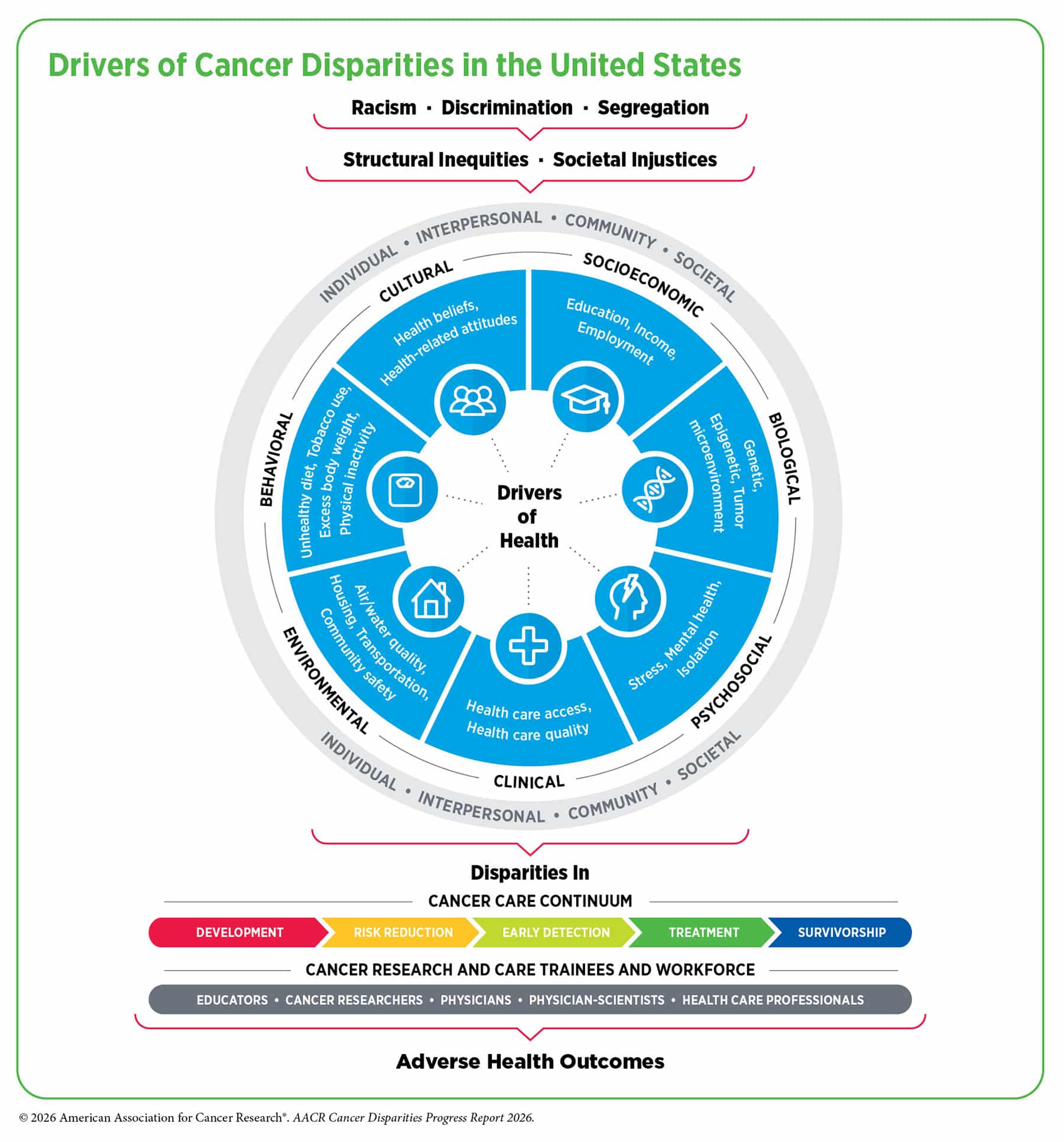
At the VCU Massey Comprehensive Cancer Center, Baskin said they implemented the Alliance for Equity in Cancer Care initiative to help identify patients with SDOH barriers and to offer corresponding support services. So far, the program has assessed 3,264 patients and identified 2,834 patients with at least one barrier—and ultimately, 2,296 of these patients have used the available support services to get care.
Finally, Baskin touched on the need to not only facilitate new discoveries but shorten the time it takes for discoveries to reach the communities most in need. She explained how artificial intelligence (AI) holds great promise for addressing cancer disparities—such as by identifying regions with low cancer screenings or helping to accelerate drug development—but emphasized that we need to ensure existing disparities are not exacerbated by omitting data from underrepresented populations in AI models.
Beyond AI, Baskin highlighted the importance of having a diverse set of people working to solve these problems. This includes researchers codesigning solutions with members of the community as well as having a biomedical workforce that is fully representative of the U.S. population. In a study that examined the relationship between research impact and different areas of diversity (ethnicity, discipline, gender, affiliation, and academic age), ethnic diversity had the strongest correlation with scientific impact.
“If we’re really looking for how do we improve and move towards health equity, we’ve got to look at our teams and make sure that we are bringing different perspectives into the room,” Baskin concluded.
Addressing Gaps in Care for Patients With Metastatic Cancer
While the programs Baskin outlined are helping address various cancer disparities, Michael H. Hu shared his experience as a patient with stage 4 lung cancer to highlight a group of patients in need of more support—those with metastatic disease.
As of 2025, Hu said there were around 693,000 people living with metastatic disease in the United States, and that number is projected to increase to around 1 million by 2040 as treatment options continue to improve. Hu added that a growing number of these patients tend to be on the younger side. For example, he said in the case of stage 4 ALK-positive lung cancer, the cancer type he has, about 50% are under the age of 50.
“For younger adults, longer survival means carrying terminal uncertainty through years when people are building careers, savings, relationships, and families,” Hu explained. “Many [survivorship] programs were built around treatment with curative intent, which helps explain why people with stage 4 disease may never be referred, or may find that the services do not address our ongoing treatment uncertainty and long-term side effects.”
Hu himself was diagnosed in 2022 at the age of 43, with kids who were 4 and 6 at the time. Even though the cancer was incurable, his doctor said that his cancer tested positive for an ALK mutation and was the best possible news, given the number of treatments available targeting that specific gene. In under five years, Hu has been on seven lines of therapy, and he is grateful for even the short amount of time each one was effective. While he was able to keep working when he first started treatment, the cognitive side effects from his second-line therapy eventually forced him to go on short-term disability leave. Five weeks later, he was laid off.
“Suddenly, the system sustaining my life with terminal cancer, my health insurance, life insurance, and income were at risk all at once,” Hu said. “I didn’t know it was possible, but trying to keep those supports from collapsing felt even more stressful than being diagnosed with cancer.”
Hu expressed how fortunate he was to find a way to maintain his life insurance, how lucky he was to have the resources to see a therapist who specializes in surviving with long-term disease, and how much he has benefited from palliative care. But he also knows that not all stage 4 patients are as privileged as he is, which is why he is advocating for researchers and clinicians to help close certain gaps related to research and treatment for metastatic disease.
Long-term survival isn’t just a number on a curve. It’s years of someone’s life, and we need to know how well people are actually living them.
For one, he explained how the support patients receive can vary based on where they get care. As an example, patients who receive treatment in community practices may not have dedicated navigators or survivorship staff to help them coordinate an often-complex care schedule that could include scans, lab tests, prior authorizations, and follow-up appointments.
“There’s a saying in our community that managing our cancer is a full-time job,” Hu said, adding that, without someone in their corner pushing them along, it is easy for patients to fall off their care schedule. “And for us, falling off can cost a lot more than time.”
The other gap that Hu would like to see addressed is more research on the long-term impact of treatments in patients with metastatic cancer.
“Many trials follow participants long enough to establish efficacy and near-term safety, but not long enough to capture what treatment does to the body, mind, family, and working life over a decade,” Hu said. “Long-term survival isn’t just a number on a curve. It’s years of someone’s life, and we need to know how well people are actually living them.”
Recognizing a Distinguished Cancer Disparities Researcher
The opening session wrapped with the recognition of a couple of award recipients. Vanessa M. Hayes, PhD, head of the Ancestry and Health Genomics Laboratory at the Charles Perkins Centre at the University of Sydney in Australia, delivered this year’s AACR Distinguished Lectureship on the Science of Cancer Health Disparities. (Read more about her award lecture in this post.)

Meanwhile, special early recognition was paid to Sanya A. Springfield, PhD, who will receive the 2027 AACR Distinguished Public Service Award at the AACR Annual Meeting 2027, to be held April 2-7 in Orlando, Florida. Springfield, who is the director emeritus of NCI’s Center to Reduce Cancer Health Disparities, has been a visionary leader in the field of cancer disparities throughout her career spanning over four decades.
She has led the development and implementation of a national framework to address biological factors and structural inequities that contribute to cancer disparities, contributed to numerous National Institutes of Health initiatives dedicated to improving equity across the biomedical research ecosystem, and played a pivotal role in launching the first AACR Conference on the Science of Cancer Health Disparities in 2007.
Springfield thanked all the people who helped her throughout her life and career, from her family and friends to her colleagues. To the next generation of cancer disparities researchers, she delivered a powerful message: “Don’t measure your success only by the number of grants that you have, or the number of publications, the positions that you serve—measure it by the people that you impact, the doors that you open. And always remember: You cannot do this alone.”