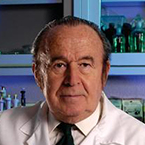
Andrew V. Schally, PhD, FAACR, who shared the 1977 Nobel Prize in Medicine or Physiology for his discoveries on endocrine signaling in the nervous system, died October 17, 2024, at the age of 97.
Schally characterized various secretory, hypothalamic signaling hormones that affect downstream pituitary gland function. These trailblazing studies established the foundation for many research areas—including neuroendocrinology and reproductive endocrinology —and illuminated the previously unknown relationship between the hypothalamus, pituitary gland, and endocrine system.
These fundamental discoveries have been used to further the understanding and treatment of endocrine-related diseases such as breast and prostate cancer. Schally also pioneered the development and use of synthetic analogs of hypothalamic hormones for therapy of various cancers. For his accomplishments, Schally was honored with membership in the national academies of eight countries and awarded 30 honorary degrees.
Schally was born November 30, 1926, in Wilno, Poland. After a harsh childhood in Nazi-occupied Eastern Europe, Schally settled in the United Kingdom where he completed high school and studied chemistry in London. He studied from 1950 to 1952 at the National Institute of Medical Research in Mill Hill, London, which he said profoundly influenced the course of his career. In 1952, he moved to Montreal to work and study at McGill University. He received a doctorate in endocrinology from McGill University in 1957.
That year, he moved to the United States to continue his research at Baylor University College of Medicine in Houston, Texas. In 1962, Schally left Baylor to set up his own lab at the Veterans Affairs Medical Center in New Orleans.
He remained there until 2005 and was on the faculty of Tulane University School of Medicine from 1962 to 2006.
Since 2007, he had been chief of endocrine and cancer research at the Veterans Affairs Medical Center in Miami and a professor at the University of Miami’s Miller School of Medicine, where he conducted research on the role of brain hormones in cancers of the brain, breast, colon, lung, ovaries and pancreas.
Schally became a naturalized citizen of the United States in 1962. He became a member of the AACR in 1990 and was elected to the inaugural class of Fellows of the AACR Academy in 2013.
In 1977, he shared the Nobel Prize in Medicine or Physiology with Roger C. L. Guillemin, MD, PhD, FAACR, and Rosalyn Yalow, PhD, for their work on peptide hormones.
He received many other recognitions throughout his distinguished career, most notably the Gairdner Foundation International Award in 1974 and the Albert Lasker Basic Medical Research Award in 1975.
Career Highlights
2012 Research Excellence Award, Department of Veterans Affairs, Miami, FL
2004 Chevalier, Légion d’Honneur
1997 Award of Instituto Mexicano del Seguro Social (IMSS), Mexico
1981 AMVETS, Silver Helmet, Civil Servant of the Year Award
1979 Blue Cross – Gold Category – of the Social Security Hospital System of Spain
1979 Ordem Nacional do Cruzeiro do Sul (Southern Cross) (Brazil’s highest decoration)
1978 Golden Plate Award, American Academy of Achievement
1977 Nobel Prize in Physiology or Medicine
1975 Albert Lasker Basic Medical Research Award
1975 Borden Award, Association of American Medical Colleges
1974 Gairdner Foundation International Award
1974 Charles Mickle Award of the Faculty of Medicine, University of Toronto
1970 William S. Middleton Award
1969 Van Meter Prize, American Thyroid Association
1957 PhD, McGill University