Examining the Rise of Early-onset Incidence Across Cancer Types
At 25 years old, Lourdes Monje was excited about starting the next chapter in their life. Monje, who identifies as nonbinary, was preparing to move from New York to Philadelphia to launch a new career. Then, one morning in October 2020, they felt a lump on their chest. When Monje was eventually diagnosed with stage 4 breast cancer, it was as if time—and their life—froze.
“I felt my world stop. All my plans had to go out the window. It was just about getting this taken care of,” Monje explained in the AACR Cancer Progress Report 2024. “While I was watching my friends advance in their careers, and get married, and go into committed relationships, and have kids, I was spending a lot of time just navigating my diagnosis.”
Stories like Monje’s are becoming more common as cases of early-onset cancer—typically defined as cancer in those between the ages of 15 and 49—are on the rise. From 2010 to 2019, a total of 2,020,829 individuals were diagnosed with early-onset cancer, according to a study published in the AACR journal Cancer Discovery. Among the 33 cancer types the study examined, 14 had a significant increase in early-onset incidence.
So, which types of cancer are seeing more early-onset cases? What do we know about why more people under 50 are getting cancer? Is the rise of early-onset cases leading to more deaths from cancer? Several researchers are examining these very questions.
Which Cancer Types Have Increasing Rates of Early-onset Incidence?
In the Cancer Discovery study, Meredith Shiels, PhD, MHS, from the National Cancer Institute (NCI), and her colleagues used data from the United States Cancer Statistics database to analyze cancer incidence from 2010 to 2019. Cancer was considered early-onset if it was diagnosed in one of three age groups—15-29, 30-39, and 40-49—while the older-onset age groups consisted of those 50-59, 60-69, and 70-79.
“Understanding which cancers are increasing in younger age groups, and whether those cancers are also increasing among those at older ages, will inform future studies focused on identifying the drivers of rising rates,” Shiels said in a press release.
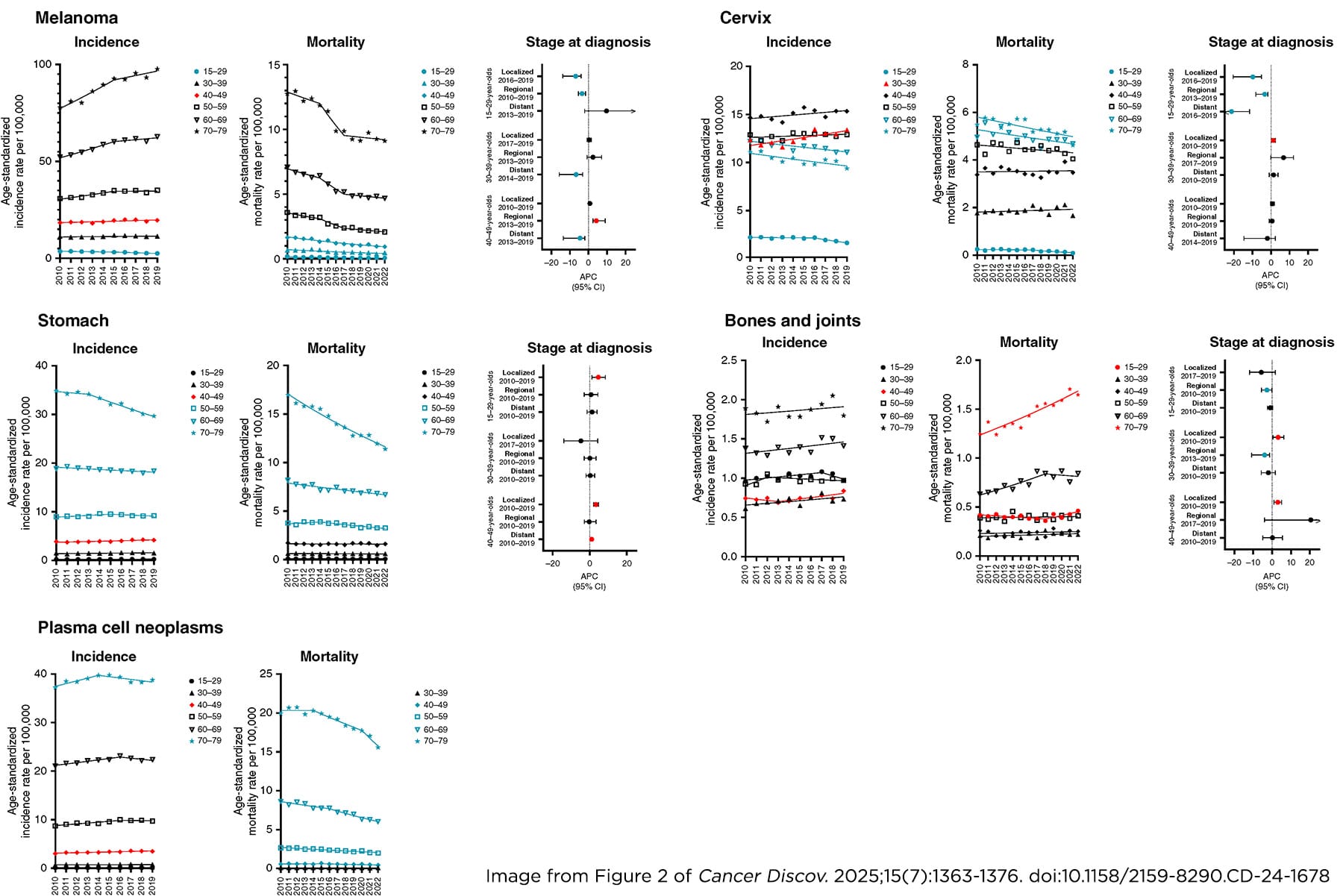
Five cancer types had an increase in at least one of the early-onset groups without any corresponding increase in the older-onset age groups:
- melanoma;
- plasma cell neoplasms;
- cervical cancer;
- stomach cancer; and
- cancer of the bones and joints.
Nine cancer types had an increase in at least one early-onset group and at least one older-onset age group:
- female breast cancer;
- colorectal cancer;
- kidney cancer;
- testicular cancer;
- uterine cancer;
- pancreatic cancer;
- precursor B-cell non-Hodgkin lymphoma;
- diffuse large B-cell lymphoma; and
- mycosis fungoides/Sézary syndrome.
Overall, the largest increases in the number of additional early-onset diagnoses in 2019 compared with 2010 were seen in female breast (4,834), colorectal (2,099), kidney (1,793), uterine (1,209), and pancreatic cancers (511). Together, these cancers accounted for more than 80% of the additional cancers diagnosed during this period.
Another study published in the Annals of Internal Medicine found that early-onset incidence is also on the rise for appendix cancer. Previous studies have observed an increasing rate of appendix cancer cases overall, but Andreana Holowatyj, PhD, MSCI, from the Vanderbilt-Ingram Cancer Center and a 2019 AACR NextGen Star, wanted to better understand how incidence was changing across birth cohorts.
Holowatyj and her colleagues used data from NCI’s Surveillance, Epidemiology, and End Results (SEER) Program and found 4,858 cases of appendiceal adenocarcinomas diagnosed between 1975 and 2019. But compared to those born in 1945, incidence rates more than tripled for those born in 1980 and more than quadrupled for those born in 1985.
As for cancer types with decreasing early-onset incidence, Shiels and her colleagues found that Kaposi sarcoma, liver cancer, and Burkitt lymphoma had the largest decreasing rates while prostate, lung, and ovarian cancers had the largest decreases in the total number of cases.
How Does Early-onset Cancer Differ by Sex?
Beyond age, Shiels and her colleagues also broke down incidence based on sex. Overall, early-onset cases were more common in females, who were diagnosed with 63% of the cases. The most common types of early-onset cancer in females were breast cancer, thyroid cancer, and melanoma.
For female breast cancer and uterine cancer, the researchers also examined how incidence differed based on cancer subtype. Estrogen receptor (ER)-negative breast cancer rates only increased significantly among those 20-29 while ER-positive breast cancer rates increased significantly among those 30-39 and 40-49. Increasing incidence of uterine cancer was limited to the more common endometrioid subtype, which saw higher rates across the three early-onset age groups.
For males, the most common types of early-onset cancer were melanoma, colorectal cancer, and testicular cancer.
Why Are More People Under 50 Getting Cancer?
In brief, there aren’t yet any definitive answers as to what is causing the rise in early-onset cancers, but researchers have some ideas.
Genetics plays at least some role, according to Zsofia K. Stadler, MD, from Memorial Sloan-Kettering Cancer Center. At the AACR Annual Meeting 2025, Stadler said that her group looked at the prevalence of high-penetrance germline mutations—such as BRCA1/2 and the Lynch syndrome genes (MLH1, MSH2, MSH6, PMS2, and EPCAM) that carry an increased risk of certain cancers—in early-onset cases compared to average- and late-onset cases. They found that the overall prevalence of these hereditary mutations was 18.4% in early-onset, 15.6% in average-onset, and 12.3% in late-onset cancers.

Even though genetics was found to have a stronger impact on early-onset cancers, Stadler said that still means around 80% of those with early-onset cancer don’t have a germline mutation.
“Genetics [alone] cannot explain the rise that we have seen for early-onset cancers because our genome just doesn’t change so quickly over several decades,” Ulrike Peters, PhD, MPH, from Fred Hutchinson Cancer Center, explained during that same session.
Instead, Peters suggested looking at the possibility of how gene-environment interactions contribute to the development of early-onset cancers. For example, she discussed more closely examining the impact of certain lifestyle and environmental factors such as pollutants, microplastics, ultraprocessed foods, forever chemicals (pre- and polyfluoroalkyl substances), extreme weather, sleep, stress, obesity, and gut dysbiosis.
However, she cautioned that: “For many of these, there’s no strong epidemiological evidence that they are linked to early-onset cancers. This is really a research area that is just evolving.”
She is excited by advances in geospatial datasets, multiomics, and wearable monitoring devices that are making it possible to conduct more comprehensive exposure assessments, which could lead to a better understanding of the connection between environmental/lifestyle factors and early-onset cancers.
Are Cancer Mortality Rates Also Increasing?
Overall, cancer mortality rates did not increase significantly across all cancers and age groups between 2010 to 2022, based on Shiels and her colleagues’ analysis of national death certificate data. However, out of the 14 cancer types with increased early-onset incidence, four of them had higher mortality rates in at least one early-onset age group:
- testicular cancer among those 30-39;
- uterine cancer among those 30-39 and 40-49;
- colorectal cancer among those 30-39 and 40-49; and
- cancer of the bones and joints among those 15-29.

Notably, in a study presented at the AACR Annual Meeting 2025, Adetunji Toriola, MD, PhD, MPH, of Washington University School of Medicine, and colleagues found that deaths from breast cancer among women 20-49 declined significantly from 2010 to 2020.
Toriola reported that across all breast cancer subtypes and racial/ethnic groups, incidence-based mortality in women 20-49 declined from 9.70 per 100,000 women to 1.47/100,000. For most of the breast cancer subtypes and racial/ethnic groups the researchers examined, the declines were most pronounced after 2016. Toriola explained that this likely reflects advancements in treatment options—such as the broader adoption of CDK4/6 inhibitors and optimization of endocrine therapy between 2015 and 2016—as well as expanded access to care and screening in women ages 40-49.
“We must continue to perform impactful research to ensure further reduction in breast cancer mortality, including research into understanding the tumor biology and molecular mechanisms driving carcinogenesis and treatment response in younger women,” Toriola said in a press release.
Monje is hopeful that their own contribution to clinical research can help others with cancer to live longer. After being treated with ribociclib (Kisqali) for six months and then palbociclib (Ibrance) for over two years, Monje joined a clinical trial to treat cancer that metastasized to their lungs.
“The way I’ve been approaching this trial is knowing that it’s not just for me, it’s for other people who will come after me,” they said. “Because I know that the two medications that I had access to beforehand that are relatively new are because of people like me who went through clinical trials.”
Throughout the trial, which concludes at the end of August, Monje’s cancer has remained stable. And thanks to each of these treatments, Monje also no longer feels as if their life is on hold.
“I feel like I’m having as normal of a life as I can and creating the memories that I’ve wanted to.”
From December 10 to 13, the AACR is hosting a special conference on The Rise in Early-Onset Cancers—Knowledge Gaps and Research Opportunities. Individuals interested in submitting an abstract for presentation during the conference must do so by September 25.