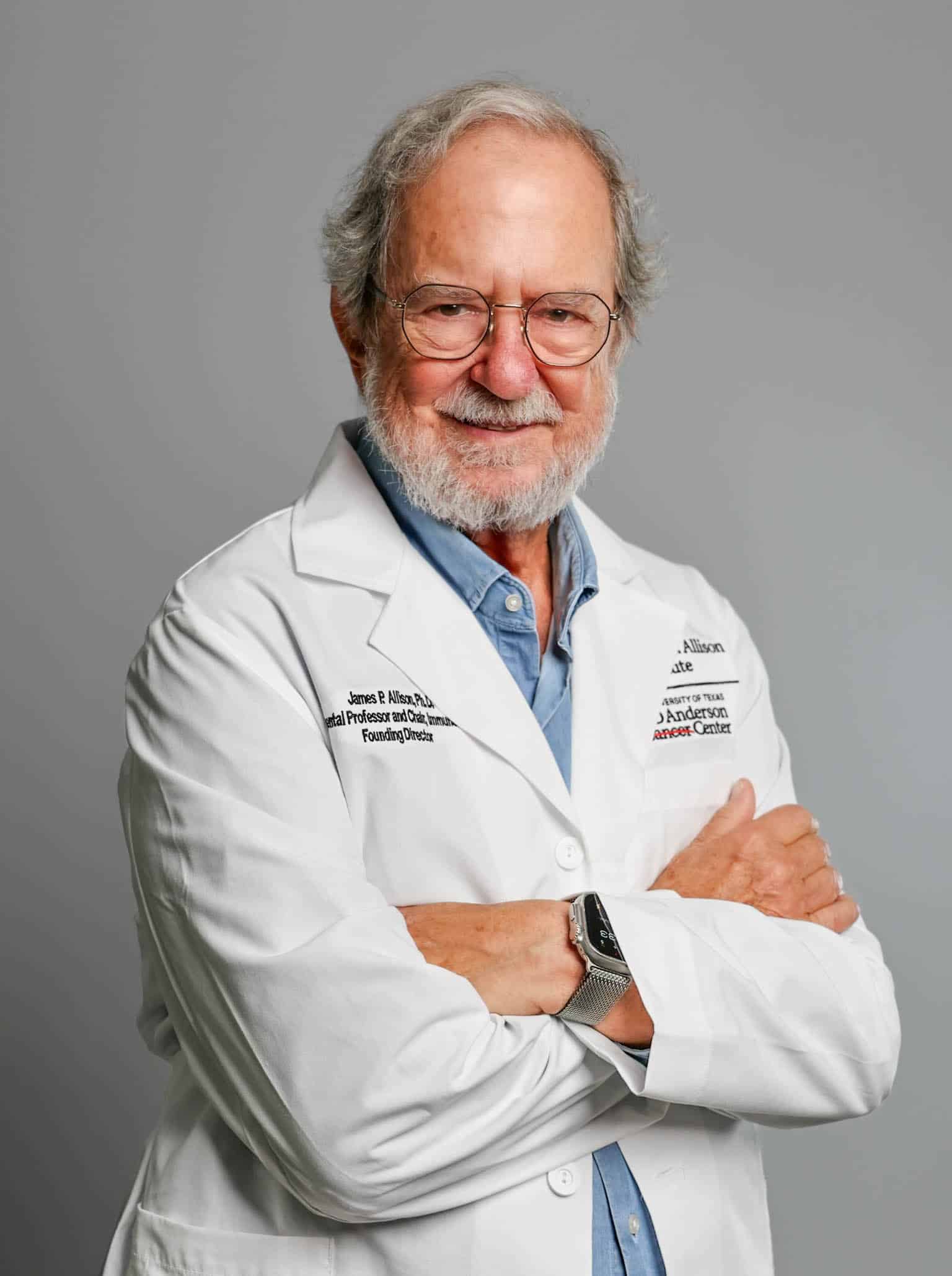
James P. Allison, PhD, FAACR, Honored With the 2026 AACR Award for Lifetime Achievement in Cancer Research
SAN DIEGO – The American Association for Cancer Research (AACR) will present the 2026 AACR Award for Lifetime Achievement in Cancer Research to James P. Allison, PhD, Fellow of the AACR Academy, during the AACR Annual Meeting 2026, to be held April 17-22 at the San Diego Convention Center in San Diego, California.
Allison is the Regental Professor and chair of the Department of Immunology, vice president for immunobiology, and founding director of the James P. Allison Institute at The University of Texas MD Anderson Cancer Center. He is being recognized for his lifelong scientific achievements and transformative contributions to cancer research and patient care. Most notably, Allison is being celebrated for his identification of CTLA-4 as a negative regulator of T-cell activation, an insight that has since been translated into a first-in-class therapy that revitalized the field of cancer immunology and led to a revolution in novel cancer immunotherapy treatments. Built largely on the foundation of his pioneering discoveries, immune checkpoint inhibitors and other cancer immunotherapeutics now represent highly precise and effective treatment options for many cancer patients. Through his landmark contributions to cancer research, as well as his scientific leadership in advancing the future of immuno-oncology, Allison has made and continues to make an unparalleled impact on the cancer field, reshaping its scientific direction and improving the lives of patients worldwide.
The AACR Award for Lifetime Achievement in Cancer Research honors individuals who have made significant fundamental contributions to cancer research, either through a single scientific discovery or a collective body of work. These contributions, whether in research, leadership, or mentorship, must have had a lasting impact on the cancer field and must have demonstrated a lifetime commitment to progress against cancer.
A globally recognized immunologist and Nobel laureate, Allison studies the molecular mechanisms of T-cell receptor activation and the downstream signal transduction events that affect immune system function. Early in his career, he discovered the T-cell antigen receptor, which serves as an “ignition switch,” by recognizing specific antigens and also interacting with costimulatory molecules such as CD28, which function as a “gas pedal” to fully initiate T-cell activation and expansion. His research later led him to discover CTLA-4, an immune system inhibitory checkpoint molecule expressed by T cells, which he hypothesized acted as a molecular “brake” for T-cell activation and immune system function. He subsequently confirmed this hypothesis through experiments showing that a CTLA-4-targeted antibody, developed by his lab, could block CTLA-4 function and enhance immune-cell proliferation. Moreover, inhibition of CTLA-4 function allowed the immune system to recognize and attack cancerous cells, leading to inhibition of tumor growth in preclinical models.
These pivotal results led to clinical testing of the CTLA-4-targeted monoclonal antibody ipilimumab (Yervoy) for the treatment of cancer. Ipilimumab later received U.S. Food & Drug Administration (FDA) approval as a treatment for unresectable or metastatic melanoma in 2011. Since then, immune checkpoint blockade therapies have been approved for more than 20 different cancer types, with some also receiving approval for use in solid tumors that present with certain biomarkers. It is estimated that more than half of patients with cancer in the United States are eligible for an immune checkpoint inhibitor therapy. These major accomplishments have cemented Allison’s status as a quintessential leader in the fields of immunology and immunotherapeutics and resulted in his recognition as one of the recipients of the 2018 Nobel Prize in Physiology or Medicine, alongside Tasuku Honjo, MD, PhD, FAACR. Allison’s current research aims to improve immune checkpoint blockade therapy by identifying new strategies by which to unleash the power of the immune system to eradicate cancer.
Allison has been an AACR member since 2000 and was elected as a Fellow of the AACR Academy in 2014. He served on the AACR Board of Directors from 2014-2017. He has been recognized with the Pezcoller Foundation-AACR International Award for Extraordinary Achievement in Cancer Research (2015), the AACR-G.H.A. Clowes Award for Outstanding Basic Cancer Research (2014), and the AACR-Cancer Research Institute (CRI) Lloyd J. Old Award in Cancer Immunology (2013).
Allison has helped shape AACR’s work through service on numerous AACR committees, including as chair (2014-2015) and member (2016-2018) of the AACR-CRI Lloyd J. Old Award in Cancer Immunology Committee, member of the AACR Clinical Research and Experimental Therapeutics Awards Committee (2012-2014), and member of the Pezcoller Foundation-AACR International Award for Extraordinary Achievement in Cancer Research Committee (2010-2011). He has also served as cochair of the AACR Annual Meeting Program Committee (2015-2016), member of the AACR Council of Scientific Advisors (2014), and member of the AACR Molecular Epidemiology Working Group Steering Committee (2012-2013).
In addition to receiving the Nobel Prize, Allison has been honored with a distinguished collection of honors and awards, with selected recognitions including the Cold Spring Harbor Laboratory Double Helix Medal (2023), the Texas Healthcare & Bioscience Institute Luminary Award (2019), University College London Prize Lecture in Clinical Science (2018), the Albany Medical Center Prize in Medicine and Biomedical Research (2018), the BBVA Foundation Frontiers of Knowledge Award (2018), the King Faisal International Prize (2018), The University of Texas MD Anderson Cancer Center Mike Hogg Award and Lecture (2018), the Dr. Paul Janssen Award for Biomedical Research (2018), the WebMD Health Hero Lifetime Achievement Award (2018), the National Academy of Sciences Jessie Stevenson Kovalenko Medal (2018), the Balzan Prize for Immunological Approaches in Cancer Therapy (2017), the Sjöberg Prize (2017), the Fudan-Zhongzhi Science Award (2016), the Lasker~DeBakey Clinical Medical Research Award (2015), the American Society of Clinical Oncology Science of Oncology Award (2015), the Paul Ehrlich and Ludwig Darmstaedter Prize (2015), the Stand Up To Cancer Phillip A. Sharp Innovation in Collaboration Award (2014), the OncLive Giants of Cancer Care Award for Scientific Advances (2014), the Breakthrough Prize in Life Sciences (2014), the Brandeis University Jacob Heskel Gabbay Award in Biotechnology and Medicine (2011), the AAI Lifetime Achievement Award (2011), the Society for Immunotherapy of Cancer Richard V. Smalley, MD, Memorial Award (2010), the AAI-Dana Award in Human Immunology Research (2008), the CRI William B. Coley Award for Distinguished Research in Basic and Tumor Immunology (2005), and the Aventis Behring Centeon Award for Innovative Breakthroughs in Immunology (2001).
In 2018, Allison became an honorary member of the President’s Council of the New York Academy of Sciences. He has been elected to numerous prestigious societies, including the American Academy of Arts and Sciences, the National Academy of Inventors, the National Academy of Medicine, the Institute of Medicine, the American Association for the Advancement of Science, the National Academy of Sciences, and the American Academy of Microbiology. He is a founding member of the Academy of Cancer Immunology.
He earned his bachelor’s degree in microbiology and his doctoral degree in biological sciences from The University of Texas at Austin and completed a postdoctoral fellowship at Scripps Research, formerly the Scripps Clinic and Research Foundation.
Allison’s award lecture will be held on Sunday, April 19, at 3 p.m. PT.
Download a photo of Allison