A Shared Path Toward Cancer Progress
For 28 years, the American Association for Cancer Research (AACR) Scientist↔Survivor Program®—referred to as SSP—has worked to educate patient advocates about the power of research so they can bring the science back to their communities.
During the program, advocates attend scientific sessions and meet with researchers to discuss the biological underpinnings of cancer. They also present posters to conference attendees, bridging the gap between clinical data and the lived experience of patients.
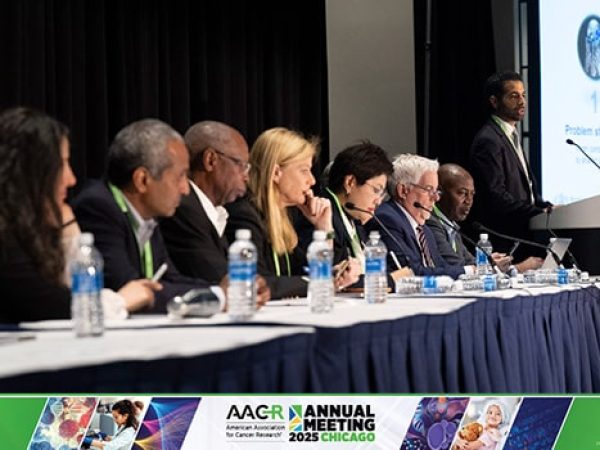
This year, 47 advocates from eight countries and 17 states were selected to attend the AACR Annual Meeting 2026, held April 17 to 22 in San Diego, to learn skills that will allow them to translate highly technical scientific findings into action and impact in their communities. By connecting researchers with survivors and advocates, SSP helps ensure that awareness of breakthrough discoveries moves beyond medical journals to reach the people who hope to benefit from them.

SSP also provides scientists an opportunity to learn from advocates. While researchers track survival curves and hazard ratios, advocates offer the lived experience required to navigate treatment alongside family and professional responsibilities.
“For research to be both scientifically rigorous and meaningful, the people expected to live with the outcome belong in the room to help shape what is asked, what is measured and what is prioritized,” Jill Feldman, a stage 4 non-small cell lung cancer survivor and past SSP participant, said during the meeting’s opening ceremony. Feldman received the 2026 AACR Distinguished Patient Advocacy and Engagement Award. “That is the difference between measurable progress and meaningful progress. But we should celebrate all progress. It is really important.”
Grassroots Education in the Bronx
SSP provides advocates with insight into the science of cancer research, with the hope they will return home and help connect patients to accurate, up-to-date health information. For Colette Smith, an 11-year stage 1 lung cancer survivor, that community is the Bronx. To improve health literacy in her community, Smith has transformed 31 New York City tree beds into hubs for cancer education and health equity by posting QR codes to link passersby to cancer survivor stories and resources. These sites also feature art, flowers, and community libraries. She also has organized wellness events focused on cancer education, screening, and prevention.
She is currently pursuing 501(c)(3) status to transition her HEALing the Bronx initiative into a formal nonprofit organization. This move would enhance her fundraising capabilities and make it eligible for public and private grants as she hopes to scale the program across New York City, she says.

Smith hopes her experience with SSP will provide the scientific framework she needs to scale her impact. “Our community wants factual data,” Smith tells Cancer Today while presenting a poster on her efforts at the meeting. “They don’t want us to be scientists or doctors, but they want us to have some level of awareness because they trust us, especially in our community of Black and Hispanic people.”
After attending SSP sessions on how clinical trials operate, Smith now plans to teach her community about clinical trial eligibility through more events and information at the tree boxes. “If our community doesn’t participate in clinical trials, they are not represented, and they could have different outcomes,” she says.
The Power of Representation
Isabella Mireles, a pediatric cancer survivor and political science major at the University of California, Irvine, echoes this call for representation. SSP offered Mireles an opportunity to better understand her own history with acute lymphoblastic leukemia, which she was diagnosed with at age 2.
“I have never had the opportunity or have never really had the time to sit down and understand, on a biological level, what actually happened to me and how it happened, what effects that it had at a cellular, molecular level,” Mireles says.
Mireles notes that this perspective often remains inaccessible to Indigenous Latinos. Research frequently groups all Latinos together, overlooking unique cultural barriers and the specific needs of subgroups. Her father belongs to the Zapotec civilization of Oaxaca, Mexico, and still speaks his native language. During her poster presentation, Mireles wore a huipil, a traditional, hand-stitched Indigenous garment from Oaxaca, while discussing her research on culturally grounded cancer prevention and screening programs in Indigenous Latino communities in California.

“Oftentimes in public health research, the term Latinos is thrown out there,” Mireles says. “It doesn’t take into account unique experiences, like what it means to be Indigenous. … Indigenous Latinos already face that in their home country because there’s such stigma against being Indigenous. And then once they come to the U.S., they have to face that by the broader Latino community and then also face stigma for being Latino by the broader American community.”
Mireles founded a Blood Cancer United chapter at UC Irvine. She plans on bringing the lessons she learned about the biology of cancer and disparities research to these students.
Understanding the Science of Survival
While Mireles and Smith focus on education and policy, Lisa Haines, a nearly 11-year stage 4 non-small cell lung cancer survivor, is what she terms an “immunotherapy success story” whose disease went into remission after she began taking nivolumab (Opdivo) in December 2015. Haines experienced a full-circle moment at the meeting when she attended a special SSP education session taught by Jedd D. Wolchok, MD, PhD, FAACR, a medical oncologist at Weill Cornell Medicine’s Sandra and Edward Meyer Cancer Center in New York City who helped lead the clinical trials that established immune checkpoint inhibitors as effective cancer treatments.
“I have a little bit better understanding of what goes into a clinical trial, what they’re looking to design, how difficult it is, how much money is involved and why it’s so challenging,” Haines says. “It sounds easy to say we need more clinical trials, but it’s not that easy.”

Armed with a deeper understanding of the research process, Haines will return to what she refers to as her “lung cancer family” with an informed sense of hope. While she has always prioritized empathy, she now plans to offer her peers concrete knowledge about the research process, she says. “I love to support other people,” Haines says. “That’s my passion. Now I’m trying to learn the research and scientific side, but being there for people matters to me.”
SSP aims to make research accessible and ensure advocates maintain a seat at the table in the scientific research community. As Smith puts it, “The science works. That’s where the hope is, and we are going to connect those patients to that science.”
This article was originally published on the Cancer Today website. Cancer Today is a quarterly magazine for cancer patients, survivors, and caregivers published by the American Association for Cancer Research. Subscriptions to the magazine are free.