Cancer Research Meets Artificial Intelligence: The Road to Revolutionized Research
At the AACR Annual Meeting 2026, scientists declared that the AI revolution in cancer research was already underway throughout the field.
“It truly is an AI revolution in cancer research,” said Jakob Nikolas Kather, PhD, MSc, at an AACR Annual Meeting 2026 Plenary Session dedicated to advances in artificial intelligence (AI). Dr. Kather, of the Technische Universität Dresden in Germany, was on the stage to introduce just a few of the speakers who would, over the course of the meeting, lay out the ways that AI has become not just a part of their research but a driver of it.
From AI-powered screening and diagnostic technologies to AI-based research tools that use orchestras of AI agents to conduct complex research processes, the world of AI on display at the world’s largest cancer research meeting was a wide one, involving multiple subdisciplines and a variety of applications.
Many of the tens of thousands of members of the American Association for Cancer Research (AACR) are working together to bring the power of AI to bear on the challenges that cancer poses.
I Spy With My AI: AI-powered Cancer Imaging
At the meeting’s Opening Plenary Session, Regina Barzilay, PhD, of the Massachusetts Institute of Technology, shared the story of how both her life and research were changed in 2014 when she, along with hundreds of thousands of U.S. women, received a diagnosis of breast cancer.
Dr. Barzilay took it as an opportunity to use her own expertise, which had, up to that point, nothing to do with cancer at all—but a lot to do with deep learning, a core technology underlying AI.
Pivoting to cancer, Dr. Barzilay used deep learning techniques to teach a specialized AI system to predict future breast cancer risk from mammogram images, and her work culminated in a model capable of detecting subtle, difficult-to-see changes indicative of cancer’s development.
Image classification is one of the foundational applications for contemporary, deep-learning-based AI, so it makes intuitive sense that, in an era of AI advances, image-based AI systems are being developed and tested widely.
During the Plenary Session dedicated to AI, Faisal Mahmood, PhD, of Harvard Medical School, showcased the ability of his AI system, Apollo, to serve as “an atlas of medicine” based in large part on image data from millions of patients’ histopathology slides (the thin slices of tissue traditionally studied under a microscope).
This histopathology image data was pooled from several hospital systems and combined with a vast amount of supporting health care data to train Apollo. That intensity of training, Dr. Mahmood said, makes Apollo a valuable context tool for clinicians, from comparing similar cases to guiding cancer treatment for individual patients.
Virtual Scientists: AI as a Lab Assistant
As computing power has grown over time, scientists have increasingly brought programs and algorithms to bear on cancer biology, which has augmented researchers’ ability to identify patterns and potential vulnerabilities throughout reams of cancer data. Recent advances in AI have propelled computational approaches to cancer even further ahead, as researchers build and improve context-specific AI models that can help extract valuable hypotheses from datasets. AACR Project GENIE®, long a valuable and esteemed data source for cancer genomics research, hosted several poster sessions throughout the 2026 meeting that allowed researchers to showcase their AI-driven investigations of Project GENIE’s more than 289,000 sequenced samples. With AI analysis, these data have even greater potential to reveal previously unknown connections that can, in turn, help clarify cancer’s highly complex biology.
The computational and analytical abilities of AI were also rolled up into a singular model of an agentic digital scientist that Jure Leskovec, PhD, of Stanford University, presented at the meeting. The model known as Biomni, Dr. Leskovec said, can automatically arrange and run the kinds of data analyses that routinely occupy researchers’ time. In his talk, Dr. Leskovec said that these AI-driven advances in the research process itself could have the potential to speed up the engine of cancer research discovery by supercharging what scientists can accomplish with the data they already have.
AI as a Treatment Guide: Emerging Clinical Applications
Although AI is largely not yet a major force in the clinical bedside setting, the opportunities for the technology to transform treatment are immense, and researchers are already hard at work in designing AI tools aimed at augmenting clinicians’ ability to tailor cancer treatments to individual patients.
Scientists like Tae Hyun Hwang, PhD, of Vanderbilt University Medical Center, are combining genomic analysis with spatial modeling of tumors and response to treatments. This has allowed him to create a system of interconnected AI agents—some of which have their own subagents—that combine to model a patient’s tumor, test the tumor model’s response to different potential therapies over time, and even identify promising clinical trials for which a patient may be eligible given the specifics of their disease.
AI expert and Fellow of the AACR Academy Christina Curtis, PhD, MSc, of Stanford University, agrees that agentic capabilities represent a promising new array of possibilities for cancer research.
“We can have AI agents that perform certain tasks that have different toolkits,” she said, “so you can have AI agents that work on very different workflows, even collaborating. You can set this up in an automated fashion, and that’s what’s hugely exciting.”
Where the Revolutionary Road Leads: The Future of AI in Cancer Research
In thinking about what comes next for the field, Dr. Curtis emphasized the utmost importance of data quality and proper evaluation.
“Without benchmarks to evaluate how these AI tools perform to establish metrics, we will not know how well they do and where we should deploy them,” she said. “This is a global initiative, and it is one that involves many stakeholders. And because the technology is evolving so very rapidly, we need to get to this sooner than later. The models are only going to be as good as the data we give them.”
Progress does indeed continue at a rapid pace, but AACR will be there on the frontier of AI-powered research developments to facilitate collaborations. In March of 2027, the AACR Data Science and Artificial Intelligence in Oncology Conference will unite researchers from a wide range of backgrounds to share expertise and exchange views on how to best deploy AI in the fight against cancer.
“I anticipate that AI is going to have transformative effects on how we do research,” said Dr. Curtis, a cochair of the upcoming conference. “It already is.”
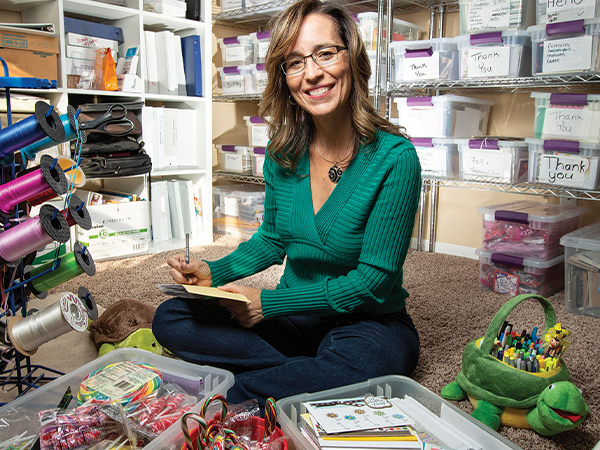
Brain cancer survivor Lanette Veres started the Gray Matters Foundation, a nonprofit that provides encouragement to brain tumor patients through gift packages and cards. Read Lanette's story and the stories of other cancer survivors.
Learn More
Learn about physician-scientists and cancer researchers like Fellow of the AACR Academy Lewis C. Cantley, PhD, who are driving progress against cancer.
Learn More