Smart Chemotherapy Gets Smarter: Advances in Antibody-drug Conjugates
Since the turn of the millennium, antibody-drug conjugates (ADCs) have come to occupy a substantial niche in the world of targeted cancer treatments, with 14 ADCs approved to treat several cancer types by the U.S. Food and Drug Administration (FDA) at the time of this writing.
An earlier installment of Cancer Research Catalyst’s “What Is” explainer series explored the history, function, and approval landscape of ADCs. Here, we look to the future—and the technologies enabling new ADC designs, improved ADC treatment approaches, and more.
Oncology Origami: Complex ADC Designs
Scalable monoclonal antibody engineering, the technological backbone of ADCs, went scientifically mainstream in the 1970s—but bioengineering has come a long way since then. At the AACR Annual Meeting 2026, the Minisymposium “Advanced Antibody, Conjugate, and Targeted Therapeutic Platforms” showed how new antibody architectures could be used to bolster ADCs’ efficacy.
In a platform called Synthbody, presenter Daniel S. Chen, MD, PhD, of the Synthetic Design Lab, described how a “logic gate” could be built into ADCs by creating antibody structures with several different foldable chains. For comparison, traditional ADCs are built with Y-shaped monoclonal antibodies, which have only three chains: two light chains (the upper arms of the Y) and one heavy chain.
The ADCs that Chen presented, however, had complex geometries constructed with multiple chains capable of folding and unfolding—even as the entire complex of the synthetic ADCs clocked in with molecular weights comparable to traditional ADCs.
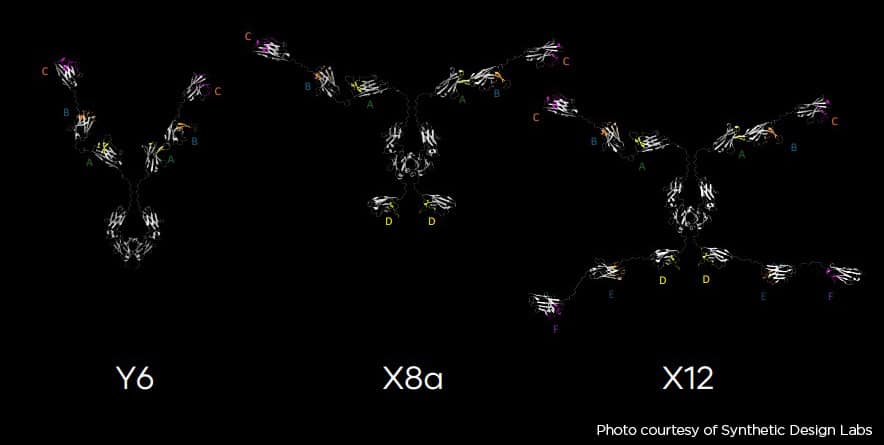
“Because the molecule has a number of different binding domains, we essentially can create these molecules to organize geometric conformations of proteins on the surface of the cancer cell,” said Chen. “And this allows us to create some really interesting conditional binding properties.”
Due to these ADCs’ multiple targeted domains (as many as 12) and foldable arrangement, the payload delivery to a targeted cell can be scaled correspondingly with the targeted cancer markers that the cell expresses, explained Chen.
To illustrate how this arrangement created an embodied ADC “logic,” he gave an example of a synthetic ADC engineered to bind to three different cancer antigens: BCMA, GPRC5D, and CD38. But the ADC’s binding preference among the targets, he said, was not equal. Instead, the folding design created a decision tree for antigen binding:
- if a cell expresses BCMA, the ADC’s BCMA domain binds, allowing for partial uptake and release of the cytotoxic payload;
- once a BCMA domain binds, the GPRC5D domain is pulled in toward the cell surface, allowing for even more binding and payload release if GPRC5D antigens are also present; and
- only if both BCMA and GPRC5D have bound, the domain for CD38 is pulled in toward the cell surface for binding.
This successive binding strategy, Chen said, allows for highly amplified payload delivery within the cells most likely to be cancerous, while potentially mitigating payload release among healthy cells that incidentally express one of the targeted antigens.
He then presented the preclinical data behind the BCMA x GPRC5D x CD38 synthetic ADC design in multiple myeloma cell lines, which showed that the Synthbody ADC achieved levels of payload internalization that were more than four times greater than those achieved by traditional ADCs that targeted either BCMA, GPRC5D, or CD38 individually.
Guilty Bystanders: Antibody-drug Conjugates Target the Tumor Microenvironment
Researchers investigating ADCs consider the bystander effect—which occurs when ADC payloads circulate and kill cells throughout the tumor microenvironment—to be a critical dimension of ADCs’ effectiveness. Recently, some have even begun to design ADCs that target the tumor microenvironment itself.
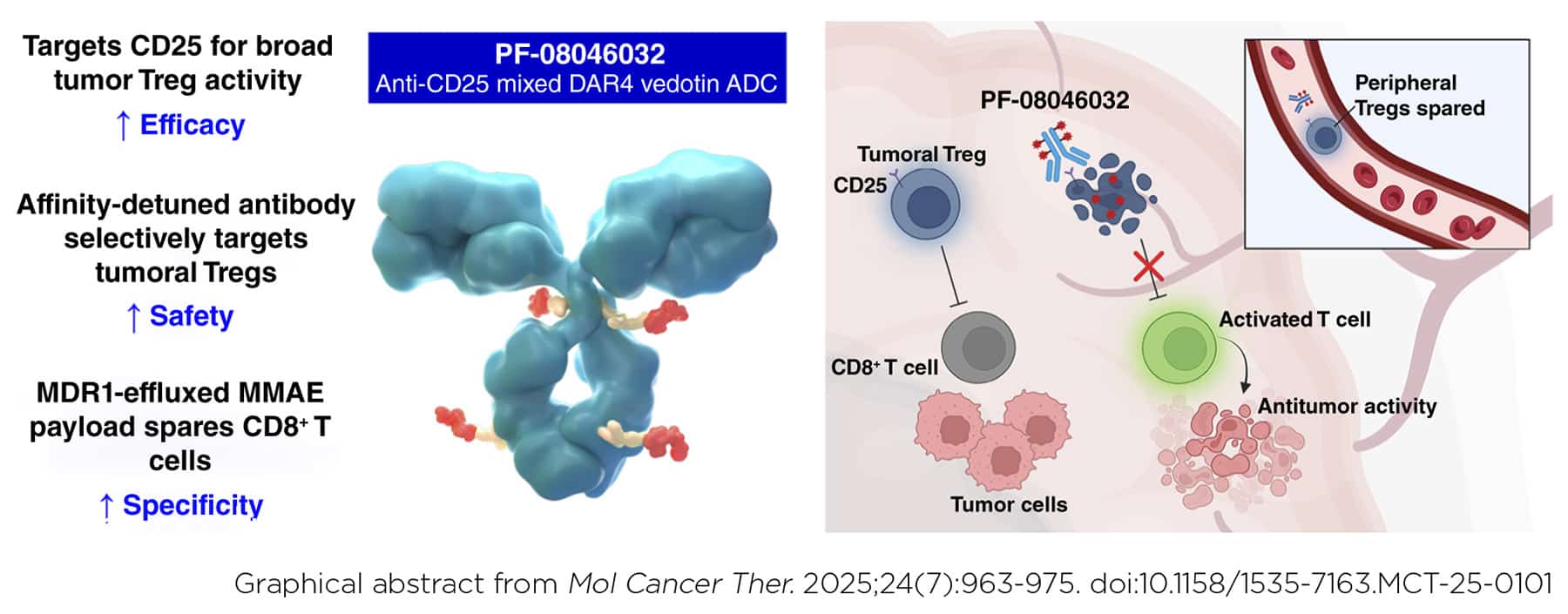
In a paper published in Molecular Cancer Therapeutics, researchers took aim at intratumoral T regulatory cells (Tregs). Tregs are T cells that help keep the body’s immune system from flaring into overactivation by suppressing certain lymphocytes, including the T effector cells that can attack cancer.
Within the tumor microenvironment, tumor-associated Tregs prevent anticancer T-cell activity and enable tumor growth. In the study, the researchers described an investigational ADC designed to attack intratumoral Tregs: PF-08046032. In preclinical experiments, the authors’ ADC preferentially killed intratumoral Tregs and allowed for greater antitumor T-cell activity, leading to dose-dependent slower tumor growth.
And other cells within the tumor microenvironment can also be targeted. Fibroblasts, for instance, are cells that ordinarily provide general structural support and perform functions like collagen synthesis. However, cancer-associated fibroblasts (CAFs) frequently enable tumors by sending immunosuppressive signals and remodeling the extracellular matrix surrounding the tumor. A recent paper from Cancer Research Communications went after uPARAP, a protein implicated in the extracellular matrix of mesothelioma and expressed in CAFs. The research team designed an ADC to target uPARAP and found that it attacked the cancer cells and the CAFs—which led to what the researchers said was likely bystander-mediated killing even in cancer cells with minimal uPARAP expression.
Similarly, a study published in Cancer Research showcased the efficacy of an ADC that targeted SDC1—a protein expressed on certain CAFs that can drive resistance to radiotherapy. The researchers found that an SDC1-targeting ADC inhibited SDC1-positive CAFs, which led to a restoration of both natural killer cells’ anticancer function and tumor sensitivity to radiation.
Making It So: Antibody-drug Conjugates’ Next Generation
The ADC revolution shows no signs of slowing down as more candidates work their way through the clinical trial pipeline. The Clinical Trial Plenary Session “Therapeutic Advances in ADCs” at the AACR Annual Meeting 2026 featured updates from four different clinical trials on ADCs.
In the first presentation, trastuzumab deruxtecan (T-DXd; Enhertu) treatment effectively synergized with olaparib (Lynparza) to treat platinum-resistant uterine and ovarian cancer—a strategy that achieved an objective response rate (ORR) of 46%. Clinical trial results were also presented for three novel, next-generation ADC designs.
Patients who received an investigational EGFR-targeting ADC, SYS6010, experienced an ORR of either 42.9% or 50% (depending on the dose level) for advanced nasopharyngeal carcinoma. A clinical trial that tested QLS5132, an ADC that targets CLDN6, reported a disease control rate (DCR) of 94.4% in patients with platinum-resistant ovarian cancer.

Finally, results were presented for a B7H3-targeting ADC, risvutatug rezetecan, or ris-rez. In patients with nonsquamous non-small cell lung cancer, ris-rez was administered in combination with the investigational immune checkpoint inhibitor adebrelimab, and the trial reported an ORR of 47.1% and a DCR of 94.1%.
These promising results demonstrate the tangible, compelling progress being made in improving ADCs to achieve better results for patients. And exciting as these clinical trial results were, they still represent only a fraction of the growing ADC pipeline.
ADC Accelerants: Strategies to Counter ADC Resistance
As a disease of runaway growth, cancer evolves rapidly to survive, which can lead to the development of resistance to everything from systemic chemotherapy to targeted therapeutics—and ADCs are no exception. Scientists are currently testing a wide array of strategies to ensure that ADCs remain effective against cancer, even in the face of drug resistance.
At the inaugural AACR Drug Discovery and Development (AACR D3) meeting held July 21 to 24, 2026, in Boston, scientists in both academia and industry unveiled several exciting new advancements in ADCs that they hope to see through to clinical trials—from ADCs that target the notorious KRAS oncogene’s upstream modulator, EGFR, to ADCs that incorporate multiple payloads as a way to achieve greater potency and mitigate drug resistance.
Creative ideas for augmenting ADC therapies abound. One elegant possibility for improving ADCs that target human epidermal growth factor receptor 2 (HER2) may be the coadministration of lovastatin, a common cholesterol medication, to increase tumors’ HER2 expression—and, consequently, HER2-targeting ADCs’ ability to bind to and kill them.
T-DXd is another HER2-targeting ADC approved to treat a variety of cancer indications, but for most patients, tumors eventually develop resistance to T-DXd. Cancer can resist T-DXd in a number of ways, which is a challenge, but each of those resistance mechanisms also presents an opportunity.
One study aimed to prevent the protein EGFR from interfering with T-DXd’s ability to enter cells by combining T-DXd treatment with EGFR antibodies. This combination, the researchers found, successfully allowed for T-DXd internalization and restored tumor cells’ sensitivity. A different research team went a step further than ADC-and-antibody combination therapy. They engineered an approach with click chemistry that allows separately administered ADCs and antibodies to “click” together once inside the body. The resulting antibody-ADC constructs, the authors wrote, outperformed ADCs on their own in preclinical experiments.
Another group of researchers focused on a different resistance mechanism to T-DXd: the p95HER2 protein, which is a truncated form of HER2 that T-DXd cannot bind to. The researchers successfully used neratinib (Nerlynx) to degrade p95HER2, which restored the tumors’ sensitivity to T-DXd.
Not all resistance mechanisms are mediated by dynamics on the cellular surface. A paper published in Cancer Discovery aimed to overcome intracellular resistance to ADC payloads. The researchers used exatecan—a highly lethal cytotoxic agent that is less sensitive to multidrug resistance. Previously, the chemical structure of exatecan had made it difficult to use practically in an ADC, but the research team overcame this hurdle with a new linker design. Compared with ADCs made with the more traditional deruxtecan (DXd) payload, the researchers’ exatecan ADC was more successful in treating drug-resistant cancers in preclinical experiments.
ADCs have come a long way from their origins in hamsters, and as the technologies undergirding them continue to improve—from computational augmentation of ADC engineering to methods for predicting their effects on patients—so does their potential to combat cancer.
AACR Annual Meeting sessions are available for virtual viewing for all registered attendees through October 2026.