Party With a Purpose Honors the Power of Immunotherapy
Two decades ago, Robert H. Vonderheide, MD, DPhil, FAACR, director of the Abramson Cancer Center of the University of Pennsylvania and AACR President-Elect was gifted a faux orchid for his office because a colleague noticed he couldn’t keep a real plant alive. Fortunately, for what Vonderheide lacked in horticulture, he made up through his accomplishments as a cancer immunologist and mentor.
One of his most notable mentees is Andrew Rech, MD, PhD, an assistant professor of pathology and laboratory medicine at the University of Pennsylvania, who worked in Vonderheide’s lab when he was an undergrad almost 20 years ago.
Even as an early researcher, Rech distinguished himself through the strength of his science, Vonderheide said while recounting a memorable tale from their early mentor-mentee relationship. “When Andrew was a research technician in my lab, he generated findings strong enough to earn an oral presentation at a major national conference, an opportunity typically reserved for faculty members and senior graduate students. Despite being relatively inexperienced as a presenter, he rose to the challenge and delivered an outstanding talk.”
Today, that faux orchid still resides in the very same office, only now it is sun-bleached, and the office is occupied by Rech.
This year’s Party with a Purpose, an annual philanthropic gala to support the American Association of Cancer Research (AACR), will recognize Vonderheide, the Scientific Achievement Honoree, and Rech, who was nominated by Vonderheide, as the Early Career Investigator Honoree, for their achievements and continued efforts to drive new cancer immunotherapy advances.
Immunotherapy has changed the field dramatically for treating several types of cancers. This approach, which harnesses the body’s own immune system to fight cancer, has given many patients more options, more time, and most importantly, hope when they previously had none. Yet significant challenges remain, including reducing side effects, overcoming resistance, and expanding to additional cancer types.
Cancer Research Catalyst had the opportunity to speak with Vonderheide and Rech about the history of cancer immunotherapy, the importance of philanthropic support for research, and their two-decade mentor-mentee relationship.

What led you to focus on cancer immunotherapy?
Vonderheide: I was first introduced to basic immunology as a graduate student. Coming from a chemical engineering background, I found the basic levers and pulleys of the immune system fascinating. Then I went to medical school, and I realized that immunology was a part of almost all physiology and pathophysiology. Still, at that time, the field of cancer immunology was in its infancy.
During my fellowship, I attended a lecture about the first tumor antigens that were discovered and being described. The attendance at this talk was packed—standing room only—and the energy was thrilling. That was a turning point for me. It was a nice merger between medicine, basic immunology, and translational research.
Rech: For me, it started in college. I had thought I wanted to go to medical school but was encouraged by my biology lab professor to think about graduate school.
So, I took her advice, explored research opportunities, and ended up emailing Bob. I worked in his lab as an undergraduate and was introduced to cancer immunotherapy.
While working in Bob’s lab, I attended a conference where clinical trial results from one of the first immunotherapies were being presented. Thousands of people were there to see the results and learn how successful the therapy had been. It was an exciting experience to be part of that moment.
What do you enjoy most about working in this field?
Vonderheide: Andrew and I, as physicians, have the privilege of caring for patients who’ve been treated with immunotherapies, and some of the results are breathtaking. I’ve met patients who enrolled in early clinical trials for treatments that are now FDA-approved and prescribed around the world. The successes have been remarkable.
What has always fascinated me about immunotherapy is that, unlike many of the treatments we were trained to use in the “before times,” the target often isn’t the tumor cell itself. Instead, the goal is to activate the immune system and enable it to recognize and destroy the cancer. So, you’re not creating the therapy, you’re turning on the body’s own therapy.
And it’s important to remember that these therapies weren’t discovered by magic. When I was in training, chemotherapy was often developed through trial and error. Immunotherapy emerged from a deeper understanding of how the immune system works and how cancers evade immune surveillance. Its success reflects decades of scientific discovery translated into treatments that can transform patients’ lives.
Rech: What I enjoy most in this area is the challenge. Although we’ve made substantial progress, there’s still so much to learn and accomplish. I’m particularly drawn to the idea of curative immunity, where the immune system can completely eliminate a disease. We see this in many infectious diseases, where in most cases the immune system can completely clear any traces of the pathogen. Cancer, however, is different for many reasons that we do not fully understand.
My research focuses primarily on solid tumors, an area where certain immunotherapies have not yet achieved the same level of successes seen in blood cancers. Those successes demonstrate what is possible and motivate me to help bring similar breakthroughs to more patients.
What stood out to you about Dr. Rech and his work when selecting him to receive the Early Career Investigator award?
Vonderheide: It’s a great honor to share this award with Andrew. Since he first contacted me in 2007, it’s been a pleasure to watch his journey from the beginning of his career to where he is today as a faculty member.
The best mentees are the ones who challenge the mentor. They tell you you’re not thinking big enough and push you to explore a different direction or try a new technique. Andrew has always been my guard against becoming stale.
How has your relationship with Dr. Vonderheide influenced your research path?

Rech: Bob has not only taught me a lot scientifically, but he has also been one of the strongest influences on my development as both a researcher and a mentor. His encouragement and example motivated me to work hard and support others.
Interestingly, I learned as much about Bob’s influence from others as I did through my own experiences. Over the years, whenever colleagues learned that I worked with Bob, they would share stories about his leadership, kindness, and dedication to mentoring others. While I had seen these qualities firsthand, hearing how widely respected he was reinforced the kind of scientist and leader I wanted to become. The impact he had, and continues to have, on so many people helped shape my own approach to research and reinforced my commitment to building a collaborative and supportive scientific community.
Can you share specifically how these funds will support your research and the questions you’re hoping to answer?
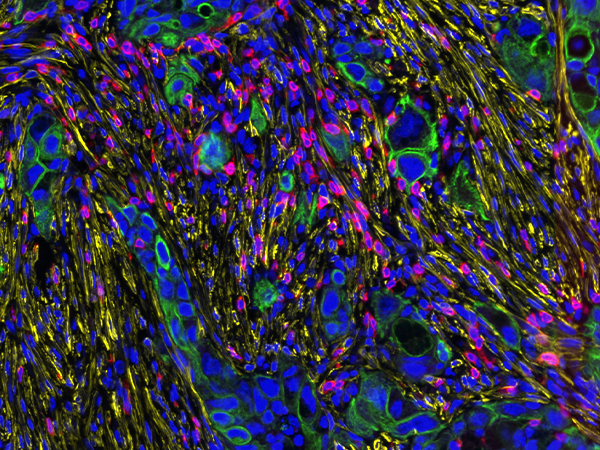
Rech: I am studying the solid tumor microenvironment in settings where chimeric antigen receptor (CAR) T- cell therapy currently has limited success. The two ongoing studies that this award will support focus on prostate cancer and refractory lymphoma, two cancers in which the microenvironment creates barriers to effective T-cell responses. I will use complementary mouse models and computational biology approaches to characterize the cellular and molecular composition of these tumor microenvironments.
This work will investigate how immune suppression and interactions between CAR T cells and other cells within the tumor microenvironment influence treatment response. We will also examine specific features of the tumor microenvironment that may contribute to CAR T-cell resistance.
Why is funding from charities and nonprofits important for advancing research in the current environment?
Vonderheide: Different types of funding and funding sources are catalytic in different ways. Nothing can compare to the sheer vastness of the federal government for funding biomedical research. However, many federal grants require years of experience and substantial preliminary data before investigators are considered competitive applicants.
Foundations, on the other hand, often support research that is more creative, innovative, and higher risk. This emphasis applies not only to the projects themselves but also to the investigators they fund, who are often early-career researchers. Although foundation grants are typically smaller than federal awards, they play a critical role in helping researchers establish and grow their programs.
Rech: I am very appreciative to receive funding from Party with a Purpose. As Bob said, private foundation grants are incredibly valuable to early-career investigators like myself. This award will allow me to generate preliminary data, strengthen my grant writing skills, and gain experience managing research funds, all of which will prepare me to compete for larger federal grants. Ultimately, this support will help position me for future funding success and provide an important foundation for establishing an independent research lab.