AACR and Kids Beating Cancer Launch New Grant to Advance Pediatric Leukemia Research
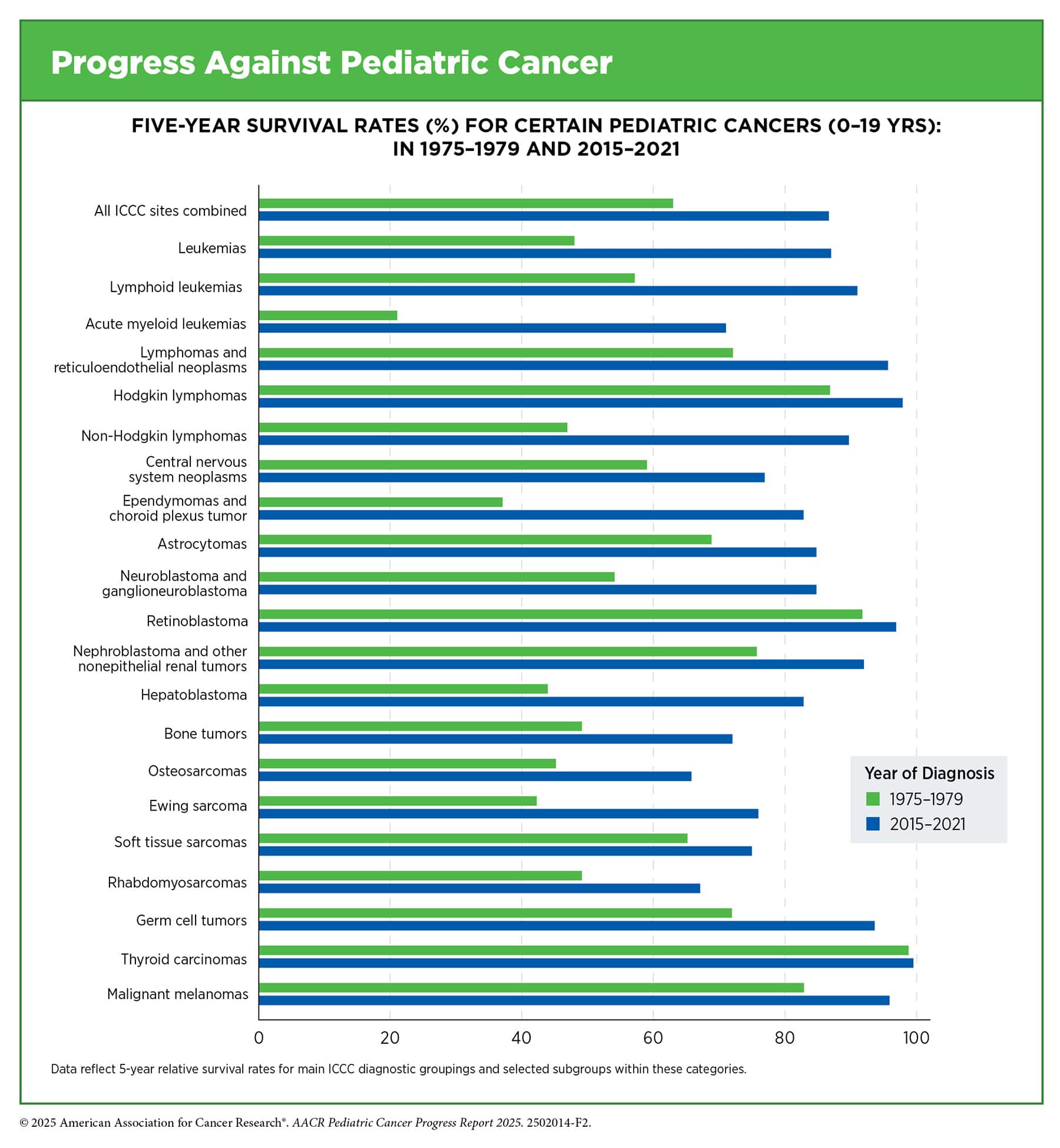
Decades of scientific advances have transformed outcomes for many children with cancer. The five-year survival rate for pediatric cancer increased from 63% in the 1970s to 87% in 2015-2021, with rates exceeding 90% for certain types. Continued growth will require sustained investment in pediatric cancer research and collaboration.

In 2025, the American Association for Cancer Research (AACR) published its inaugural AACR Pediatric Cancer Progress Report, the first of its kind to focus on advances in pediatric oncology. The report highlights how innovative research has contributed to new U.S. Food and Drug Administration (FDA)-approved therapies, resulting in life-saving treatments for children with cancer.
The report also underscores the challenges that remain. Despite the progress in recent years, cancer remains the leading cause of death in children, and many pediatric cancers lack effective treatment options. Advances have also been uneven across cancer types, leaving some patients with limited options.
Pediatric cancers are fundamentally different from adult cancers, yet funding has not always reflected the unique challenges of studying and treating these diseases. Dedicated research efforts are needed to better understand their underlying biology and develop more effective therapies.
The report also highlights the need for greater investment in rare pediatric cancers, expanded access to clinical trials, and stronger global and public-private partnerships. These efforts could help address disparities in pediatric cancer diagnosis and outcomes.
Sustaining Progress Through Action: New AACR-Kids Beating Cancer Grant
Today, AACR and Kids Beating Cancer launched a new research grant to support pediatric leukemia research. The grant was announced at the AACR Special Conference in Cancer Research: Bridging Discovery and Clinical Impact in Pediatric Cancer, held September 22-25 in Philadelphia, and will support research aimed at improving outcomes for children with high-risk acute myeloid leukemia (AML) subtypes.
“Through this grant, we will support innovative research that advances our understanding of pediatric leukemia and other childhood cancers,” said Annie A. Huang, PhD, one of the cochairs of the conference and a senior neuro-oncologist with the Pediatric Brain Tumour Program at the Hospital for Sick Children in Canada. “We are particularly grateful to Kids Beating Cancer for making this opportunity possible and helping us bring new resources to researchers pursing important questions in pediatric cancer.”
Leukemia is the most commonly diagnosed childhood cancer. Approximately 20% of leukemias are AML. Although survival rates for pediatric AML have improved over the past three decades, certain AML subtypes continue to have poorer outcomes. A deeper understanding of these high-risk subtypes could help identify new treatment approaches.
This new collaborative grant honors the legacy of Margaret Guedes, chief executive officer and founder of Kids Beating Cancer, whose son died from AML with monosomy 7, a rare and aggressive subtype. Nearly 30 years ago, Guedes was inspired by her son’s courageous journey and established the nonprofit to support children with cancer and their families. The AACR-Kids Beating Cancer Margaret Guedes Monosomy 7 Legacy Cancer Research Grant will provide $300,000 over three years to support research that will shed light on poorly understood AML subtypes, such as monosomy 7, where significant unmet clinical needs persist.
“This grant will help researchers investigate the unique biology of this disease, identify vulnerabilities that may lead to new therapeutic targets, and address the continuing challenges of treatment resistance and relapse,” said Ian Henrich, PhD, chair of the Kids Beating Cancer Scientific Advisory Board. “We hope this grant becomes a catalyst—by giving an exceptional researcher the resources to translate laboratory discoveries into clinical applications, helping provide more options, more time, and more hope to those affected by this devastating disease.”
Advancing pediatric cancer research requires both bold science and resources to bring promising ideas forward. “We’re bringing together AACR’s scientific leadership and global research community and Kids Beating Cancer’s deep commitment to children and families. Together, we can transform donor generosity into carefully selected, high-impact research with the potential to reach children everywhere,” explained Henrich.
Guedes continued, “Thirty-five years after my son died, we still have no cure for AML with monosomy 7, few effective treatment options, and one of the lowest survival rates among pediatric leukemias. We believe this partnership with AACR will help change that.”