Cracking “Undruggable” Cancer Proteins: Precision Oncology Meets p53
Historically, certain cancer-driving proteins—such as KRAS—have been postulated to be “undruggable” based on their structural qualities, including the lack of binding pockets that could accommodate small-molecule drugs. After decades of basic research, the dogma has been upended by the discovery of previously unrecognized vulnerabilities that enabled the development of mutant-specific therapeutic strategies for KRAS-driven cancers.

Two KRAS G12C inhibitors are now approved by the U.S. Food and Drug Administration for treatment of specific types of lung and colorectal cancer. This breakthrough provided impetus for developing a broader class of drugs that block multiple forms of the RAS protein rather than targeting one specific mutation. The first of these drugs, daraxonrasib (Rasonque), recently hit the market after approval for pancreatic cancer.
In a previous post, we reviewed the milestones in the development of RAS inhibitors and discussed the transformative research of Kevan M. Shokat, PhD, FAACR, the scientist whose pioneering chemistry helped unlock KRAS as a drug target.
Using a similar approach, Shokat has joined other researchers working to solve the next big challenge in drug discovery: tackling p53, the most frequently mutated protein in human cancer.
Cancer Research Catalyst continued the conversation with Shokat—a professor at the University of California, San Francisco (UCSF) and at the University of California, Berkeley, and a Howard Hughes Medical Institute investigator—to bring you the latest research directions, the status of clinical research, and the next frontiers for scientists in this field.
The Most Frequently Mutated Gene in Cancer
The p53 protein was discovered in 1979 and was initially mistaken for an oncoprotein. Later research clarified that it was indeed a tumor suppressor protein, and arguably the most important one in the cell. Its role in sensing cellular stress and DNA damage and halting cell division to allow for the damage to be repaired—or triggering cell death if damage is too severe—earned it the designation of “guardian of the genome.” Loss of p53 function strips a major barrier to malignant transformation, giving p53-mutated cells a strong selective advantage.
TP53, the gene that encodes for p53, is mutated in approximately 50% of human cancers, making it the most frequently altered cancer-associated gene.
Evolution of p53-targeting Approaches
Considering how widespread p53 mutations are and the crucial functions the protein plays in the cell, it is only logical that targeting mutant p53 has been a longstanding goal since its discovery.

However, as an intracellular protein with no obvious pockets for drug binding, it has been widely considered undruggable, and scientists have focused their efforts on different directions, for example replacing the missing or dysfunctional p53 through gene therapy approaches to reinstate the anticancer barrier. Preclinical studies confirmed that restoring p53 activity had antitumor effects, but this strategy proved challenging to translate to clinic due to a number of obstacles, including low delivery efficiency and limited duration of transgene expression.
Researchers then tried a different approach: dialing up wild-type p53 function by inhibiting its degradation. Many cancers retain wild-type TP53 but suppress p53 expression through upregulation of its inhibitor MDM2, which normally ensures p53 gets rapidly degraded once its job is done. This understanding led to the development of compounds to block the p53-MDM2 interaction or inhibit MDM2 function. These compounds did in fact induce tumor-cell death but failed to show clinical benefit due to toxicity associated with unselective p53 activation in normal tissues.
Lessons From KRAS: The Importance of Following the Genetics
While scientists in the p53 field struggled to overcome those challenges, the breakthrough in targeting KRAS by focusing on a particular amino acid introduced by the G12C mutation offered new inspiration.
“I think the KRAS experience reinforced the importance of following the genetics,” said Shokat, suggesting that the winning approach to unlocking KRAS and p53 is to focus on the specific mutants found in cancer cells, rather than trying to inhibit KRAS as a whole or increase the overall expression of p53.
“Until we had the KRAS inhibitors, there was always a slight disconnect between the major oncogenes and their targeting. For genes like KRAS, for which we didn’t have a drug, it seemed like the genetics was sitting there, but we couldn’t quite get our hands on it,” continued Shokat. “Once we knew how effective KRAS inhibitor therapies could be, it made us think, okay, now let’s keep looking at the human genetics and force ourselves to be really creative on the chemistry side. The next frontier was obviously p53, because there is no bigger gene in human cancer genetics than that.”
Shokat emphasized how going after mutant p53 helps bypass the issue of activating the protein in healthy cells and causing cell death and toxicity. “Since the mutant-specific approaches only hit tumor cells, you are already wiping out the potential toxicity of targeting wild-type p53,” he said. “You don’t actually need to worry what wild-type p53 does, because you’re not touching it.”
Conceptually, as a tumor suppressor, p53 was the “ultimate undruggable,” Shokat noted. However, unlike most tumor suppressor genes that are deleted or truncated, resulting in loss of protein expression, TP53 is affected by point mutations that result in the production of a full-length, nonfunctional protein. “Luckily, p53 is not absent in cancer cells, but carries point mutations in certain hotspots.”
Once we knew how effective KRAS inhibitor therapies could be, it made us think, okay, now let’s keep looking at the human genetics and force ourselves to be really creative on the chemistry side. The next frontier was obviously p53, because there is no bigger gene in human cancer genetics than that.
A p53 mutant called Y220C, a well-known cancer-associated hotspot variant in which a tyrosine amino acid residue (Y) is replaced by a cysteine (C) at codon 220, caught the attention of different laboratories.
The Y220C mutation results in the creation of a crevice on p53’s surface that reduces the protein’s stability at body temperature and compromises p53 signaling, which in turns drives tumorigenesis.
Looking at the mutant through a chemical biology lens and leading from their experience targeting the KRAS G12C mutant, Shokat’s lab saw a drug development opportunity presented by the mutant cysteine residue. “Of the 20 natural amino acids, cysteine is the most chemically reactive. Its properties allow us to make covalent bonds in a very selective way,” explained Shokat. “So once we see a cysteine in a target, we immediately think, okay, let’s take a chemical approach that makes a covalent bond to that cysteine.”
Described in a paper from 2023 published in Cancer Discovery, the team developed compounds that covalently react with the mutant cysteine to restore the thermal stability of the mutant and reinstate p53 wild-type activity in cancer cells that carry the mutation.
Another group of researchers took a structure-based approach to design a novel class of small molecules able to sit in the mutation-induced pocket and stabilize the p53 Y220C mutant, thereby inducing cell death in cancer cell lines that carried the mutant.
P53 Goes Pop(t): A New Drug Class Takes Shape
Taking a similar approach, scientists from the biotech company PMV Pharma created an optimized, orally bioavailable noncovalent molecule called PC14586. The preclinical characterization of this molecule—now known by the generic name of rezatapopt—and its ability to restore wild-type p53 function were initially reported at the AACR Annual Meeting 2021. Another study published in 2025 in Cancer Discovery confirmed that rezatapopt treatment reactivated p53, induced cell cycle arrest and expression of p53 target genes, and inhibited tumor growth in mouse models.
The drug entered clinical testing with the phase I/II PYNNACLE trial in heavily pretreated patients with p53 Y220C-mutated solid tumors. Phase I results showed an overall response rate (ORR) of 20% among all patients across multiple tumor types and 30% among those who had a KRAS wild-type tumor and received rezatapopt at a dose of at least 1,150 mg once daily.
Initial analysis of the phase II part of the trial, discussed at AACR-NCI-EORTC International Conference on Molecular Targets and Cancer Therapeutics in 2025, demonstrated an ORR of 34% in heavily pretreated patients across tumor types with Y220C mutant p53. Notably, responses were observed in 22 out of 48 (45.8%) patients with ovarian cancer. All the patients who experienced a response had a reduction in mutant p53 circulating tumor DNA (ctDNA), implying specific activity of the drug on its target, p53 Y220C.
Staying One Step Ahead of Therapy Resistance
As rezatapopt advances in clinical development, scientists are already tackling the mechanisms of resistance to the drug. Shokat was among the authors of another recent Cancer Discovery study that assessed ctDNA from patients enrolled in the PYNNACLE study who experienced cancer progression while receiving rezatapopt. The analysis revealed multiple secondary TP53 mutations that impaired p53’s function or interfered with the binding of rezatapopt to mutant p53, essentially impeding p53 reactivation.
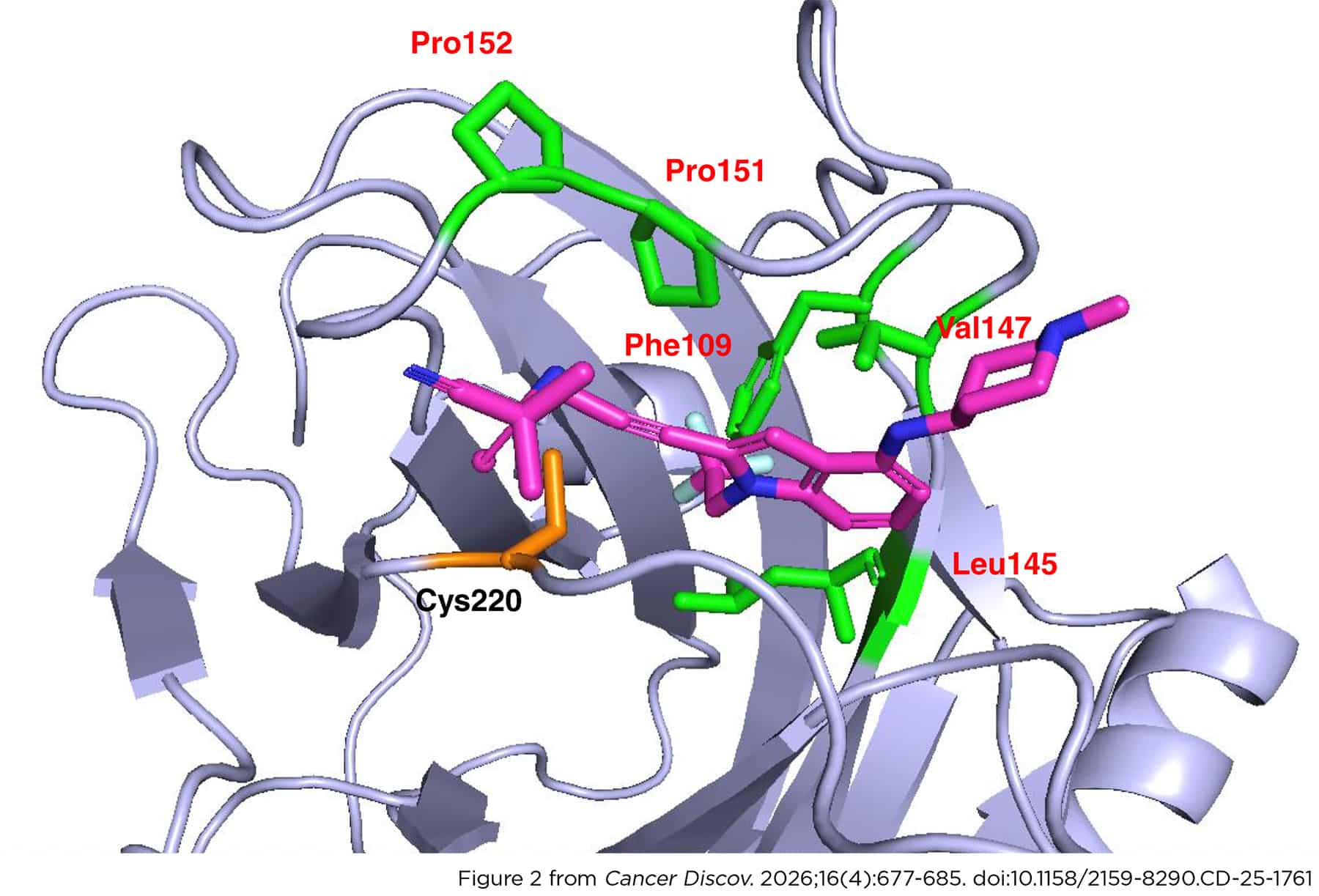
“I think if we just reactivate p53 in a mutant cell, it gives the tumor a chance to just ‘fix’ the problem by acquiring additional mutations,” commented Shokat. “If we add a KRAS inhibitor at the same time, for example, it could narrow the chance. I think it is going to need a combination approach right up front.”
Looking Ahead
Shokat likened the current stage of research in the p53 field to 2018 in the KRAS field, when the first KRAS inhibitors were showing promise in the clinic.
“Now that researchers see that it is possible to target p53 Y220C, they are expanding to lots of possibilities,” he said. “We now have drugs against all the KRAS mutants, and I think that is what will come for p53 in the next couple of years—I think rezatapopt will really jump start the race to target all the other mutants.”