Camizestrant Granted Accelerated Approval in Combination Therapy for Certain ESR1-mutated, HR-positive Breast Cancers
The approval marks the first ctDNA-guided cancer therapy.
The U.S. Food and Drug Administration (FDA) has granted accelerated approval to camizestrant (Etcamah) in combination with a CDK4/6 inhibitor (either abemaciclib [Verzenio], palbociclib [Ibrance], or ribociclib [Kisqali]) for adults with hormone receptor (HR)-positive, human epidermal growth factor receptor 2 (HER2)-negative, locally advanced or metastatic breast cancer upon detection by circulating tumor DNA (ctDNA) of a mutation in the estrogen receptor-1 (ESR1) gene during treatment with an aromatase inhibitor and a CDK4/6 inhibitor.
Most HR-positive breast cancers depend on signaling through the estrogen receptor (ER) to form, grow, and spread. Patients with HR-positive breast cancer are commonly treated with aromatase inhibitors, which help reduce the levels of estrogen in the body. However, HR-positive cancers often become resistant to these therapies by developing mutations in ESR1, the gene that encodes the ER. The mutant ER is able to signal even in the absence of estrogen, thereby allowing cancers to keep growing.
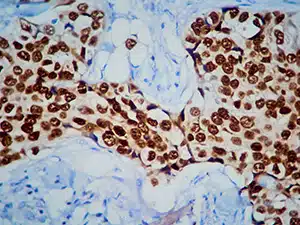
Camizestrant is a selective estrogen receptor degrader (SERD), a type of therapeutic that results in the degradation of ER, thereby reducing estrogen signaling. Camizestrant degrades both wild-type and mutant forms of ER. The preclinical characterization of camizestrant was published in Cancer Research, a journal of the American Association for Cancer Research (AACR), in 2023.
CDK4/6 inhibitors slow or block tumor growth by targeting certain proteins that regulate cell division.
This is the first FDA approval for camizestrant, which is the first FDA-approved cancer therapy to depend upon ctDNA-based mutation detection without the need to first observe radiographic progression. Because it can be isolated from a blood sample, ctDNA—fragments of DNA from tumor cells that can be detected in patients’ bloodstreams—allows for noninvasive monitoring of cancer, including the detection of resistance-conferring mutations.
The approval was based on results from SERENA-6, a randomized, double-blind, placebo-controlled, multicenter phase III clinical trial. Results from an early-phase trial, SERENA-1, were published in Cancer Research and provided support for the dosage evaluated in SERENA-6. Additionally, interim results from SERENA-6 were presented at the San Antonio Breast Cancer Symposium 2025, which is co-organized by AACR.
SERENA-6 enrolled 315 adult patients with ER-positive, HER2-negative breast cancer with ctDNA-detectable ESR1 mutations who were receiving combination therapy in the form of an aromatase inhibitor with a CDK4/6 inhibitor. Patients must have been receiving the combination therapy for at least six months, with no evidence of disease progression. On a 1:1 basis, patients were randomly assigned to switch to camizestrant with a CDK4/6 inhibitor or continue to receive an aromatase inhibitor (anastrozole or letrozole) with a CDK4/6 inhibitor.
After a median follow-up of 12.6 months, the median progression-free survival (PFS) was 16 months in the camizestrant arm, compared with 9.2 months in the aromatase inhibitor arm—which represents a 56% reduction in the risk of progression or death among patients who received camizestrant. At the time of the analysis, overall survival data were not yet mature.
The label for camizestrant carries a boxed warning for arrythmia when used with ribociclib or other drugs that cause the heart to require more time to reset between beats (an effect known as a prolonged QTc interval).
The recommended dose of camizestrant is 75 mg daily, administered orally via tablet, until disease progression or unacceptable toxicity. CDK4/6 inhibitor therapy should be continued alongside camizestrant at the same dosage and frequency as when the ESR1 mutation was detected.
Breast cancer is, apart from nonmelanoma skin cancer, the most common cancer in women in the United States. Most cases of breast cancer, about 70%, are HR-positive and HER2-negative. According to federal statistics, it was estimated that 321,910 individuals would be diagnosed with female breast cancer and 42,140 patients would die of the disease in the United States in 2026.
The FDA rendered its decision on September 4, 2026. Accelerated approval means that continued approval may be contingent upon a confirmatory trial. Please check this FDA web page for information about any accelerated approvals in oncology that may have been subsequently withdrawn and are no longer FDA-approved. Check this resource for updated information on all therapeutics regulated by the FDA.