First Approved Treatment for Adults with High-risk Smoldering Multiple Myeloma
The FDA approved daratumumab and hyaluronidase-fihj for adults with smoldering multiple myeloma that has a high risk of progression.
The U.S. Food and Drug Administration (FDA) has approved daratumumab and hyaluronidase-fihj (Darzalex Faspro) as a monotherapy for adults with high-risk smoldering multiple myeloma.
Daratumumab, a monoclonal antibody, targets the protein CD38, which is highly expressed on the surface of abnormal plasma blood cells, such as those that comprise multiple myeloma. Binding of daratumumab to CD38 leads to cell death. The hyaluronidase-fihj element of the treatment partially breaks down the extracellular matrix around cells so that daratumumab can reach CD38-expressing cells more effectively.
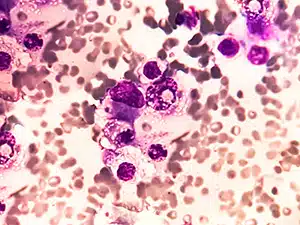
Daratumumab and hyaluronidase-fihj were previously approved to treat active multiple myeloma and a plasma cell disorder known as light-chain amyloidosis. The latest approval makes it the first treatment approved to treat smoldering multiple myeloma, a slow-growing, asymptomatic precursor to active multiple myeloma. Smoldering multiple myeloma is normally managed with active monitoring.
The new approval is based on results from the open-label, randomized, multicenter phase III AQUILA clinical trial. The trial enrolled 390 patients with high-risk smoldering multiple myeloma, who were randomly assigned (1:1) to either a control group—in which they received no treatment but were actively monitored—or a treatment group that received subcutaneous daratumumab and hyaluronidase-fihj.
Daratumumab and hyaluronidase-fihj significantly reduced the risk of smoldering multiple myeloma progressing to active multiple myeloma, as those who received the treatment were 51% less likely than those in the control arm to see their disease progress during the follow-up time of 72 months. The median progression-free survival was not reached in the treatment arm, which means more than half of the patients in this arm had not developed multiple myeloma during 72 months of follow-up. In contrast, half of the patients in the control arm had their disease progress to multiple myeloma within the first 41.5 months.
Daratumumab and hyaluronidase-fihj is administered as a subcutaneous injection in the abdomen. The recommended dose is 1,800 mg of daratumumab with 30,000 units of hyaluronidase.
Multiple myeloma develops within the bone marrow when excessive abnormal B cells accumulate and form tumors throughout multiple bones. Smoldering multiple myeloma is an asymptomatic, slow-growing condition that can progress to active multiple myeloma, and one study showed that the cumulative probability of progression after 15 years was 73%. The National Cancer Institute estimated that, in the United States, 36,110 individuals would be diagnosed with multiple myeloma and 12,030 patients would die of the disease in 2025. A recent measure of smoldering multiple myeloma incidence in Canada showed 1.4 cases per 100,000 people.
The FDA rendered its decision on November 6, 2025. Check this resource for updated information on all therapeutics regulated by the FDA.