Caring for Evan
27-year-old Grace Kennedy shares her experience caregiving for her late husband, Evan Knaff.
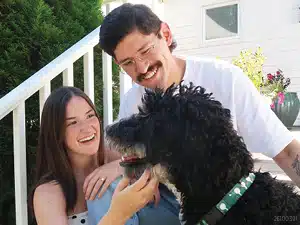
In October 2022, I was living in Boston after graduating college, while my boyfriend, Evan, lived in Pennsylvania near my family and would visit as often as possible. Early in the month, he had complained about discomfort in his right hand, a numbness in his thumb that spread to his wrist. Urgent care determined that it was likely carpal tunnel syndrome and sent him home with information and wearing a wrist brace. He didn’t let it get in the way of our visit.
Back home about 10 days later, Evan went out for a training run for the Philadelphia Half Marathon. Roughly 10 minutes in, his right foot kept dropping. He returned to urgent care, and they referred him to orthopedic urgent care.
Later that month, we had plans to travel and visit with friends. Evan still wore the wrist brace, experienced occasional headaches, and his foot dropped more frequently during the trip. We were concerned, so Evan agreed to leave work early the next day and go to the emergency room.
I flew back to Boston on a 6 a.m. flight and went straight into a full day at the office. I kept up with Evan over text as he left work and headed to the ER. On my walk home that evening, I realized I hadn’t heard from him in over an hour. His last message said they were going to run some tests. Eventually, Evan called. When I answered, all I could hear were shallow, uneven breaths. I instantly knew he was crying.
I asked what was wrong. “They found a tumor on my brain,” he said.
His symptoms had concerned the ER team enough that they immediately ordered bloodwork and a head CT, which quickly revealed the tumor. Based on that first scan, they felt hopeful that it might not be fully in his brain, but rather pressing into it. At the time, I didn’t understand why that distinction mattered, but I clung to it because it sounded hopeful.
I booked the first flight back to Philadelphia. It was a 7:35 p.m. flight and it was already approaching 6 p.m. but, somehow, I made it in time.
That night, Evan was transferred to the Jefferson Hospital for Neuroscience in Philadelphia and shortly after had undergone a total resection of the tumor. Immediately after surgery, he showed promising signs of movement on his right side. However, numerous complications in the days that followed required about a week of varying levels of sedation and ventilation due to a series of seizures. The hardest moments remain burned into the backs of my eyelids.
After a two-week stay at Jefferson, Evan was transferred to a rehabilitation hospital to strengthen his right side. But the week of sedation, 17-pound weight loss, and significant brain swelling made it unclear how much strength he could ultimately regain.
He did not return home for another month, spending Thanksgiving in the hospital with his brother and a meal cooked by my mother. His only request was to be home by Christmas, and he made it with 10 days to spare.
My first lesson in this beast of a disease was that brain cancer does not behave like other cancers, nor is it treated the same way. Our first call with Evan’s oncologist opened an entirely new world of terminology and concepts. I didn’t know chemotherapy could come in pill form. I didn’t know someone could undergo radiation to the brain five days a week for six weeks straight. I didn’t know the difference between gliomas and astrocytomas came down to the origin of the mutated cells.
After that call, I was fairly certain of one thing: I never wanted to be caught off guard again.
Caregiving itself was never foreign to me. I had watched family members grow old and grew up as an older sister to four younger siblings. What I could never have anticipated, though, was becoming the primary caregiver for my previously healthy, 24-year-old boyfriend of five years.
I realize now that moment set me on the coping path I would follow for the next three years. I was deeply uncomfortable with how little I knew. Evan, meanwhile, didn’t want to know more than what his doctors told him. Since there was no cure for us to hold onto as hope, I clung to information instead.
In the early weeks after diagnosis, the story I told people included every detail—every doctor’s note, every medication dosage and schedule, every word Evan said. I wanted to stay firmly planted in reality. I resisted leaning too heavily into optimism and qualified every positive development with “for now.” I refused to surrender that realism because I was terrified that denial would prevent him from receiving the care he needed. Over time, the story evolved into a concise summary of his symptoms, surgery, treatment plan, and current progress.
When people asked how I was doing, my answers were really descriptions of how Evan was physically responding to treatment. Looking back, I realize that being able to recount every detail of the chaos surrounding his diagnosis and surgery gave me a sense of control. If I couldn’t change what was happening, at least I could prove to myself, and to others, that I understood it. I spent countless hours researching, reading studies, and combing through online forums and support groups while simultaneously helping manage Evan’s treatment, symptoms, and side effects. For a girl with a political science degree, I held my own better than I expected.
Evan remained strong for three years and tolerated radiation, chemotherapy, and eventually immunotherapy with remarkable resilience. His spirit carried us through those years, and that spirit was learned. He had spent 15 years watching his mother live with cystic fibrosis, and after her passing, her appreciation for life became his blueprint for living.
His courage carried both of us, and it still carries me now.
If you ever met Evan, it was easy to picture him as a father. He dreamed of raising children, owning more dogs, and spending more days at the beach. He dreamed of watching his best friend marry the love of his life. He dreamed of seeing his father grow old with less stress and watching his younger brother move through every stage of life.
This disease stole many of Evan’s long-held dreams. However, we were lucky enough to fulfill one of them: He became a husband. We were married in November 2025, earlier than we had planned. And less than three weeks later, Evan was gone.
Until the end, he held tightly to two things: singing and sass.
In his final months, even as his speech declined, Evan could still sing along to nearly any song. At our wedding, “Pink Pony Club” somehow became his anthem as his best friends lifted him and his wheelchair into the air while he sang every word proudly.
And in his final days, his most common reaction was a raised eyebrow followed by the slightest smirk, certainly his way of making sure everyone knew he was still in there.
After spending three years clinging to information, refusing to look away from the disease, and forcing myself into a constant staring contest with death, I didn’t expect to feel shocked when he died. Theoretically, I should have been prepared. I had rehearsed every hypothetical in my head and convinced myself I knew how I would survive each outcome.
But I learned very quickly that the human mind cannot truly imagine death.
And in some ways, I’m grateful for that. Evan’s actual passing was gentler and more peaceful than anything I had prepared myself to witness. But no amount of preparation could lessen the gut-wrenching reality of watching someone take their final breath while fighting every instinct to save them.
You cannot rehearse the logistics of your husband being carried out of your home less than a month after your wedding. You cannot perfectly prepare the words you will use when calling a father into the room to tell him the exact time his son died.
No amount of anticipatory grief softens the grief itself, or the death, the funeral planning, the receiving line full of hugs, or the unbearable void left behind. I rarely spoke openly of this. It felt too raw and too intimate to share, as if acknowledging it aloud might somehow hasten it.
Even now, my grief feels deeply personal, almost like my final act of caring for him.
Any amount of caregiving carries a physical, emotional, mental, and social toll that cannot truly be quantified. Caregiving through a terminal diagnosis is a losing battle filled with frustration. Anticipatory grief and grief after loss are simply two sides of the same coin.
Since December 2025, nearly all of my energy has centered around Evan—the loss of him and the future he should have had without this disease. That remains the core of what I think about, write about, and talk about.
In recent months, largely with the help of my therapist, Alex (everyone should have an Alex), I’ve started extending some of that same care and compassion toward myself and the weight I carried.
Often, my thoughts become tangled in the truth that I would not change anything about being the person who cared for Evan. It was an honor to walk with him through the end. Because of that conviction, I sometimes struggle to separate the meaning I found in caring for him from the brutality of the experience itself.
But in clearer moments, I can recognize how profoundly awful it is that either of us had to endure that, especially at this age.
A 26-year-old should not be measuring morphine at 2 a.m. She should not be lifting a 190-pound man off the floor after he falls out of bed. She should not be learning how to interpret MRI reports.
I can already see how those experiences will reverberate through the rest of my life: through my health, my future relationships, my future children, and the way I will experience aging and illness in the people I love.
Unfortunately, many caregivers never get the chance to breathe, let alone attend therapy regularly or reflect deeply on the emotional and psychological toll caregiving takes on them.
I can see now that with stronger, more consistent caregiver support, Evan would have received even better care. I may not have developed stress-related health complications. Evan may have worried less about being a burden. I may have spent more time simply being with him and less time desperately trying to learn everything about the disease taking him from me.
Without strong support systems, caregivers often don’t know which questions to ask or what information they truly need. At the time of diagnosis, cancer is a black hole of the unknown. No one gets the luxury of turning away from it and hoping for the best. It’s our responsibility to try to ease the process the best we can for those around us and help them see the light.
Whether you are a patient, survivor, caregiver, or loved one touched by cancer, your story can have an enormous impact. You can provide hope and inspiration to someone recently diagnosed with cancer or a patient undergoing therapy.
SHARE YOUR STORY
Learn about physician-scientists and cancer researchers like Fellow of the AACR Academy Lewis C. Cantley, PhD, who are driving progress against cancer.
Learn More
There are many ways in which you can lend your talents to support lifesaving research. Learn how you can become an advocate for cancer research, participate in events to raise awareness, volunteer your time, and share your story of how cancer has affected your life.
Get Involved