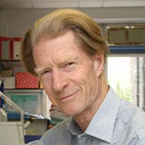
Sir John B. Gurdon, DPhil, FAACR, emeritus professor of cell biology at Cambridge University who shared the Nobel Prize for Physiology or Medicine in 2012 for his discovery that mature adult cells can be reprogrammed to a pluripotent state, died October 7, 2025. He was 92 years old.
In 1962, Gurdon published the results of experiments in which he replaced the nucleus of a frog with the nucleus of a mature cell from the intestine of a tadpole. The embryo that resulted grew into a clone of the tadpole, indicating that the nuclei of specialized adult cells still hold the potential to become any other type of cell. The discovery led to years of research on the phenomenon of reprogramming and has had major implications for a variety of diseases.
Born October 2, 1933, in the English hamlet of Dippenhall, Gurdon graduated from Oxford University in 1956 and received his doctorate in 1960. After postdoctoral study at California Institute of Technology, he returned to Oxford as a lecturer in zoology in 1962. He moved to Cambridge University and its Laboratory of Molecular Biology in 1972 and later became a professor of cell biology in the Department of Zoology.
When the Wellcome Trust/Cancer Research UK Institute was founded at Cambridge in 1989 to explore the relationship between cancer and developmental biology, Gurdon was named founding chairman. It was renamed the Gurdon Institute in his honor in 2004.
Gurdon received a knighthood in 1995. Among other honors, he was a fellow of the Royal Society (1971), foreign honorary member of the American Academy of Arts and Sciences (1978), a foreign associate of the National Academy of Sciences (1980), and a foreign member of the American Philosophical Society. He received the Wolf Prize in Medicine in 1989 and the Albert Lasker Award for Basic Medical Research in 2009. Gurdon shared the Nobel Prize with Shinya Yamanaka.
Career Highlights
2012 Nobel Prize in Physiology or Medicine
2009 Albert Lasker Basic Medical Research Award
1995 Knight Bachelor
1990 Elected Foreign Associate, French Academy of Sciences
1989 Wolf Prize in Medicine
1987 Emperor Hirohito International Prize for Biology
1985 Fullerian Professor of Physiology and Comparative Anatomy, Royal Institution
1985 Royal Medal, The Royal Society, London, United Kingdom
1984 Priz Charles Leopold Mayer, French Academy of Sciences
1983 Elected Foreign Member, American Philosophical Society
1980 Elected Foreign Associate, National Academy of Sciences, Washington, DC
1978 Elected Foreign Honorary Member, American Academy of Arts and Sciences
1977 Paul-Erlich-Ludwig-Darmstaedter Prize
1971 Fellow of the Royal Society
1960 D.Phil., Oxford University