Apps and Acupuncture: Improving Breast Cancer Survivors’ Quality of Life
Cancer patients long for the day when they have completed treatment and hear the words: no evidence of disease. But even after cancer is gone, it doesn’t always mean its impact on the patient’s life is over. Young adult cancer survivors, in particular, face elevated social risks like insecure access to food and housing compared to their peers without cancer and older cancer survivors. In breast cancer specifically, studies have shown that survivors under 50 are more likely to have worse long-term quality of life and suffer from more severe or frequent depressive symptoms than survivors over 50. But what if there was an app to help with that—and it had been tested in a clinical trial?
At the San Antonio Breast Cancer Symposium (SABCS) 2025, Ann H. Partridge, MD, MPH, of the Dana-Farber Cancer Institute, presented results from a randomized clinical trial studying the effectiveness of a mobile health (mHealth) tool designed to help young adult breast cancer survivors self-manage their symptoms and concerns.
“While many acute physical complaints resolve following initial treatment, the long-term physical, emotional, and psychosocial impact on a young woman’s life trajectory may worsen or only become evident in survivorship, when much less attention is paid to them from the health care system,” Partridge, who founded and directs the Program for Young Adults with Breast Cancer at Dana-Farber, said in a press release.
Given that the incidence of young women with breast cancer is on the rise while mortality rates among these patients are significantly declining, Partridge and her colleagues saw a need to develop an accessible and scalable solution to help the growing population of young adult breast cancer survivors. They designed the Young, Empowered & Strong (YES) mHealth tool to deliver tailored support to women based on their own electronic patient-reported outcomes (ePROs).
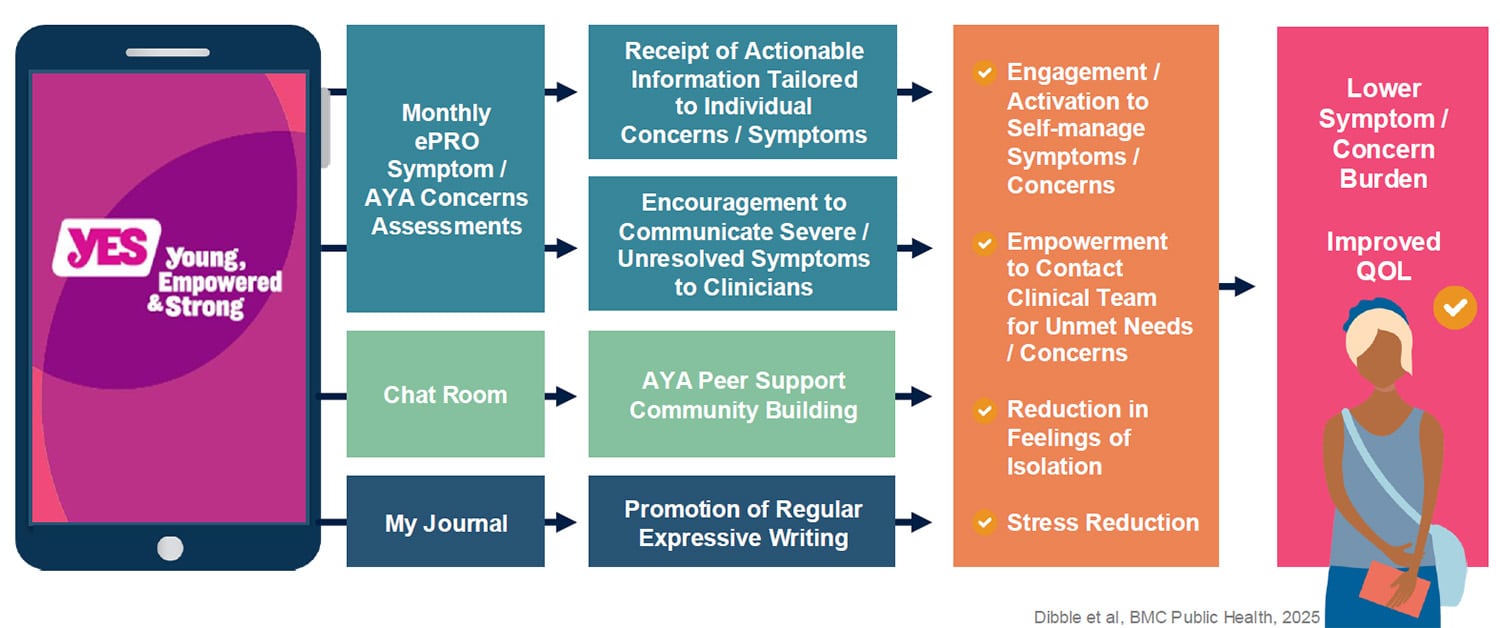
For instance, if a woman mentions feeling anxiety, pain, or menopausal symptoms then the tool—which is available as an app or web portal—will provide specific information and resources for dealing with those symptoms. Similarly, the tool can also offer support for common concerns among young adult breast cancer survivors, including financial problems, fertility questions, and body image issues. Other features of the mHealth tool include an expressive writing platform and a monitored group chat room for peer support.
“This is important in many ways,” said Virginia Kaklamani, MD, codirector of SABCS who moderated a press conference in which this study was presented. “There is all of this information online that [patients] seek, so it is nice for them to have something that is approved by the physicians to be able to get potentially more accurate information.”
Can an App Improve Quality of Life? The Answer Is YES.
In a multicenter randomized controlled trial of YES, 360 women between the ages of 21 and 39 were enrolled who had been diagnosed with stage 0-3 breast cancer within the last three years. At the start of the trial, each woman completed the Quality of Life in Adult Cancer Survivors (QLACS) questionnaire, which looks at both general well-being (i.e., fatigue, pain, social relationships, and sense of purpose) and cancer-specific issues (i.e., concerns about recurrence, changes in appearance, sexual problems, and the impact of cancer on outlook on life).
After six months, those in the YES arm showed greater improvement in both general and cancer-specific quality of life. Mean QLACS scores for general quality of life improved by 8.7 points in the YES arm vs. 1.6 points in the usual care arm. For cancer-specific quality of life, scores improved by 7.8 points in the YES arm vs. 3 in the usual care arm. Partridge called the results “paradigm changing.”

“Most interventions using ePROs that have shown benefit have been with patients undergoing active therapy with high clinician effort, and now we have shown that a low-touch intervention with limited clinician input can improve outcomes important to patients,” she explained. “This type of intervention has the potential to improve the health and well-being of several other hard-to-reach populations, such as busy young adults and rural Americans who are less able to engage in person with cancer center resources and support.”
In addition to quality of life, the trial also evaluated whether YES could help alleviate other common symptoms that young breast cancer survivors face, including fatigue, depression, arm pain, vaginal issues, hot flashes, nausea, bladder control, musculoskeletal pain, cognitive problems, and weight problems. Of those, only arm and vaginal symptoms saw significant improvement in those who used YES, along with a modest—but not statistically significant—improvement in fatigue. Partridge said they plan to examine if YES can be improved to better address all these symptoms in the future.
Can Acupuncture Relieve Chemo Brain?
Another study presented at SABCS 2025 tested acupuncture to improve cognitive symptoms in breast cancer survivors. Cancer-related cognitive difficulties, which can sometimes be referred to as “brain fog” or “chemo brain,” affect an estimated 40% of breast cancer survivors.
These types of cognitive difficulties contributed to what Francine Quazza described as a “long way back to health” following the completion of her treatment for stage 2 breast cancer. In addition to trouble sleeping and constant fatigue, she also found it difficult to complete thoughts and tasks to the point where she limited herself to concentrating on just one responsibility each day.
“If you were to ask me a question, it would take me a really long time to finish that answer because my brain speed just wasn’t there anymore,” Quazza explained. “And this was at a time when I was trying to raise my newborn son, teach him how to talk, and get him into all these different programs.”
Quazza tried intravenous vitamin therapy, exercise, eating a healthy diet, among other things, but nothing worked.
“Unfortunately, there are very few treatments that are backed by evidence for this problem,” said Jun J. Mao, MD, MSCE, of Memorial Sloan Kettering Cancer Center, in a press release.
But as Mao and his colleagues previously discovered, insomnia has been associated with cognitive difficulties in breast cancer survivors, and acupuncture could improve insomnia. So, they designed the randomized phase II ENHANCE trial to see if acupuncture could also be effective at addressing cognitive issues. Instead of only comparing acupuncture to usual care, they also included sham acupuncture, a placebo procedure used in clinical research that involves placing needles at locations not considered classic acupuncture points without penetrating the skin.

“Just believing you’re receiving a helpful treatment and engaging in relaxation by lying down for 20-30 minutes can have potential therapeutic benefits even if the needles aren’t inserted or aren’t placed in specific therapeutic points,” Mao explained. “By comparing real acupuncture to sham acupuncture, and not just to usual care, we were able to better understand whether the benefits were due to the acupuncture technique itself or to the overall experience.”
Mao and his colleagues recruited 260 breast cancer survivors over the age of 18 (the mean age was 56.6) and randomly assigned them to receive real acupuncture (129), sham acupuncture (70), or usual care (61). Throughout the trial, the perceived cognitive function of participants was measured using the Functional Assessment of Cancer Therapy – Cognitive Function (FACT-Cog PCI) survey, which asks patients how they feel their memory, attention, and ability to perform daily tasks have been affected; while objective cognitive function was evaluated via the Hopkins Verbal Learning Test-Revised (HVLT), which uses standardized tasks to measure memory, learning, or attention performance.
Mao pointed out that often a patient’s perception about their cognitive abilities does not match what the objective tests find. In fact, at the start of the trial, only 30% of participants who reported cognitive difficulties met the criteria for objective cognitive impairment based on HVLT results.
“This mismatch highlights the importance of using both tools together as they provide a more complete picture,” Mao explained.
How Effective Is Acupuncture?
After 10 weeks, real acupuncture and sham acupuncture demonstrated similar—and clinically meaningful—effectiveness at improving perceived cognitive difficulties. FACT-Cog PCI scores improved 10.3 points in the real acupuncture arm, 10.5 points in the sham acupuncture arm, and 4.8 points in the usual care arm.
When it comes to improving objective cognitive function, however, real acupuncture was significantly better than sham acupuncture with a 4-point difference in HVLT scores. But in this case, real acupuncture performed similarly to usual care with one exception. In the subset of participants who tested for objective cognitive impairment at the beginning of the trial, real acupuncture showed a promising trend in improving memory compared with usual care and sham acupuncture. Given this finding was in a limited number of patients, Mao noted it would need to be validated in a larger trial.
So, what should breast cancer survivors take away from this trial? To needle or not to needle?

“While this trial showed that acupuncture’s ability to improve a patient’s perceived cognitive difficulty is likely due to the process of receiving acupuncture care rather than specific needling techniques, it is still reasonable for women with breast cancer to try a course of acupuncture to see if it can help improve their sense of cognitive difficulty,” Mao concluded.
Mao also indicated that one of the encouraging things about acupuncture is its lasting benefit. While patients can receive acupuncture for extended periods of time, the first 10 to 12 sessions are what matters the most, he said.
Quazza also expressed that the effects have lasted even though she is no longer receiving acupuncture—and the impact has made a huge difference in her life.
“My cognitive function is better,” she said. “I am able to multitask again. I’m sleeping great—getting 6 to 8 hours every night—so I no longer feel exhausted or cranky, which also means I can get more stuff done each day, including spending more time with my kids.”
For those who have registered for the symposium, sessions may be viewed on the SABCS virtual platform through March 31, 2026.