From the Bench, Fall 2026: Virtual Cells, Talking Cells, Eating Cells, and More
Somehow, 2026 is already drawing to a close, but scientists have remained busy as ever when it comes to innovating creative approaches to cancer research. In this year’s final installment of “From the Bench,” our quarterly series featuring cancer research approaches of notable ingenuity, Cancer Research Catalyst has assembled a roundup of fascinating preclinical studies, with many focusing on new approaches to bioengineering—from adding albumin to monoclonal antibodies to prevent the placental transport of certain cancer drugs during treatment, to activating the anticancer potential of tumor-associated macrophages.
Keeping Fetuses Drug-free: Blocking Placental Transport of Some Cancer Therapies
Although relatively uncommon, cancer can occur during pregnancy; unfortunately, pregnancy can present distinct challenges for cancer treatment due to the risk of potent, monoclonal antibody-based cancer therapeutics crossing from expectant mothers’ systems to fetuses via the placenta.
A study published in Science Immunology, however, presented a potential method for blocking monoclonal antibodies—including antibody-drug conjugates (ADCs)—from traversing the placenta.
Because most monoclonal antibodies are based on immunoglobulin G (IgG) subclass and contain the fragment crystallizable (Fc) region, they can bind to the neonatal Fc receptor (FcRn), which allows for maternal-fetal transfer. However, the authors found, this binding could be blocked with the addition of a single protein: albumin.
By fusing the IgG antibodies with albumin, the most abundant protein in the blood plasma, the researchers significantly reduced maternal-fetal transport in mouse models. The team then used an engineered form of albumin that was designed to enhance its binding to FcRn; by fusing this engineered albumin with the antibodies’ fragment antigen-binding regions, the researchers were able to administer the altered antibodies to mouse models with minimal fetal exposure.
Though for now limited to a mouse-model proof-of-concept, the research could potentially lead to a minimization of fetal exposure risks for certain therapies, the authors wrote.
A Virtual Cancer Cell: AI Helps Researchers Predict Breast Cancer Drug Responses
Finding the right cancer treatment can be like solving a puzzle. Even breast tumors that look similar under the microscope can respond differently to the same drug. This challenge is especially pressing for triple-negative breast cancer (TNBC), an aggressive subtype that lacks common therapeutic targets, leaving fewer treatment options.

Could artificial intelligence (AI) help researchers piece together why some drugs work while others fail? In a study published in Nature, researchers developed ProteinTalks, an AI-driven virtual cell model trained on millions of protein measurements to predict how cancer cells respond to different drugs.
To build their virtual cell, the researchers collected more than 38 million protein-abundance measurements from 18 breast cancer cell lines treated with 63 approved anticancer drugs and 59 drug combinations. Importantly, they measured protein levels at multiple time points, capturing how cancer cells changed over time in response to treatment rather than providing a single snapshot. This dynamic approach allowed the model to learn patterns linking changes in protein levels to cellular responses.
When tested on 81 different drugs, ProteinTalks predicted responses with 85% accuracy and identified proteins associated with drug resistance in cancer cell lines. But could it pass the ultimate test: Predicting how real patients’ tumors respond to treatment? Using pretreatment tumor samples from patients with TNBC, the model’s predictions matched actual treatment outcomes. Finally, using patient-derived models to screen 3,000 compounds, the virtual cell platform correctly identified treatment regimens that were shown to be clinically effective.
ProteinTalks is still a prototype, and more research is needed before it can help guide treatment decisions in the clinic. Still, the model supports how AI could help researchers identify promising drug candidates, investigate treatment resistance, and uncover new possibilities for more personalized care.
Local Anesthetic Tells Talking Tumor Cells to Keep Quiet
As tumors grow, they shape the biology around them to their own purposes. In order to create favorable conditions for itself, cancer has to take action, and tumors do this by communicating through molecular signals.
Protumor signaling can involve the peripheral nervous system when a tumor establishes a communication pathway between itself and nerve cells to influence its microenvironment toward cancer-favoring conditions like immunosuppression. But a recent study from Cell Reports Medicine demonstrated a possible way to disrupt crosstalk between cancer cells, neurons, and immune cells with a simple intervention: the local anesthetic bupivacaine.

The researchers developed their strategy when they observed that 32 out of a cohort of 68 patients with colon cancer had a high density of cholinergic nerve fibers (networks of neurons that communicate via the neurotransmitter acetylcholine) within and/or around their tumors—an involvement that was associated with worse overall survival in early-stage colon cancer.
A subsequent analysis of a colorectal cancer dataset, confirmed in further lab experiments, revealed that higher tumoral expression of cholinergic signaling markers was associated with lower anticancer T-cell infiltration and higher CD68-positive macrophage infiltration, suggesting an immunosuppressive role for cholinergic signaling. Subsequent tests with colon cancer cell lines showed that increased levels of acetylcholine enhanced cancer cell proliferation.
Enter bupivacaine, a long-used local anesthetic that blocks interneuronal communication. Using a hydrogel form of bupivacaine to keep the drug in place around tumors, the researchers found that the drug shifted the tumor microenvironment toward a more immunologically active state. And in preclinical models of colon cancer, bupivacaine enhanced the anticancer effectiveness of both chemotherapy and immune checkpoint inhibitor therapy—suggesting that the addition of this anesthetic to treatment may improve treatment efficacy.
Close Encounters: A New Approach for Delivery of Targeted Cancer Therapy
Certain cancer drugs, such as ADCs, rely on the cancer cells’ ability to “swallow” them after they bind to tumor-specific target antigens present on the cell surface, a process called receptor-mediated endocytosis. Once inside the cell, the ADCs undergo enzymatic or chemical degradation that results in the release of the toxic drug payload.
However, many antigens do not readily get pulled inside the cell when bound by an ADC and therefore do not serve as ideal targets for drug-conjugate approaches. This drastically limits the repertoire of antigens available for this therapeutic modality.
In a study published in Nature, a group of researchers found a way to bypass this bottleneck through a strategy called “binding-to-release” (BTR) that allows for targeted drug delivery independently of receptor-mediated endocytosis.

For this strategy, inspired by induced proximity-based therapeutic modalities, a membrane-permeable payload is attached to the target-binding part (ligand) of the drug through a special linker designed to be stable and not get cleaved in the blood circulation, to prevent unwanted toxicity to normal cells. Then, when the drug reaches the tumor cell, upon binding of the ligand to the target receptor, the linker is positioned in proximity to a reactive amino acid in the receptor, which triggers a chemical reaction called phosphorus(V)-phenol exchange (PhoPEx). This reaction allows for release of the payload that can then freely enter the cell without the need for active transport.
The researchers tested the BTR strategy by producing a prototype drug molecule that targeted the fibroblast activation protein (FAP), a cancer antigen that is highly expressed on cancer-associated fibroblasts with minimal expression on normal tissues and that is poorly internalized through receptor-mediated endocytosis.
In animal models, treatment with the FAP-BTR-small molecule drug conjugate resulted in nearly six times higher payload exposure in the tumors than with a comparable internalization-dependent FAP-targeted small molecule drug. The FAP-BTR-conjugate led to near-complete tumor regression in preclinical tumor models.
The authors then successfully applied BTR to target the PD-L1 protein in preclinical studies, indicating that the BTR strategy could be extended to other therapeutic targets.
Putting Cancer Cells on the Menu: Targeting Macrophages for Immunotherapy
Immunotherapy has transformed cancer treatment, but its success often depends on the presence of an active immune response within the tumor. Many cancers are considered immunologically “cold”, meaning they lack the immune activity needed for current therapies to work effectively. While a good deal of cancer immunotherapy focuses on T cells, another immune cell type, the macrophage, represents an attractive target.
Macrophages are the immune system’s professional cleanup crew. Their job is to patrol tissues and engulf harmful invaders, dead cells, and cellular debris through a process known as phagocytosis. However, tumors can hijack these cells, using them to support their growth and survival and help suppress immune responses.
Strategies to target these cells and inhibit macrophage-mediated immune suppression have been actively pursued, but the complex nature of the tumor microenvironment presents significant barriers. As a result, growing interest has shifted toward multitargeting approaches that simultaneously promote antitumor macrophage activity while alleviating immune suppression. In a study published in Cancer Research, scientists developed a molecular bridge to “wake up” the macrophages and eat nearby cancer cells.
The molecule, named phagocytic synapse enhancer (PSE), is constructed with two functional termini. One arm binds PD-L1, an immune checkpoint protein expressed on tumor cells or other cells within the tumor microenvironment that suppresses antitumor immune responses, while the other arm carries tuftsin, a peptide that activates phagocytic cells to engulf targeted tumor cells.
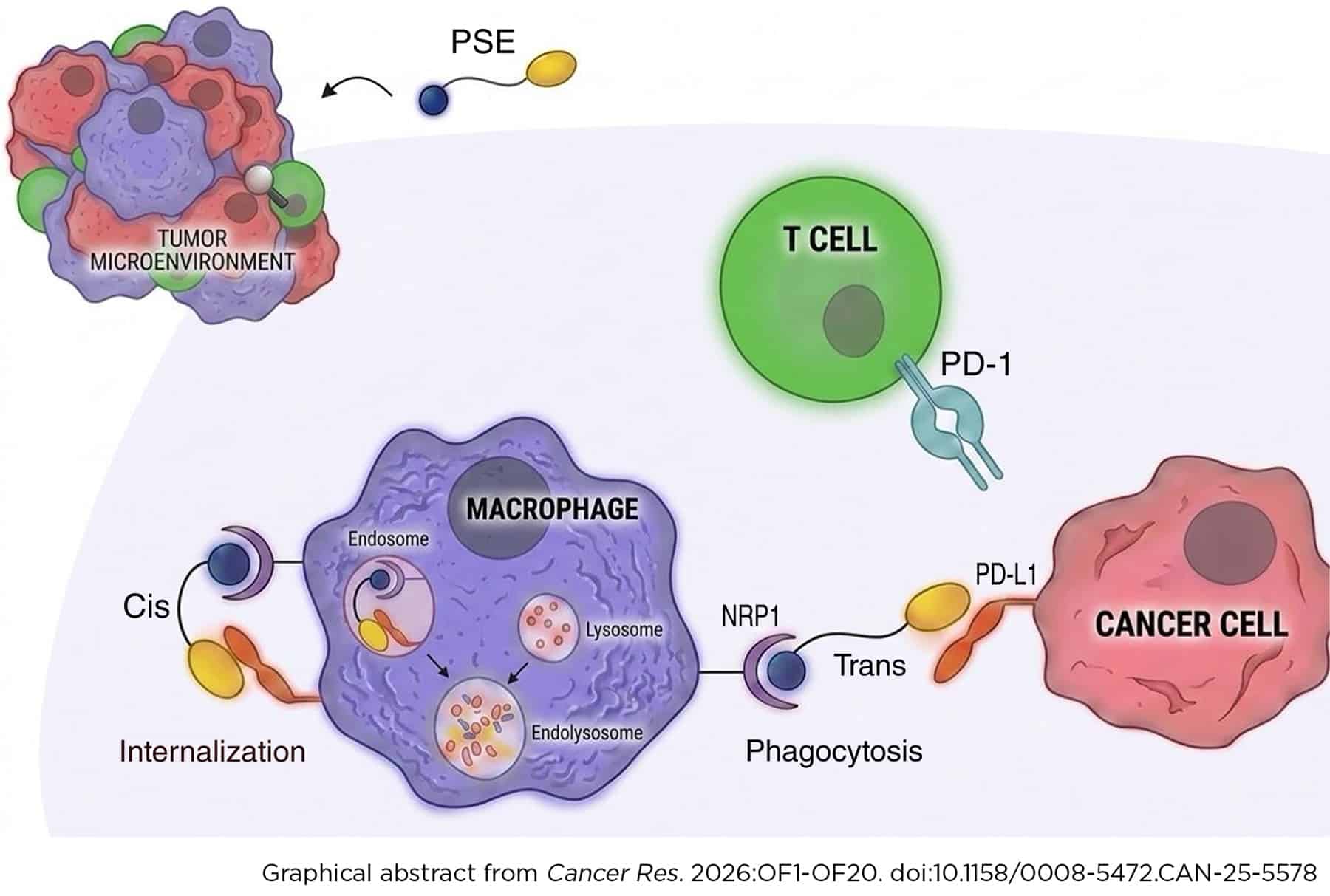
The researchers tested their approach using cell lines, zebrafish, and mouse models. The addition of PSE reprogrammed immunosuppressive macrophages into a more proinflammatory state and increased their ability to clear tumor cells. The PSE also acted directly on macrophages expressing PD-L1, causing PD-L1 to be removed from the cell surface. This reduced local immune suppression by eliminating the important inhibitory checkpoint.
Colorectal and pancreatic cancer are among the most immunologically “cold” tumors. In mouse models of these cancers, PSE treatment slowed tumor growth, improved survival, and enhanced antitumor responses, suggesting that targeting macrophages is a feasible strategy, even in the “coldest” of cancer types.