Editors’ Picks, October 2026: Surgical De-escalation, New CAR T-cell Approaches, and More
Boo! I hope we didn’t scare you too much. Now that you’ve had a moment to recover, grab a handful of Halloween candy and enjoy October’s edition of Editors’ Picks.
This month, we’re highlighting standout cancer research studies published across the 10 peer-reviewed journals of the American Association for Cancer Research (AACR). Explore findings on multiple primary cancers in World Trade Center responders, surgical de-escalation for atypical ductal hyperplasia, a modular chimeric antigen receptor (CAR) T-cell platform, an inhibitor that targets the MEK pathway through alternating on and off cycles, and more.
Treat yourself to this month’s featured research using the links below to access the full-text articles, available free for a limited time. Don’t let this opportunity vanish into the night!
Journal: Blood Cancer Discovery
Chimeric antigen receptor (CAR) technology has revolutionized B-cell malignancy treatment by enabling T cells to effectively recognize and target lineage-specific surface antigens. However, CAR T cells show limited efficacy against myeloid neoplasms and solid tumors due to challenges in identifying suitable surface targets. In this study, we present a CAR targeting the intracellular WT1 oncoprotein, cross-presented by surface HLA class II (HLA-II) alleles. WT1-CAR T cells, derived from an antibody raised solely against a WT1 peptide, recognized the WT1330–348 peptide promiscuously presented by 18 out of 20 tested HLA-II alleles, overcoming traditional HLA restrictions. WT1-CAR T cells specifically recognized leukemic cells in a WT1- and HLA-II–dependent manner and mediated an antitumor response in vitro and in vivo. This approach broadens CAR-targetable antigens beyond traditional HLA restrictions and offers a promising therapeutic option to a wide and genetically diverse patient population.
Significance: Leveraging the promiscuous binding of HLA-II–peptide complexes, we developed a CAR T-cell approach targeting an intracellular oncoprotein WT1 presented across diverse HLA-II families. Our study establishes a framework for CAR therapies against intracellular antigens, extending potential CAR T-cell applications to new cancer types and patient populations.
This article was highlighted in the September issue.
Learn more about how CAR T-cell therapies work and which ones are approved by the U.S. Food and Drug Administration: What Is CAR T-cell Therapy?
Journal: Cancer Discovery

Pancreatic intraepithelial neoplasia (PanIN) precedes pancreatic cancer, a deadly disease characterized by an extensive tumor microenvironment. How the microenvironment evolves during cancer progression is largely unknown, as PanINs are microscopic and nondiseased pancreas samples are exceedingly rare, while adjacent normal samples are disrupted by the presence of malignancy. Leveraging donor organs and spatial technologies, we mapped the evolution of PanIN to cancer. The PanIN epithelial component falls on a continuum with cancer, whereas the PanIN microenvironment is drastically distinct. Progression to cancer is accompanied by profound geographic reorganization of myeloid cells and lymphocytes and the formation of a cancer-specific fibroblast population characterized by high levels of smooth muscle actin, LRRC15, and the WNT signaling component LEF1. Together, our data show asynchronous evolution of epithelial and stromal components during pancreatic carcinogenesis. Lack of stromal reprogramming might explain why most PanINs do not progress to cancer. Compiled data available at https://www.pancreas-precancer-atlas.com/.
Significance: Pancreatic cancer precursor lesions are widely prevalent in the population, but progression to invasive cancer is uncommon. Identifying barriers to cancer progression is critical for cancer interception. Our findings describe unique features of the precancer microenvironment that are likely responsible for keeping precursor lesions from progressing to malignancy.
This article was featured on the cover of the October issue, where it was highlighted.
Journal: Cancer Epidemiology, Biomarkers & Prevention
Background: World Trade Center (WTC) responders were exposed to carcinogens during rescue, recovery, and cleanup operations following September 11, 2001. Although responders have an elevated risk of various primary cancers, they may also have an increased risk of second primary cancers. This study evaluates the incidence of multiple primary cancers among male responders compared with a population-based cohort.
Methods: We assembled a cohort of male WTC general responders with cancer diagnosed between 2002 and 2022 and compared them with male patients with cancer from Surveillance, Epidemiology, and End Results (SEER) diagnosed during the same period. Crude and age-standardized proportion ratios (PR) were used to compare the occurrence of multiple primary cancers between cohorts.
Results: Among 4,815 WTC responders, we observed a higher age-standardized proportion of multiple primary cancers than among 3,376,402 SEER patients [PR = 1.84; 95% confidence interval (CI), 1.61–2.11]. The proportion of multiple primary cancers was higher among younger WTC responders than SEER patients (20–44 years: PR = 3.76; 95% CI, 3.04–4.67; 45–54 years: PR = 1.36; 95% CI, 1.17–1.58), whereas responders aged 65+ had lower proportions (PR = 0.79; 95% CI, 0.65–0.96).
Conclusions: Male WTC responders experience a higher burden of multiple primary cancers than the general US population, particularly at younger ages, highlighting multiple primary cancers as an underrecognized consequence of WTC exposure.
Impact: Enhanced cancer monitoring strategies may be warranted for WTC responders and other populations that have been similarly exposed.
This article was highlighted in the October issue where a related commentary was published.
Learn more about this study and the elevated cancer risks that researchers have documented among 9/11 first responders: The Cancer Aftermath of the 9/11 Attacks on First Responders
Journal: Cancer Immunology Research
Meditope-Enabled Chimeric Antigen Receptors Facilitate Plug-and-Play Control of T Cells
Chimeric antigen receptor (CAR) T cells have transformed cancer treatment, yet challenges for achieving broader clinical success remain, including overcoming tumor antigen heterogeneity and limited T-cell fitness. To address these challenges and enhance CAR T-cell functionality, we leveraged meditope technology, a lock-and-key platform where fragment antigen-binding (Fab) regions of antibodies are modified to bind a small cyclic peptide termed meditope peptide (meP). We developed a panel of meditope-enabled Fab-based CARs (meCAR), which showed selective binding to the meP and comparable activity with traditional single-chain variable fragment–based CARs. Focusing on HER2-targeted meCARs for evaluating platform utility, we exploited the modularity of the meditope platform to detect meCAR T cells using meP-fused fluorescent agents, promote meCAR T-cell expansion via meP-fused IL15 cytokine, and broaden tumor antigen targeting through meP-fused antibodies to address tumor heterogeneity. These findings establish the meditope technology as a versatile strategy to augment CAR T-cell functionality and overcome key limitations of current CAR-based therapies.
A related commentary was published in the October issue.
Journal: Cancer Prevention Research
Active Monitoring versus Surgical Excision for Atypical Ductal Hyperplasia
The recently published 2-year outcomes of the comparing an operation to monitoring, with or without endocrine therapy (COMET) trial provide evidence for the noninferiority of active monitoring of ductal carcinoma in situ (DCIS), compared with excision. These findings raise questions for the management of atypical ductal hyperplasia (ADH). To assess whether active monitoring is a safe strategy in selected patients with ADH, we used observational data on women diagnosed at an academic comprehensive cancer center and emulated a target trial of surgical excision versus active monitoring. Eligibility criteria were adapted from the COMET trial: age 40 years or older, without concurrent malignancy or a history of ipsilateral breast cancer or DCIS within the prior 5 years, without breast cancer symptoms, with no mass on physical examination or imaging, and without a history of recent endocrine therapy use. We estimated the risk of ipsilateral invasive carcinoma. There were 673 women with low-risk ADH, 238 (35.4%) of whom underwent surgical excision within 6 months. The risk of ipsilateral invasive carcinoma was 2.4% [95% confidence interval (CI), 0.8–4.1%] at 2 years with surgical excision and 0.4% (95% CI, 0–0.9%) with active monitoring (difference: 2.0; 95% CI, 0.3–3.8). At 5 years, the risk was 2.4% (95% CI, 0.8–4.2%) with surgical excision and 1.8% (0.7–3.3%) with active monitoring (difference: 0.5; 95% CI, −1.6 to 2.6). All cancers diagnosed at surgical excision or during follow-up were stage I. These findings provide evidence that active monitoring is safe and does not increase the risk of invasive carcinoma compared with surgical excision in patients with low-risk ADH.
Prevention Relevance: Surgical excision is commonly performed for ADH of the breast. This study found that women with low-risk ADH had a very low risk of invasive cancer with active monitoring, which was similar to the risk under surgical excision. The findings support omission of surgery in these patients.
A related commentary was published in the October issue.
Learn more about the results from the COMET trial: Giving More Options to Patients With DCIS
Journal: Cancer Research (October 1 issue)
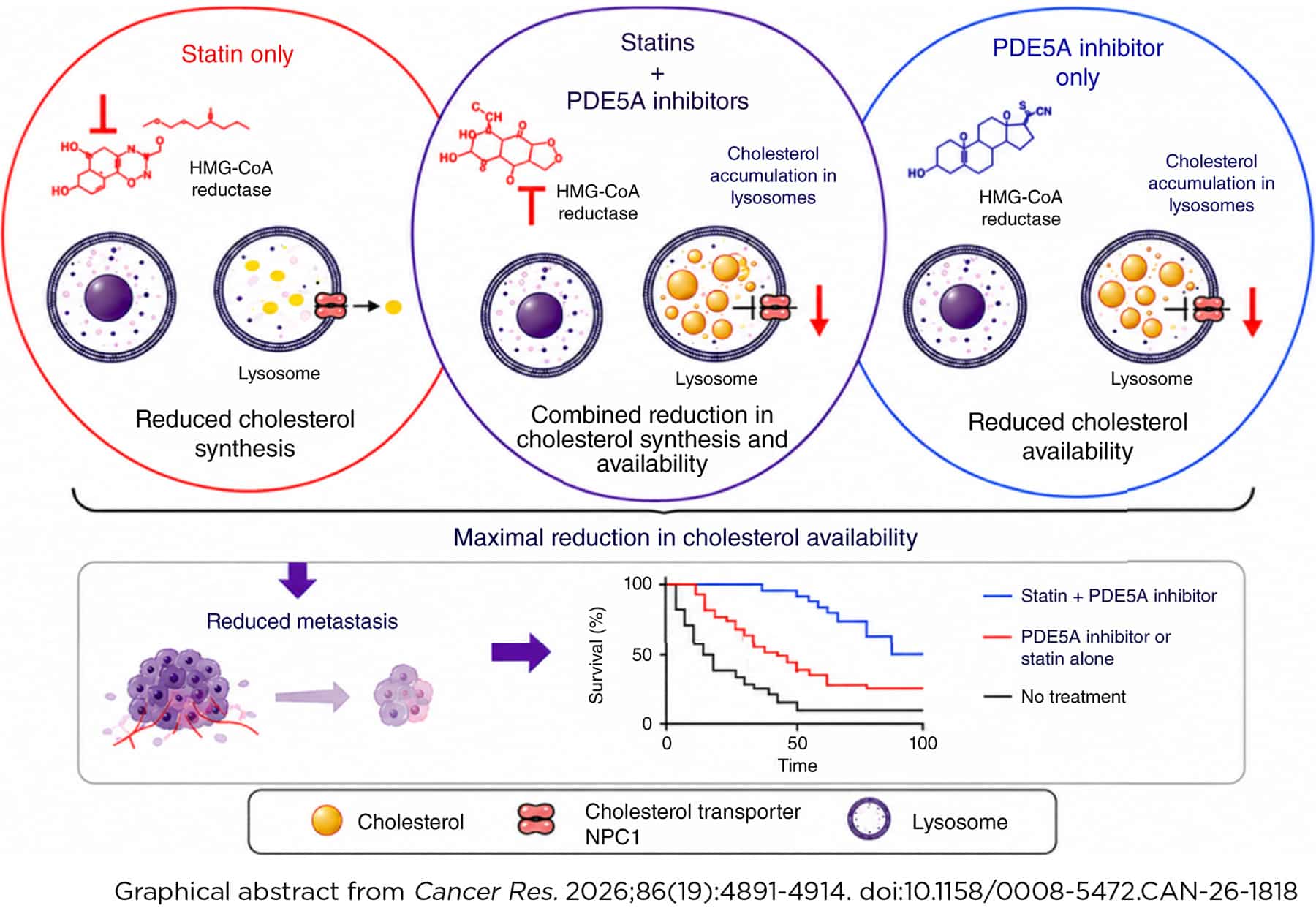
Noncanonical metabolic functions of signaling molecules contribute to cancer plasticity and metastatic progression. In this study, we demonstrated that phosphodiesterase type 5A (PDE5A) inhibitors, including sildenafil (Sild; Viagra), induced lysosomal cholesterol accumulation across multiple mouse and human cancer models, reducing cholesterol bioavailability and impairing cancer cell migration and metastasis. Cancer cells exhibited heightened sensitivity due to reduced lysosomal gene expression, rendering them particularly vulnerable to disrupted cholesterol trafficking. Mechanistically, elevated guanosine 3′,5′-cyclic monophosphate (cGMP) bound the lysosomal cholesterol transporter NPC1, impairing cholesterol export and phenocopying Niemann–Pick type C pathology. The resulting cholesterol depletion disrupted membrane lipid rafts and mitochondrial bioenergetics, thereby limiting metastatic capacity and triggering compensatory sterol regulatory element–binding protein 2 (SREBP2) activation with increased cholesterol synthesis. Combining Sild with statins yields additive antimetastatic effects by concurrently blocking lysosomal cholesterol export and cholesterol biosynthesis. Consistently, analysis of digital health records demonstrated significantly improved survival among Sild users, with a dose-dependent additive benefit observed when combined with statins. Together, these findings identify increasing cGMP levels through PDE5A inhibition as a potential strategy to restrict metastasis and offer a potential mechanistic basis for the beneficial effects of Sild.
Significance: PDE5A inhibition is linked to lysosomal cholesterol trafficking and reduced metastasis via cGMP-mediated disruption of NPC1 export, providing insights into how non-oncologic drugs and host–tumor metabolism influence progression and outcomes.
Journal: Cancer Research (October 15 issue)
Inappropriate activation of the mitogen-activated protein kinase (MAPK) pathway, often stemming from activating mutations in RAS or RAF, represents one of the most common oncogenic events in human cancer. However, currently approved RAS/RAF inhibitors target specific mutants that are only present in a small proportion of RAS- or RAF-activated tumors. Current MEK inhibitors (MEKi) are associated with class-effect toxicities and tumor escape via CRAF bypass of MEK blockade.

To address these issues, we designed atebimetinib to resist CRAF-mediated bypass and enable a pharmacokinetic/pharmacodynamic profile termed deep cyclic inhibition (DCI), an approach that transiently but deeply suppresses oncogenic signaling while allowing daily physiologic reset. Unlike chronic or intermittent approaches, DCI optimizes depth and duration of MEK suppression on a daily cycle, blunting rebound signaling while preserving recovery windows for normal tissues. Functioning as an allosteric, selective MEKi, atebimetinib potently inhibited ERK phosphorylation in vitro and in vivo, resisted CRAF bypass, and was well tolerated and more efficacious in xenograft models of cancer compared with current MEKis. Overall, these findings establish atebimetinib as a dual-MEKi with the potential to provide mutation-agnostic inhibition of the MAPK pathway while leveraging DCI, designed to avoid toxicities associated with existing MEKis. Atebimetinib offers MEK inhibition that is durable and tolerable, supporting the potential of this therapeutic paradigm.
Significance: Atebimetinib, a deep cyclic inhibitor of MEK, blocks MAPK signaling, resists RAF bypass, and is active in RAS– and RAF-mutant tumors, representing a mechanistically differentiated approach in the field of targeted therapies.
A related commentary was published in the October 15 issue where this article was featured on the cover.
Journal: Clinical Cancer Research (October 1 issue)
Purpose: We aimed to investigate the prognostic and predictive value of tumor-infiltrating lymphocytes (TIL) for adjuvant immunotherapy in high-risk early triple-negative breast cancer (TNBC).
Patients and Methods: The phase III A-BRAVE trial randomized 466 patients with high-risk early TNBC to adjuvant avelumab or observation after standard therapy. Inclusion criteria allowed 2 strata: stratum A (primary surgery followed by adjuvant chemotherapy, defined at high risk based on pathologic stage) and stratum B (neoadjuvant chemotherapy followed by surgery without pathologic complete response). TILs were centrally assessed on treatment-naïve tumor samples [baseline TILs (BSL-TIL)] and on residual disease (RD) after neoadjuvant chemotherapy (RD-TILs, stratum B). Residual cancer burden (RCB) was assessed in stratum B. Survival endpoints were disease-free survival (DFS), distant DFS (DDFS), and overall survival (OS).
Results: BSL-TILs were available for 387 patients and RD-TILs for 330 patients (290 with both BSL-TILs and RD-TILs). Higher BSL-TILs were independently associated with improved outcomes across all endpoints. In stratum B, higher RD-TILs showed a significant independent association with improved outcomes, outperforming BSL-TILs. RCB was also independently prognostic. Avelumab improved outcomes only for patients with BSL-TILs ≥30%, particularly in stratum B (3-year DDFS rates, 92% vs. 58.7%; HR, 0.20 in high BSL-TILs and 70.4% vs. 70.1%, HR, 0.92 in low BSL-TILs; interaction P = 0.019). Similar results were obtained for DFS and OS. RCB was not predictive for avelumab benefit.
Conclusions: TILs may predict benefit from adjuvant immunotherapy in early TNBC. These findings warrant validation and support TIL-guided immunotherapy strategies in future trials.
Learn more about current and emerging treatment options for each stage of triple-negative breast cancer: Experts Explore How to Treat Each Stage of Triple-negative Breast Cancer
Journal: Clinical Cancer Research (October 15 issue)
Purpose: This phase II trial investigated rucaparib [poly (ADP-ribose) polymerase (PARP) inhibitor] in combination with nivolumab in patients with advanced biliary tract cancer (BTC) without progression after 4 to 6 months of first-line platinum-based chemotherapy.
Patients and Methods: The primary endpoint was the 4-month progression-free survival (PFS) rate with null and alternative hypotheses of 63% and 85%. Secondary endpoints included the PFS rate in patients with DNA damage response (DDR) and isocitrate dehydrogenase 1 (IDH1) mutations, median PFS and overall survival (OS) from the start of study treatment (PFS1 and OS1) and first-line chemotherapy (PFS2 and OS2), best overall response, and safety (NCT03639935).
Results: Of 31 patients, 24 (77.6%) had Eastern Cooperative Oncology Group performance status 1, and 22 (71%) had intrahepatic cholangiocarcinoma. Nine (29%) patients had DDR or IDH1 mutations [BRCA2 (n = 3), ATM (2), FANCA (1), and IDH1 (3)]. Four-month PFS rate was 54.8% [95% confidence intervals (CI), 36–72.7] in all patients and 83.3% and 100% in the DDR and IDH1 cohorts, respectively. Median PFS1 and OS1 were 4.6 months (95% CI, 3.7–6.2) and 15.9 months (95% CI, 9.8–24.1), respectively. Median PFS2 and OS2 were 9.9 months (95% CI, 8.3–11.3) and 21.4 months (95% CI, 14.8–26.7), respectively. Two (6.4%) patients had a partial response. The most common grade ≥3 treatment-related adverse events included anemia (12.9%), neutropenia (9.7%), and elevated liver enzymes (12.9%).
Conclusions: The primary endpoint of the PFS rate at 4 months was not met. The PFS rate at 4 months in the DDR and IDH1 cohorts was longer than expected and supports further investigation of the addition of a PARP inhibitor during maintenance immune checkpoint inhibition for DDR and IDH1-altered patients with BTC.
Learn more about how researchers are working to make treatment more targeted to each type of biliary tract cancer or to each patient: Making Biliary Tract Cancer Treatment More Precise
Journal: Molecular Cancer Research
Desmoplastic small round cell tumor (DSRCT) is a rare, aggressive, fusion-driven sarcoma with poor outcomes despite intensive chemotherapy. Utilization of targeted therapies in DSRCT remains limited, underscoring the need for deeper characterization of patient tumors. To address this, we performed multi-omic profiling on nine patient-derived tumor biopsies from five patients enrolled in a precision oncology program. We consistently observed elevated mRNA and protein expression of human epidermal growth factor receptor 2, androgen receptor, and DNA damage response (DDR) markers, and characterized these molecular features using an integrated assay suite including bulk and single-cell RNA sequencing, protein profiling, immunohistochemistry, immune analyses, and functional homologous recombination deficiency (HRD) testing. We define a replication stress–associated DNA damage landscape and identify functional HRD in a subset of tumors lacking genomic HRD scar signatures. Single-cell analyses reveal intratumoral and intertumoral heterogeneity, whereas longitudinal sampling uncovers treatment-dependent shifts in expression and activity that may contribute to adaptive resistance. The immune microenvironment is characterized by dysfunctional T-cell states and sparse antigen-presenting cells. Collectively, these analyses delineate recurrent, biologically targetable features and patient-specific vulnerabilities, establishing a foundation for biomarker-guided therapeutic strategies in DSRCT. These findings support the investigation of rational combination approaches informed by sensitive detection methods and functional testing to address resistance in ultra-rare cancers.
Implications: Integrative multi-omic profiling combined with functional testing in DSRCTs reveals patient-specific vulnerabilities and biologically targetable receptor and DDR dependencies while defining immune states that may inform therapeutic response and rational combination strategies in this rare, fusion-driven cancer.
This article was highlighted in the October issue.
Journal: Molecular Cancer Therapeutics
Mesothelin (MSLN) is a cell membrane–anchored glycoprotein overexpressed in several cancers, including pancreatic cancer, ovarian cancer, and mesothelioma. MSLN is protease-cleaved at the membrane proximal region, releasing shed MSLN (sMSLN) into the tumor microenvironment, leaving behind a membrane-bound stub. sMSLN in the tumor microenvironment is hypothesized to create a “sink” that could limit tumor binding of MSLN-targeted anticancer therapies. We describe JNJ-79032421, a bispecific antibody (BsAb) targeting cluster of differentiation (CD) 3 on T cells and the membrane-restricted, non-shed region of full-length MSLN on cancer cells. Crystal structure analysis confirmed JNJ-79032421 binding to the membrane-restricted, non-shed C-terminal region of MSLN. Using Western blotting, enzyme-linked immunosorbent assay (ELISA), fluorescence-activated cell sorting (FACS), and immunohistochemistry (IHC), elevated levels of sMSLN were detected in blood, serosal fluids, and tumor tissue of patients and tended to increase with MSLN tumor expression. Binding and cytotoxicity of JNJ-79032421 against cancer cell lines were unaffected by the presence of sMSLN. In cancer cell lines and cell line–derived and patient-derived xenograft mouse models, increasing levels of MSLN expression led to increased JNJ-79032421 potency. In contrast, MSLNxCD3 BsAbs, binding of which is non–membrane-restricted, demonstrated a loss of cytotoxicity in the presence of sMSLN. This “sink” effect was most pronounced for high-affinity non–membrane-restricted BsAbs. Increases in CD45+ and CD8+ T-cell infiltration, as well as CD8+ T-cell activation, observed in xenograft tumor tissues were time-dependent and JNJ-79032421 dose–dependent. Overall, these data suggest that JNJ-79032421 may offer meaningful clinical activity by avoiding binding to sMSLN.
This article was highlighted in the October issue.
Learn more about how bispecific T-cell engagers help the immune system find and destroy cancer cells: Taking a BiTE Out of Cancer
Journal: Cancer Research Communications
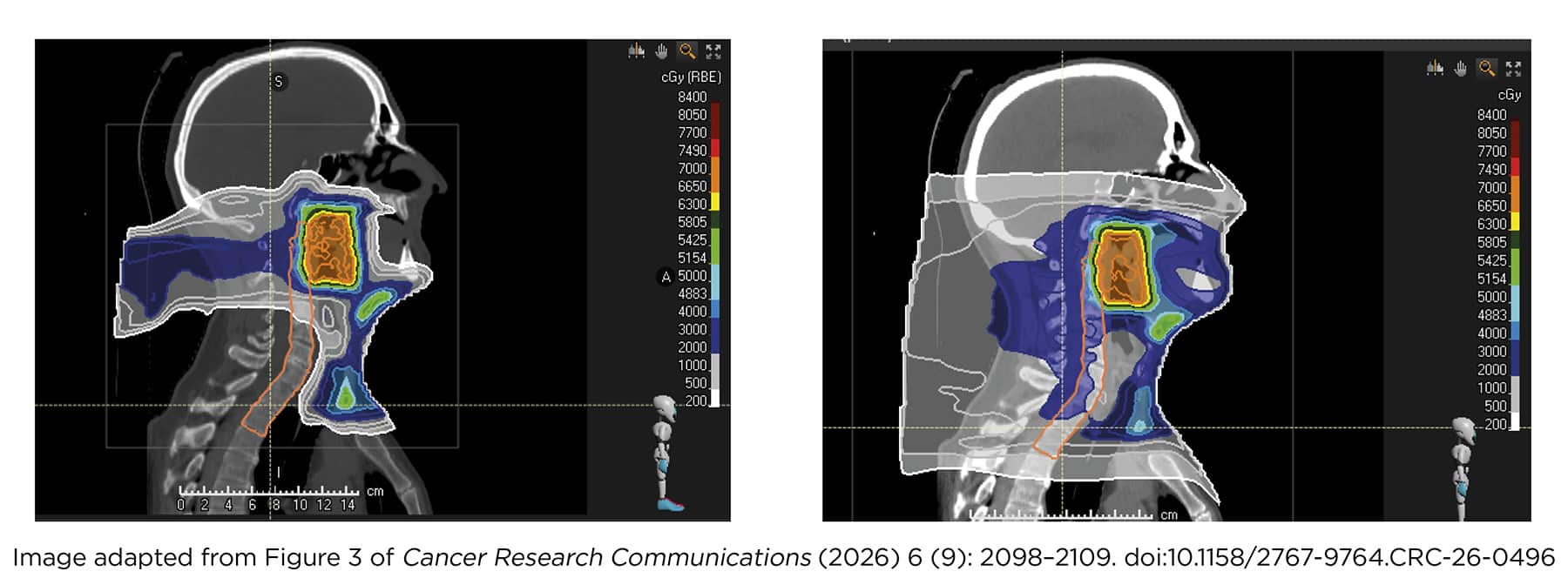
Impact of Proton versus Photon (Chemo)radiation on Circulating Immune Cells in Head and Neck Cancer
Purpose: Proton therapy delivers more precise radiation (RT) with less toxicity than photons. However, its impact on circulating immune cells in head and neck squamous cell carcinoma (HNSCC) remains poorly understood. We compared the impact of proton versus photon RT on circulating immune cells in patients with locally advanced HNSCC undergoing definitive (chemo)radiation [(C)RT].
Patients and Methods: Patients with stage III to IV HNSCC receiving definitive RT (70 Gy) with or without weekly cisplatin using proton or photon therapy were enrolled. Peripheral blood was collected at baseline, during treatment, and up to 1 year after treatment. White blood cell differentiation, lymphocyte subsets, and lymphocyte function were evaluated using high-dimensional flow cytometry and functional assays.
Results: Twenty-seven patients were enrolled: Ten received CRT with protons, eight received RT alone with protons, and nine received RT alone with photons. Absolute lymphocyte counts and naïve CD4+ T cells declined in all groups, whereas NK cells increased and memory T-cell populations remained largely unaffected, with no additional effect of concurrent cisplatin. Lymphocyte suppression persisted for up to 6 months in the CRT proton group, 3 months in the RT proton group, and 12 months in the RT photon group. Greater low-dose body irradiation (2 Gy) was correlated with lower lymphocyte counts at 5 weeks and 6 months after treatment and was more common in photon-treated patients.
Conclusions: Both proton and photon RT markedly suppress circulating lymphocytes, particularly naïve CD4+ T cells, for at least 3 months after treatment in locally advanced HNSCC.
Significance: Proton RT is increasingly utilized for head and neck cancer. However, its impact on systemic immunity remains unclear. We demonstrated that both proton and photon RT caused prolonged suppression of circulating lymphocytes for at least 3 months. Naïve CD4+ T cells were preferentially depleted, whereas memory T-cell populations were largely spared. These findings highlight the importance of considering immune effects and minimizing off-target lymphocyte exposure when combining radiotherapy with immunotherapy.