Editors’ Picks, August 2026: Weight Loss and Breast Cancer Biomarkers, Predicting Early-onset Cancer Cases, and More
The dog days of August are finally here. If you’ve been howling for exciting new cancer research, then look no further than this month’s Editors’ Picks from the journals of the American Association for Cancer Research (AACR).
This month, you can enjoy such treats as research on how weight loss and omega-3 supplementation impact the microbiome of women at an elevated risk of breast cancer; how certain symptoms could be used to predict cases of early-onset colorectal cancer; phase I clinical trial results for a chimeric antigen receptor (CAR) T-cell therapy for metastatic, castration-resistant prostate cancer; and more.
But now’s not the time to let sleeping dogs lie—these articles are free to read for a limited time. Go fetch the free links to these papers, as well as their abstracts, below.
Journal: Blood Cancer Discovery
3D Chromosome Remodeling in B-cell Development and Acute Lymphoblastic Leukemia
The identification of molecular subgroups of pediatric B-cell acute lymphocytic leukemia (B-ALL) has proven to be a powerful tool in understanding disease pathogenesis and treatment stratification. Studies have suggested aberrant transcription factor function and epigenetic regulation can explain differences between B-ALL subtypes; however, the impact of 3D genome reorganization remains unclear. In this study, we used in situ Hi-C and RNA sequencing to profile the chromatin architectural landscape in healthy B-cell progenitors and B-ALL patient samples harboring prognostically relevant structural variations, including ETV6::RUNX1, KMT2A::AFF1, and BCR::ABL. We showed that B-ALLs undergo subtype-specific changes that, in part, reflect the differentiation stage of the disease and that they acquire aberrant chromatin configurations that allow the expression of oncogenic drivers. One such driver, ERG, displayed increased interactivity and expression in ETV6::RUNX1 B-ALL, and evidence suggests that it plays a role in regulating survival and differentiation. Overall, these results underscore the essential role of 3D nuclear organization in acute leukemia.
Significance: Our integrative analyses of 3D chromatin architecture, accessibility, and gene expression in normal and malignant human B cells revealed an evolution of 3D genome architecture and associated transcription programs that may drive the differentiation of normal B cells as well as the transformation of B-ALL subtypes.
A related commentary was published in the July issue.
Journal: Cancer Discovery
Therapy-Related Mutational Signatures in Subsequent Neoplasms among Survivors of Childhood Cancer
Childhood cancer survivors have a heightened risk of developing subsequent neoplasms (SN) related to therapy. We analyzed whole-genome, exome, and RNA sequencing of 200 breast, meningioma, and thyroid SNs, which developed a median of 26.4 years after childhood cancer, among 160 survivors. Meningioma and thyroid SNs were enriched for driver gene rearrangements compared with de novo tumors, including NF2-disrupting alterations and kinase fusions potentially induced by radiation. Radiation correlated with increased insertion–deletion signature ID5. Nitrogen mustard treatment correlated with elevated “flat” signature SBS5 in breast and meningioma SNs; in vitro, these agents caused an unresolved flat signature associated with multiple flat signatures from the Catalogue of Somatic Mutations in Cancer. In meningioma, platinum therapy correlated with NF2 splice-site variants. Analysis of 19 multisample survivors revealed intrapatient heterogeneity in meningioma, including clonally independent tumors. These results demonstrate the long-term impact of childhood cancer treatment on the genomes of SNs developing in adulthood, which may guide SN treatment and prevention.
Significance: This represents the most comprehensive genomic characterization of SNs from childhood cancer survivors to date, revealing the mutagenic impact of multiple therapies on the SN genome, including the potential impact of nitrogen mustards such as cyclophosphamide. These results may guide the optimization of future cancer treatment regimens to prevent SN development.
A related commentary was published in the August issue.
Journal: Cancer Epidemiology, Biomarkers & Prevention
Positive Predictive Value of Symptoms for Early-Onset Colorectal Cancer
Background: Diagnosing colorectal cancer in people below age 50 relies largely on the evaluation of symptoms despite recent recommendations to initiate screening at age 45. There is limited information on the positive predictive value (PPV) of symptoms as indicators of early-onset colorectal cancer.
Methods: We identified patients aged 42 to 49 years in three community-based health systems between 2012 and 2020 whose first recorded colonoscopy had a diagnostic indication, with symptoms present in the two years before the colonoscopy. We computed the PPV for colorectal cancer by each individual symptom, combinations of the three most common symptoms, and combinations of the three symptoms with the highest PPVs and computed 95% confidence intervals (CI). We also evaluated the PPV of recent symptoms stratified according to the timing of onset and estimated the PPV of symptoms when followed by positive or negative fecal testing.
Results: The study included 28,198 patients. The PPV for specific symptoms, with or without other symptoms, was 2.4% (95% CI, 2.2%–2.7%) for blood loss and 4.5% (95% CI, 3.3%–5.9%) for positive fecal testing. Pairwise and three-way combinations of blood loss, diarrhea, and abdominal mass had PPV point estimates for colorectal cancer above 3%.
Conclusions: Our study suggests that specific symptoms and combinations may identify patients with a ≥3% prevalence of colorectal cancer in those aged 42 to 49 and that fecal testing results may further identify patients with a higher probability of colorectal cancer.
Impact: Future research is needed to develop high PPV strategies for identifying early-onset colorectal cancer without compromising sensitivity.
A related commentary was published in the August issue.
Learn more about some of the potential causes behind early-onset colorectal cancer that researchers are investigating: What’s Behind the Increase in Cancer Cases Among Younger Adults?
Journal: Cancer Immunology Research
Cancer Cell–Intrinsic SSBP4 Enables Tumor Immune Evasion by Promoting Cholesterol Biosynthesis
The immunosuppressive tumor microenvironment (TME) contributes to resistance against checkpoint inhibitors. However, the precise factors that shape the immune contexture of the TME remain elusive. In this study, we report that single-stranded DNA binding protein 4 (SSBP4), a previously uncharacterized protein, suppresses intratumoral T-cell activation by promoting excessive cholesteryl ester production in tumor cells. Overexpression of SSBP4 in tumor cells decreased T-cell infiltration and accelerated tumor growth in murine syngeneic tumor models. Conversely, genetic ablation of SSBP4 in tumor cells enhanced T-cell infiltration and inhibited tumor growth in a CD8+ T cell–dependent manner. Mechanistically, SSBP4 upregulated cholesterol synthesis genes, leading to increased production of cholesterol and cholesteryl esters in tumor cells, which directly suppressed CD8+ T-cell activation and function. Furthermore, SSBP4 abrogation significantly improved the efficacy of anti–PD-1 treatment. Thus, in this study, we have identified SSBP4 as a cancer cell-intrinsic regulator of cholesterol metabolism that contributes to tumor immune evasion.
A related commentary was published in the August issue.
Journal: Cancer Prevention Research

Obesity is associated with gut dysbiosis, chronic inflammation, and insulin resistance. We assessed the proportional change in fecal microbial populations in a pilot study (n = 34) of peri/postmenopausal women with a body mass index ≥28 kg/m2 who were randomized to receive either 3.25 g/day of omega-3 fatty acids or a placebo during a weight loss intervention. Body composition was assessed using dual X-ray absorptiometry, and fecal and blood samples were collected. The median weight change was −10%. Among participants who lost ≥10% of their weight, those assigned to omega-3 fatty acids showed the greatest decrease in the Firmicutes:Bacteroidetes ratio and displayed favorable changes in systemic biomarkers. Notable increases in the proportional abundance of short-chain fatty acid (SCFA)–producing microbes including Phocaeicola vulgatus and Alistipes putredinis were observed in women receiving omega-3, which correlated with improvements in breast cancer biomarkers such as bioavailable estradiol, adiponectin:leptin ratio, and C-reactive protein levels. Women administered omega-3 fatty acids displayed increased % change in plasma SCFA propionate and decreased butyrate, suggesting that intervention differentially modulated circulating bacteria-derived SCFA metabolites. High-dose omega-3 fatty acids, when added to a behavioral weight loss intervention, promoted beneficial shifts in the gut microbiome and associated with improved breast cancer risk factor biomarkers.
Prevention Relevance: Obesity is a modifiable risk factor for breast cancer, characterized by chronic inflammation and altered adipokines. This trial addresses the need to enhance weight loss by targeting underlying metabolic and inflammatory drivers. We show that omega-3 polyunsaturated fatty acids (eicosapentaenoic acid/docosahexaenoic acid) shift SCFA-producing microbiota, increase propionate, and correlate with improved breast cancer risk factor biomarkers.
This article was featured on the cover of the August issue.
Learn more about breast cancer risk factors and risk-mitigation strategies: Risky Business: Breast Cancer Risk Factors and What We Know About Them
Journal: Cancer Research (August 1 issue)
Armored Chimeric Antigen Receptor T-cell Therapy Targets Antigen-Heterogeneous Glioma
Chimeric antigen receptor (CAR) T-cell therapy has shown early promise against glioblastoma, which lacks effective treatment options. However, two key challenges curtail efficacy: tumor-antigen heterogeneity and an immunosuppressive tumor microenvironment. CAR T cells engineered to secrete combinations of immunomodulatory proteins can reverse immune suppression and engage endogenous immunity. Through head-to-head in vivo comparisons of potentially synergistic armor combinations, we demonstrated that T cells expressing a CAR plus IL12 and the decoy-resistant form of IL18 (CAR-12.DR18 T cells) show strong efficacy against antigen-heterogeneous glioma in immunocompetent mice. Robust antitumor efficacy with effective toxicity mitigation was achieved via combined administration of CAR-12.DR18 T cells with CAR T cells that secrete an anti–vascular endothelial growth factor (anti-VEGF) single-chain variable fragment (scFv). This combination therapy presents a clinically applicable strategy to overcome key barriers to the effective treatment of glioblastoma.
Significance: CAR-T cells armored with cytokines and anti-VEGF single-chain variable fragments can control orthotopic, antigen-heterogeneous glioma with minimal toxicity, providing a therapeutic strategy for glioblastoma patients in urgent need of efficacious treatments.
Learn more about how CAR T-cell therapies work and the seven therapies currently approved by the U.S. Food and Drug Administration: What Is CAR T-cell Therapy?
Journal: Cancer Research (August 15 issue)
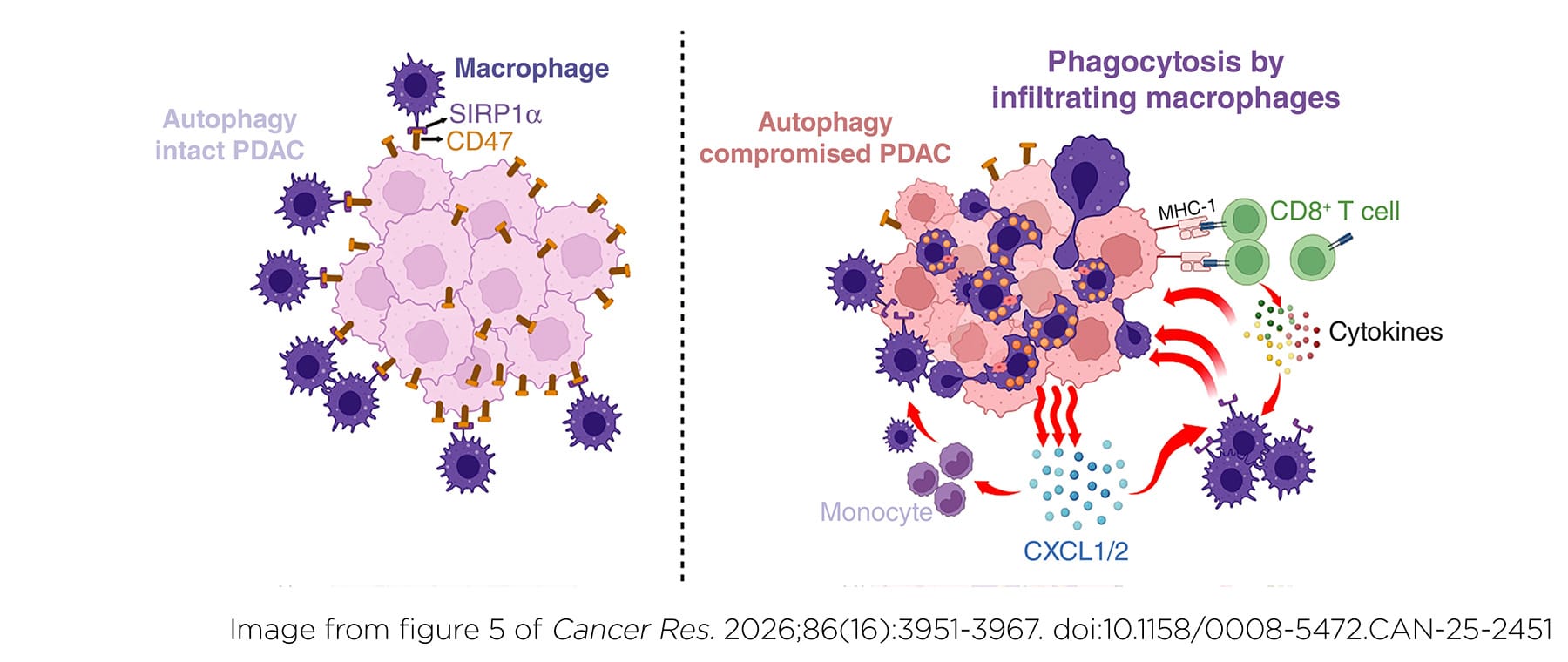
Pancreatic ductal adenocarcinoma (PDAC) relies on elevated autophagy to support metabolism, proliferation, and immune evasion. Inhibiting autophagy has been reported to improve response rates in patients with PDAC. In this work, we identified a mechanism to explain how the loss of autophagy in PDAC triggers reprogramming of the tumor microenvironment (TME) to ultimately stimulate an antitumor response. Autophagy inhibition in PDAC recruited macrophages via the CXCL1/2-CXCR2 axis. Simultaneously, the loss of autophagy resulted in a decrease in the canonical “don’t eat me” ligand CD47 on tumor cells, thereby inducing their susceptibility to macrophage phagocytosis. Although CD8+ T cells were critical to the antitumor immune response to autophagy inhibition in PDAC, they were not directly involved in cytotoxicity but played a critical role in stimulating macrophage phagocytosis of tumor cells. Taken together, this study strongly supports the implementation of autophagy inhibition in pancreatic cancer and highlights a crucial link between PDAC biology and the TME-macrophage cross-talk that effectively promotes tumor cell killing.
Significance: Inhibition of autophagy in pancreatic cancer promotes antitumor immunity through a stepwise process of recruiting macrophages and enhancing phagocytosis of cancer cells, providing a potential therapeutic strategy for this deadly tumor type.
Learn more about the progress researchers are making in developing therapeutic and preventive vaccines for pancreatic cancer: From Treatment to Prevention: How Vaccines Are Reshaping the Fight Against Pancreatic Cancer
Journal: Clinical Cancer Research (August 1 issue)
Purpose: Patients with advanced cancer have a poor prognosis and need for novel treatments. LOAd703 is a tumor microenvironment (TME) gene engineering viral vector encoding genes targeting the CD40 and 4-1BB pathways. In this study, tolerability (primary endpoint), response activity, and the capacity to inflame the TME were evaluated.
Patients and Methods: In an open-label, single-arm phase I/IIb clinical trial (NCT03225989), a maximum of eight intratumoral injections of LOAd703 were administered biweekly, combined with a gemcitabine-based chemotherapy regimen, either standard-of-care treatment or conditioning gemcitabine if no standard options were available. Dose escalation followed a standard 3 + 3 design (phase I) and, to optimize dosage, the two highest dose levels were expanded in phase II.
Results: Forty-one patients were enrolled with pancreatic (n = 29), colorectal (n = 5), ovarian (n = 4), and biliary cancers (n = 3). Treatment was generally well tolerated. The most common LOAd703-related adverse events were pyrexia (76%), chills (39%), and fatigue (34%), mostly grade 1 to 2. The overall response rate (ORR) was 0 in the LOAd703 dose cohort 5 × 10¹⁰ viral particles (VP), 25% in 1 × 10¹¹ VP, and 12% in 5 × 10¹¹ VP. All patients with an objective response had pancreatic cancer and received first-line treatment (ORR, 35%). The TME showed a significant upregulation of Th1 immunity biomarkers at week 13 posttreatment initiation.
Conclusions: TME gene engineering using LOAd703 inflamed immune cold tumors and was followed by long-term stabilized disease in several patients. Further evaluation of LOAd703 together with chemotherapy and/or checkpoint inhibitors is warranted.
Journal: Clinical Cancer Research (August 15 issue)
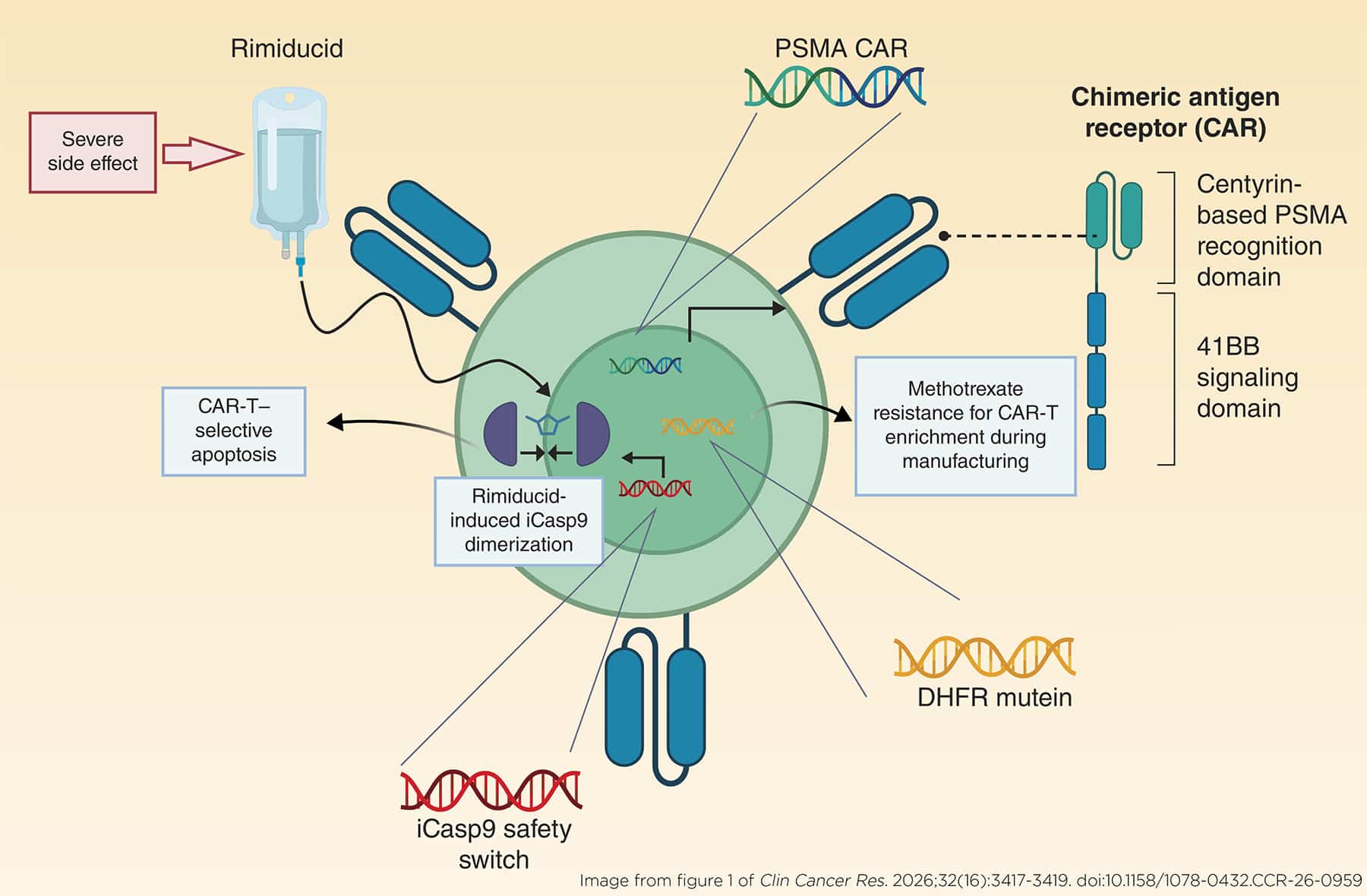
Purpose: Chimeric antigen receptor (CAR) T-cell therapies have shown potential in solid tumors. A higher proportion of stem cell–like memory T cells (TSCM) in CAR T-cell products could enhance engraftment, persistence, and prolong immune activity. This phase I trial (NCT04249947) evaluated the safety and efficacy of P-PSMA-101, an autologous TSCM-rich, bone-tropic CAR T-cell therapy targeting prostate-specific membrane antigen (PSMA), in patients with metastatic castrate-resistant prostate carcinoma (mCRPC). Secondary endpoints included objective response rate, prostate-specific antigen (PSA) response, and radiographic progression-free survival.
Patients and Methods: The final P-PSMA-101 product was produced from leukapheresis using the piggyBac DNA transposon–based platform, which integrates a multicistronic transgene encoding an inducible caspase 9 (iCasp9) safety switch in addition to the CAR, generating TSCM-rich CAR T cells.
Results: Among 33 treated patients, 18% (n = 6) had dose-limiting toxicities. Cytokine release syndrome (CRS) occurred in 61% (n = 20), with grade ≥3 CRS seen in 9% (n = 3). Activation of the iCasp9-based safety switch was required in 24% (n = 8) of cases, including one toxicity that was ultimately fatal and successful resolution of symptoms in the other seven. P-PSMA-101 demonstrated antitumor activity, with 21% (n = 7) of patients achieving a ≥50% PSA decline (PSA50 response). Among 13 RECIST-evaluable patients, one partial response was observed. Stable disease was observed in 61% (n = 20) of patients, with 21% (n = 7) maintaining disease stability for ≥3 months. Two patients experienced sustained remissions exceeding 12 months, characterized by PSA declines of more than 90%, corroborated by pharmacokinetic, biomarker, and PSMA-PET imaging data.
Conclusions: Robust expansion of P-PSMA-101 CAR T cells resulted in toxicity but also durable responses in patients with mCRPC. Future trials of CAR T therapy may be informed by the results of this nonviral engineering, TSCM cell–enriched approach.
A related commentary was published in the August 15 issue.
Journal: Molecular Cancer Research
Neuroblastoma is a heterogeneous pediatric cancer arising from developmentally arrested neuronal precursors, in which restoring differentiation offers therapeutic promise. Achaete-scute homolog 1 (ASCL1), a proneural transcription factor, is widely expressed in neuroblastoma and can drive either proliferation or differentiation depending on the cellular context. In this study, we show that distinct MYCN-amplified neuroblastoma cell lines exhibit differing differentiation responses to ASCL1 overexpression. By comparing genome-wide ASCL1 chromatin binding, transcriptional changes, and protein–protein interactions, we found that ASCL1 binds more extensively to neuronal proteins in a cell line that is more susceptible to ASCL1-driven differentiation but associates with cell-cycle regulators in less responsive cells. We show that cyclin-dependent kinase 2 (CDK2)–cyclin A2 bind ASCL1 in less responsive cells, with CDK-mediated phosphorylation of ASCL1 limiting the ability of ASCL1 to drive differentiation.
Implications: Our study reveals that context-dependent interactions of ASCL1 with protein partners on the chromatin control its ability to reengage a differentiation program in neuroblastoma.
Journal: Molecular Cancer Therapeutics
NN-01-195, a Novel Conjugate of HSP90 and AURKA Inhibitors, Effectively Targets Solid Tumors
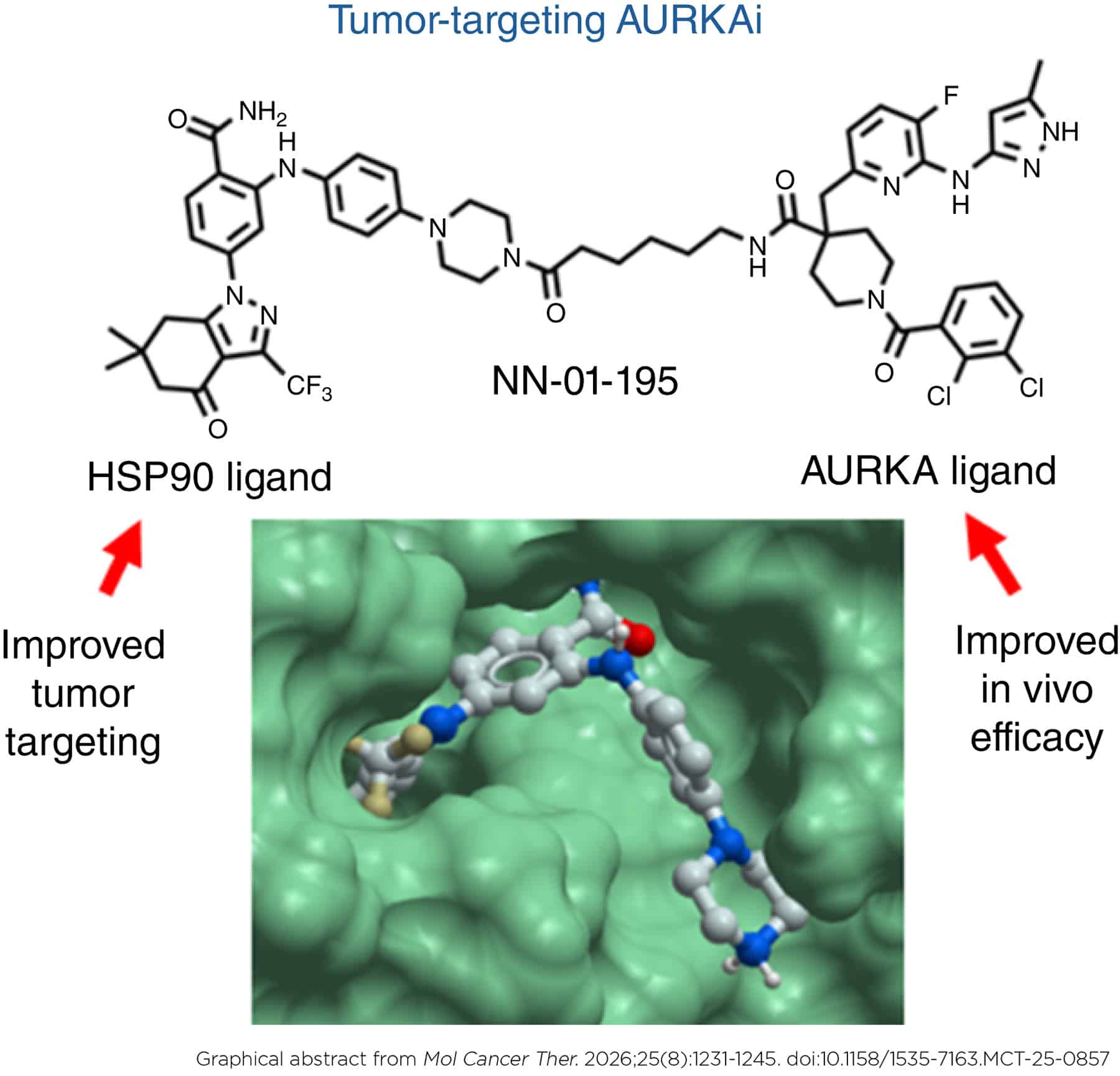
Aurora kinase A (AURKA) regulates cell-cycle progression into and through mitosis. As overexpression of AURKA in cancer cells is common and associated with mitotic defects and aneuploidy, small-molecule inhibitors of AURKA have been developed as candidate therapies for cancer. However, these have typically low activity in clinical trials, with systemic toxicities limiting dose escalation. To concentrate an AURKA inhibitor in tumors, we exploited the fact that cancer cells in solid tumors selectively express high levels of the chaperone HSP90 to counteract intratumoral stresses, providing a potential targeting moiety. We developed NN-01-195 as a novel chimeric small molecule that combines an AURKA inhibitor related to TAS-119/VIC-1911 with an HSP90-binding moiety related to SNX2112 and evaluated its function. NN-01-195 tightly binds and inhibits both AURKA and HSP90 in biochemical assays. In cancer cells, NN-01-195 causes mitotic arrest and spindle abnormalities and a profile of signaling changes that closely resembles that of an AURKA inhibitor. ADME assessment indicates moderate metabolism in liver microsomes (T1/2 = 46.7 minutes) and sustained plasma exposure following single intraperitoneal injection. Maximum tolerated repeated dose testing over 5 days indicates no weight loss or toxicity at 80 mg/kg. Importantly, NN-01-195 accumulates in xenografted tumors at higher levels and for longer duration than does an AURKA inhibitor. Furthermore, in combination with an inhibitor of the G2/M checkpoint protein WEE1, NN-01-195 is more potent than VIC-1911 in limiting growth of xenograft tumors. These data support the exploration of NN-01-195 and improved analogs as promising new candidates for therapeutic evaluation.
Journal: Cancer Research Communications
The most common platelet-derived growth factor receptor α (PDGFRA) alteration in gastrointestinal stromal tumors (GIST) is the exon 18 activation loop mutation D842V, which is resistant to imatinib and other type II tyrosine kinase inhibitors (TKI) but sensitive to type I TKI avapritinib. Avapritinib is FDA-approved for first-line treatment of all PDGFRA exon 18–mutant GIST cases but is only available for D842V-mutant cases outside the United States. Non-D842V exon 18–mutant GIST cases are understudied and lack evidence-based treatment guidelines. However, there are a few previous reports describing non-D842V exon 18–mutant patients with GIST who responded well to imatinib therapy. Given that imatinib is more tolerable, globally accessible, and significantly less expensive than avapritinib, we sought to define which patients could be treated with imatinib rather than avapritinib. We assembled a cohort of more than 1,000 PDGFRA exon 18–mutant GIST cases and identified that 78% of these mutations involved a key autoinhibitory aspartic acid residue at position 842. Using cell-based models, we demonstrated that imatinib sensitivity was dependent on the amino acid class of the 842-position residue, with all hydrophobic amino acids except alanine conferring resistance. In contrast, all 842-position mutations were avapritinib-sensitive. Structural modeling supported our biochemical results and revealed how 842-position mutations induce changes that can interfere with imatinib binding. Lastly, our biochemical data were validated using imatinib response data for first-line metastatic disease; patients with predicted exon 18–sensitive mutations had longer progression-free survival than patients with predicted imatinib-resistant mutations. These results provide key evidence that should be used to guide therapy selection for PDGFRA-mutant GIST.
Significance: Biochemical and structural modeling of PDGFRA exon 18 842-position mutations allows for the prediction of clinical TKI responses. These data can be used to generate new treatment guidelines for PDGFRA exon 18–mutant GISTs and select optimal therapies for patients.