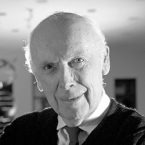
James D. Watson, PhD, FAACR, a Fellow of the AACR Academy who shared the 1962 Nobel Prize in Medicine or Physiology for the discovery of the double helix structure of DNA, died November 6, 2025. He was 97 years old.
Watson and Francis Crick proposed that the molecule of deoxyribonucleic acid (DNA), considered the fundamental building block of life, has the shape of a double helix. They shared the Nobel Prize with Maurice Wilkins, who confirmed the DNA structure using X-ray crystallography.
The double helix has been generally considered as one of the most important scientific discoveries of the twentieth century. Watson and Crick published their proposal in Nature in 1953, when Watson was only 25 years old, and it launched him on a long career at the forefront of molecular biology.
Sadly, Watson created controversy by his apparent failure to give proper credit to other researchers for their significant contributions to the discovery of the structure of DNA, especially Rosalind E. Franklin whose X-ray images of DNA provided important clues to its structure.
Born in Chicago in 1928, Watson entered the University of Chicago at the age of 15 and received a bachelor’s degree in zoology in 1947. He received his doctorate in zoology from Indiana University in 1950.
After a fellowship in Copenhagen, he conducted research at the University of Cambridge, where he and Crick collaborated on the structure of DNA.
Watson then spent two years at the California Institute of Technology and joined the faculty of Harvard University in 1955, becoming a professor in 1961. He was named director of Cold Spring Harbor Laboratory in 1968 while still on the Harvard faculty. He resigned from Harvard in 1976 to be the full-time director at CSHL. He served as president of CSHL from 1994 to 2003, chancellor until 2007, and chancellor emeritus until 2018. At CSHL, he focused his own research on cancer and steered the laboratory into tumor virology.
Watson headed the Human Genome Project at the National Institutes of Health from 1990 to 1992. In 2007, he became the second person to publish his own, fully sequenced, genome online. He said he did so to “encourage the development of an era of personalized medicine.”
He joined the AACR in 1972 and was elected to the inaugural class of Fellows of the AACR Academy in 2013.
Watson wrote several highly regarded textbooks on molecular biology. In 1968, he published The Double Helix, a best-selling account of his and Crick’s discovery of the structure of DNA.
Watson received the Presidential Medal of Freedom from President Gerald Ford in 1977 and the National Medal of Science from President Bill Clinton in 1997, among many other awards and prizes. These included the Albert Lasker Award for Basic Medical Research in 1960, the Copley Medal of the Royal Society of London in 1993, the Liberty Medal of the National Constitution Center in 2000, the Benjamin Franklin Medal for Distinguished Achievement in the Sciences in 2001, and the Gairdner Foundation International Award in 2002.
He was an elected member of the American Academy of Arts and Sciences, the National Academy of Sciences, a foreign member of the Royal Society, the European Molecular Biology Organization, and the American Philosophical Society, among other memberships.
Leave your remembrance of Dr. Watson below (limit 1,000 characters).
You cracked the most important secret of mother nature's treasure at a very early age! I'm cherishing your intellect and puzzle solving power throughout my life. Wish to meet you one more time in our next life. God bless you! RIP.
Thank you for determining the molecular secret of life. Your contributions to science are profound, and will never be forgotten.
Your Legacy lives on ! Rest in peace in the bosom of the Almighty. Amen
Very important person of 20th century and era of human history. RIP