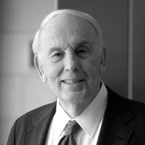
Joseph F. Fraumeni, Jr., MD, FAACR, a renowned cancer epidemiologist, a Fellow of the AACR Academy, and a former member of the AACR Board of Directors, died June 22, 2026, at the age of 93.
A career researcher and leader at the National Cancer Institute, Fraumeni was a co-discoverer of the genetic condition now known as the Li-Fraumeni syndrome and launched the U.S. Atlas of Cancer Mortality, which mapped geographic variations in cancer.
Born April 1, 1933, in Boston, Fraumeni earned a bachelor’s degree from Harvard College, a medical degree from Duke University School of Medicine, and a master of science in epidemiology from the Harvard University School of Public Health. He completed medical residencies at Johns Hopkins Hospital and the Memorial Sloan-Kettering Cancer Center.
In 1962, Fraumeni joined the Epidemiology Branch of the National Cancer Institute (NCI) as a commissioned officer in the U.S. Public Health Service (USPHS). He went on to hold several leadership positions at the NCI, including posts as head of the Ecology Studies Section, chief of the Environmental Epidemiology Branch, director of the Epidemiology and Biostatistics Program, and founding director of the Division of Cancer Epidemiology and Genetics.
He retired from the USPHS in 1999 with the rank of rear admiral and assistant surgeon general. When he retired from NCI in 2017, he was named Scientist Emeritus. He authored or co-authored more than 900 scientific publications.
Fraumeni’s research focused on epidemiologic and interdisciplinary studies of high-risk populations. Along with Frederick P. Li, MD, FAACR, he discovered in 1969 a familial syndrome of early-onset breast cancer, sarcomas, brain tumors, and other malignancies. Known today as Li-Fraumeni Syndrome, the study of this condition revealed inherited mutations in the p53 tumor suppressor gene.
In 1975, Fraumeni led the development of computer-generated atlases of cancer death at the county level, a series that became known as the U.S. Atlas of Cancer Mortality. The distinctive geographic patterns for certain malignancies prompted a series of studies in the United States and in China that helped to identify several carcinogenic exposures and inform population-level approaches to cancer control.
A member of the AACR since 1968, Fraumeni served on the AACR’s Board of Directors from 1983 to 1986. He also served the AACR as an assistant editor, senior editor, and editorial board member for Cancer Epidemiology, Biomarkers & Prevention and an assistant editor for Cancer Research. The AACR recognized him with the AACR-American Cancer Society Award for Research Excellence in Epidemiology and Prevention in 1993 and the AACR Award for Lifetime Achievement in Cancer Research in 2009. He was inducted as a member of the inaugural class of Fellows of the AACR Academy in 2013.
Fraumeni was a fellow of the American College of Physicians, the American Association for the Advancement of Science, and the American Academy of Arts and Sciences, and a member of the Institute of Medicine, the Association of American Physicians, and the National Academy of Sciences.
Among other career awards, Fraumeni received the Abraham M. Lilienfeld Award from the American College of Epidemiology in 1993; the John Snow Award from the American Public Health Association in 1995; the Charles S. Mott Prize from the General Motors Cancer Research Foundation in 1995; and the James D. Bruce Memorial Award from the American College of Physicians in 1997.
Leave your remembrance of Dr. Fraumeni below (limit to 1,000 characters).
I am deeply indebted to Joe Fraumeni as colleague during the time I was at the NCI as the Deputy Director to Barbara Rimer for the newly formed Division of Cancer Control and Population Sciences. But Joe Fraumeni was also an inspirational leader in the field more broadly and one of the early leaders of ASPO. One of the highest honors that I cherish was being awarded the Joseph F. Fraumeni, Jr. award in 2025,
When I was an Associate in the Environmental Epidemiology Branch of the NCI, Dr. Fraumeni was the chief and an extraordinary mentor. He guided our publication about disseminated intra-abdominal carcinomatosis following prophylactic oophorectomy in ovarian cancer-prone families. Later, he helped with publication of a review of harmful gastrointestinal effects of the common food additive carrageenan. Scholarly, thoughtful, kind, and diligent, he represents the best that we can hope to become.
I had the privilege and honour of being a trainee at Dr. Fraumeni’s unit at the NCI in the old Landow building in Bethesda in the early 1980s. Those sessions with him at his office were unforgettable, as I learned from him much of the science and history of cancer prevention that propelled my own career.
My deepest condolences to his family. It is a great loss to the cancer epidemiology and prevention community.
Eduardo L. Franco
Distinguished James McGill Professor, Departments of Oncology and Epidemiology
Faculty of Medicine and Health Sciences, McGill University, Montreal
I owe my career in cancer genetics to Fred Li and Joe Fraumeni. In 1977 I was on a medical oncology training fellowship at the Farber, and deciding where my career might go. Fred Li introduced me to Joe, and I flew down to see him. Joe spent much of a day with me. I still think of the 'Butterfly Moment' when Joe crossed the room and opened a wide drawer that should have contained butterflies pinned out, but instead revealed an extensive cancer family pedigree. In silence, we looked at each other... Joe knew, and I knew, that a gene map and genetic linkage could not be far away.