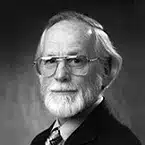
J. Michael Bishop, MD, a Fellow of the AACR Academy who shared the Nobel Prize for Physiology or Medicine in 1989 with Harold E. Varmus, MD, for their discovery of the cellular origin of retroviral oncogenes, died March 20, 2026, at the age of 90.
Bishop served as chancellor of the University of California, San Francisco, from 1998 until he retired in 2009. He presided over a major expansion of UCSF, a university that is devoted entirely to biomedical sciences.
Born in York, Pennsylvania, in 1936, Bishop grew up in a rural area and attended elementary school in a two-room schoolhouse. He received a bachelor’s degree in chemistry from Gettysburg College in 1958 and a medical degree from Harvard Medical School in 1962.
After a residency at Massachusetts General Hospital and research at the National Institute of Allergy and Infectious Diseases in Bethesda, Maryland, and the Heinrich Pette Institute in Hamburg, Germany, he joined the faculty of UCSF as assistant professor of microbiology and immunology in 1968. He became a full professor in 1972, and in 1981 he was named director of the university’s George F. Hooper Research Foundation.
In 1970, Varmus joined Bishop’s lab as a postdoctoral fellow. They began studying the Rous sarcoma virus to test the theory that healthy body cells contain dormant viral oncogenes that cause cancer when triggered. Bishop and Varmus discovered that the viral genes that cause cancer in humans and animals do not originate within viruses, as previously thought, but instead begin as normal genes within healthy cells that act to control cellular growth and division. This finding indicated that these benign genes (called proto-oncogenes) can be picked up by certain viruses and then transformed into oncogenes.
This discovery that cancer could be caused by the malfunction of normal genes revolutionized the understanding of tumorigenesis and greatly expanded the scope of associated scientific areas such as cancer detection as well as drug discovery and development.
In addition to receiving the Nobel Prize, Bishop’s honors included election to the National Academy of Sciences in 1980 and as an Honorary Fellow of the American Association for the Advancement of Science in 1987, and as a Foreign Member of the Royal Society. He received the Albert Lasker Award for Basic Medical Research in 1982, the Gairdner Foundation International Award and the Alfred P. Sloan, Jr., Prize from the General Motors Cancer Research Foundation in 1984, and the Dickson Prize in Medicine in 1986. He was presented with the 2003 National Medal of Science by President George W. Bush. He was a member of the inaugural class of Fellows of the AACR Academy in 2013.
Leave your remembrance of Dr. Bishop below (limit 1,000 characters).
For me, Mike was never only a Nobel laureate, or simply one of the defining figures of modern cancer biology. He was my mentor, a guide to my scientific life, and a lasting presence in the work we are still trying to carry forward. His discovery with Harold Varmus changed the course of cancer research. But what remains with me most is not only the brilliance of his mind, but the generosity of his guidance, his exacting standards in science, and the depth of respect he showed to those who chose to devote their lives to it. He encouraged without ever lowering the standard. He led without self-importance. He shaped not only how many of us think, but how we work, how we judge, and how we continue. The best way to remember him is not only to look back with gratitude, but to continue the work he helped set in motion. The road he illuminated is still before us, and we will keep walking it.
— Dun Yang
I had the privilege of spending my first post-doctoral stint in Mike's lab (1979-81). It was probably the most important time of my scientific career, as it really set the stage for everything that followed. I'll be forever grateful for that opportunity and for the kindness, welcome and encouragement Mike showed. That welcome and kindness extended to my wife and to my parents when they visited us.
He was a very kind, generous and brilliant person. I was a postdoc at UCSF and he was so helpful and supportive.
Deeply condole the death of Prof Michael Bishop. His contributions have phenomenally changed our understanding of cell signaling pathways.
It was the honor of my life to meet you at the Lindau Nobel Laureates Conference as a trainee. I tell your stories to others and still keep the wisdom you shared close to my heart. Your legacy lives on in all of us that pursue cancer research, scouring genetics to find answers, standing on the shoulders of giants...
What a brilliant mind and a giant in our field. From the first time I heard Michael Bishop speak, I knew there was a different level of scientific thinking and insight that I could only hope to venture into one day. We lost a true giant not only in cancer research but also in biology. I think of him as a 20th-century Charles Darwin. He was an inspiration to many who wanted to pursue a career in cancer research
Mike Bishop's passing is a very sad event - he will be sorely and keenly missed by all who knew him. I count myself incredibly lucky to have worked for him as a Bishop Lab postdoc, worked with him as a UCSF faculty colleague, and remained in touch with him as my career took me away from UCSF. He was always a source of sage advice - whether career or otherwise. His voracious appetite for both science and the arts was awe inspiring. But Mike was always down-to-earth, never one for airs and graces, and he was dismissive of any attempts at hagiography (a word I learned from JMB!) about him or his career achievements. He mentored all of his trainees into oncogene mavens, inspired and supported our curiosity and experimentation, encouraged us to teach, challenged us to go where we were needed, and to always persevere in our endeavors no matter the challenges facing us. He was a very special person - and the world is diminished now that he has departed the scene.
Requiescat in pace Mike
Oncogene Science has evolved geometrically speaking for Dr Bishop´s and Harold Varmus discovery.
RIP Dr Michael Bishop.
Dr. J. Michael Bishop’s legacy lives not only in science but also in the people and institutions he inspired. My condolences to his family, friends, and colleagues.