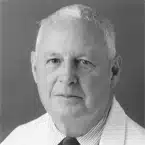
Bayard D. “Barney” Clarkson, MD, FAACR, a Past President of the American Association for Cancer Research (AACR) and a Fellow of the AACR Academy who pioneered the development of targeted therapies aimed at cancer stem cells, died December 30, 2025, at the age of 99.
Clarkson was deeply involved in the AACR and is the only individual to have ever held four major AACR leadership positions—President, Treasurer, member of the Board of Directors, and President and Founding Chairman of the Board of Trustees of the AACR Foundation, the AACR’s philanthropic arm.
“Barney was truly an icon in the field of cancer research and a deeply beloved colleague, mentor, and friend to me and to so many colleagues in the AACR community,” said Margaret Foti, PhD, MD (hc), chief executive officer of the AACR. “His legacy is characterized by the profound and enduring impact that he had on cancer research and on AACR. Through his pioneering research on cancer stem and progenitor cells, Barney helped advance discoveries in translational and clinical research that have improved the lives of countless cancer patients. Equally transformative was his visionary leadership of the AACR Foundation, which has strengthened and expanded the resources essential to accelerate our vital mission to prevent and cure all cancers. He will be remembered and profoundly missed not only for his expertise and scientific contributions, but also for his extraordinary leadership, wisdom, generosity of spirit, and commitment to excellence in everything he did throughout his long and productive life. Throughout his career in cancer research, he inspired the work of both senior and junior scientists. The world needs more people like him who are selfless and dedicated to the cause.”
Born in New York City in 1926, Clarkson graduated from Yale University and earned his medical degree from the Columbia University College of Physicians and Surgeons in 1952. In 1958, he completed a Lasker Fellowship in clinical chemotherapy at Memorial Hospital (which later merged with the Sloan-Kettering Institute to become Memorial Sloan Kettering Cancer Center).
He joined the faculty at Memorial Sloan Kettering in 1959 and stayed there for the remainder of his impressive career, serving for 19 years as Chief of the Hematology/Lymphoma Service; 10 years as Director of the Hematology and Medical Oncology Fellowship Training Program; and as Associate Chairman for Research in the Department of Medicine. He also held the Enid A. Haupt Chair of Therapeutic Research.
When Clarkson first arrived at what would become Memorial Sloan Kettering, he worked with three pioneers of chemotherapy—David Karnofsky, Cornelius Rhoads, and Joseph Burchenal—to develop early therapeutic regimens that proved effective for the treatment of acute leukemia. For more than 50 years, he studied the kinetics of cellular growth and the differentiation of normal, leukemic, and other cancer stem and progenitor cells with the goal of developing improved forms of treatment.
Clarkson is revered for his characterization of the intracellular signaling pathways altered by the BCR/ABL fusion gene, a primary genetic abnormality that promotes the onset of certain types of leukemia. His later work focused on elucidating the biology of quiescent cancer stem cells and defective quorum sensing and defining the obstacles that they present to curing cancer. Collectively, his robust research efforts resulted in more than 400 peer-reviewed, scholarly publications.
An AACR member since 1962, Clarkson served as a member of the Board of Directors from 1978-1981, AACR President in 1980-1981, and AACR Treasurer from 1994-2010. And, in 2000, he was the driving force behind the launch of the AACR Foundation, which supports the AACR’s mission to prevent and cure all forms of cancer. He served as the AACR Foundation’s first President and Founding Chairman of the Board of Trustees and continued to serve as President Emeritus of the Foundation until his death.
In 2007, the AACR Board of Directors honored Clarkson for his stellar contributions to cancer science and medicine by establishing the Bayard D. Clarkson Symposium, a symposium held annually during the AACR Annual Meeting that highlights impactful research involving stem cells and related areas of cancer research. He also received the 2012 AACR Distinguished Service Award. In 2013, he was elected to the inaugural class of Fellows of the AACR Academy for his major scientific contributions that have advanced scientific innovation and progress against cancer.
Clarkson also served as a member of the Board of Trustees of Cold Spring Harbor Laboratory from 1968-1992, and as President of the American Society of Clinical Oncology in 1973-1974. Additionally, since 1967, he served on the Board of Trustees of Clarkson University in Potsdam, New York, which was founded by his forebears.
In December 1943, Clarkson enlisted in the U.S. Navy’s aviation program. Having been judged ineligible for active military service in World War II because of a diagnosis of inactive tuberculosis, he then joined the American Field Service and drove ambulances for the British army in Italy and Germany, where he volunteered to assist in the evacuation of the concentration camp at Bergen-Belsen.
“Barney was a legend in cancer research, a respected leader at AACR, and a wonderful friend to us all,” said Dr. Foti. “AACR will be forever indebted to him for his brilliance and dedication to our organization.”
Leave your remembrance of Dr. Clarkson below (limit 1,000 characters).
Unbeknown to the cancer research community, In an article published in 1960, of which Dr. Clarkson was the lead author, he first described in great detail a puzzling, ultimately fatal case of recurrent cyclical edema and circulatory shock due to increased vascular permeability.
Since as far back as the 1980s, that rare illness has been formally known as Systemic Capillary Leak Syndrome and has informally been called Clarkson Disease or Clarkson’s Disease, see https://en.wikipedia.org/wiki/Bayard_D._Clarkson and https://en.wikipedia.org/wiki/Capillary_leak_syndrome
I told this to Dr. Clarkson in person in 2011, and it came as a complete surprise to him.
Today I recieved an email, from a colleague with the news of Dr. Clarkson’s passing. As a graduate mechanical engineer of Clarkson University, it was impressive to see the resume and life work of Dr. Bayard D. Clarkson and the Clarkson family. But what really struck me was the work Dr. Clarkson did at Memorial Sloan Kettering Cancer Center in Oncology. I credit MSKCC with saving the life of my 19 year old daughter who had treatment for lymphoma and a stem cell transplant at MSKCC. Glad to learn of this connection with Dr. Clarkson, may he rest in eternal peace.
Dr. Clarkson changed my life by accepting me into the MSKCC Oncology Fellowship program after I had followed an atypical training path through pathology. I will always be grateful for that trust he showed in me.
Of course, his quiet style was, and remains, a wonderful model to try to emulate.
Among his many scientific and academic contributions, including helping me establish my lab at MSK, Barney was also among the first medics to help with the evacuation of the Bergen-Belsen concentration camp during World War Two. Listen to his oral history: https://the-afs-archive.org/audios/article/wwii-driver-interview_4_002_2a_clarkson
Bayard Clarkson meant a great deal to me. He was my first mentor when I joined Memorial Sloan Kettering Cancer Center in June 1968 to begin my career in medical oncology.
He was a monument of integrity. He never sought fame, prestige, or recognition—only truth and the knowledge that could save lives.
Cancer research was not a job for him but a passion, and he was deeply committed to developing better treatments for his leukemia patients.
Bayard was a noble man who always put others first and remained devoted to what was best for cancer research. His commitment to the AACR was exemplary. I will always cherish his example and his memory, and I remain profoundly grateful to him.
I was a fellow at MDACC when we presented our COAP data at ASCO 1970 when Barney presented their Ara-C & TG data. Their data was slightly better than ours since they did not consider failure of RBC recovery to not be a CR. I told Barney that I thought they did better. It's amazing that now his patients would be CR's. He was such a great person talking to me who was a fellow. My boss and mentor was Emil J Freireich and the two of them were equivalent. It was a great time in the early days of progression of AML. I am sorry to see that he has died, but I am amazed how long he has lived. What an icon! I am honored that I knew and met him and we were in the same world together. May he RIP.
Barney Clarkson was very kind and encouraging to me as a junior faculty member starting out in my career. I really admired and respected him. I am so sorry to hear of his passing. He will be missed